QUESTION IMAGE
Question
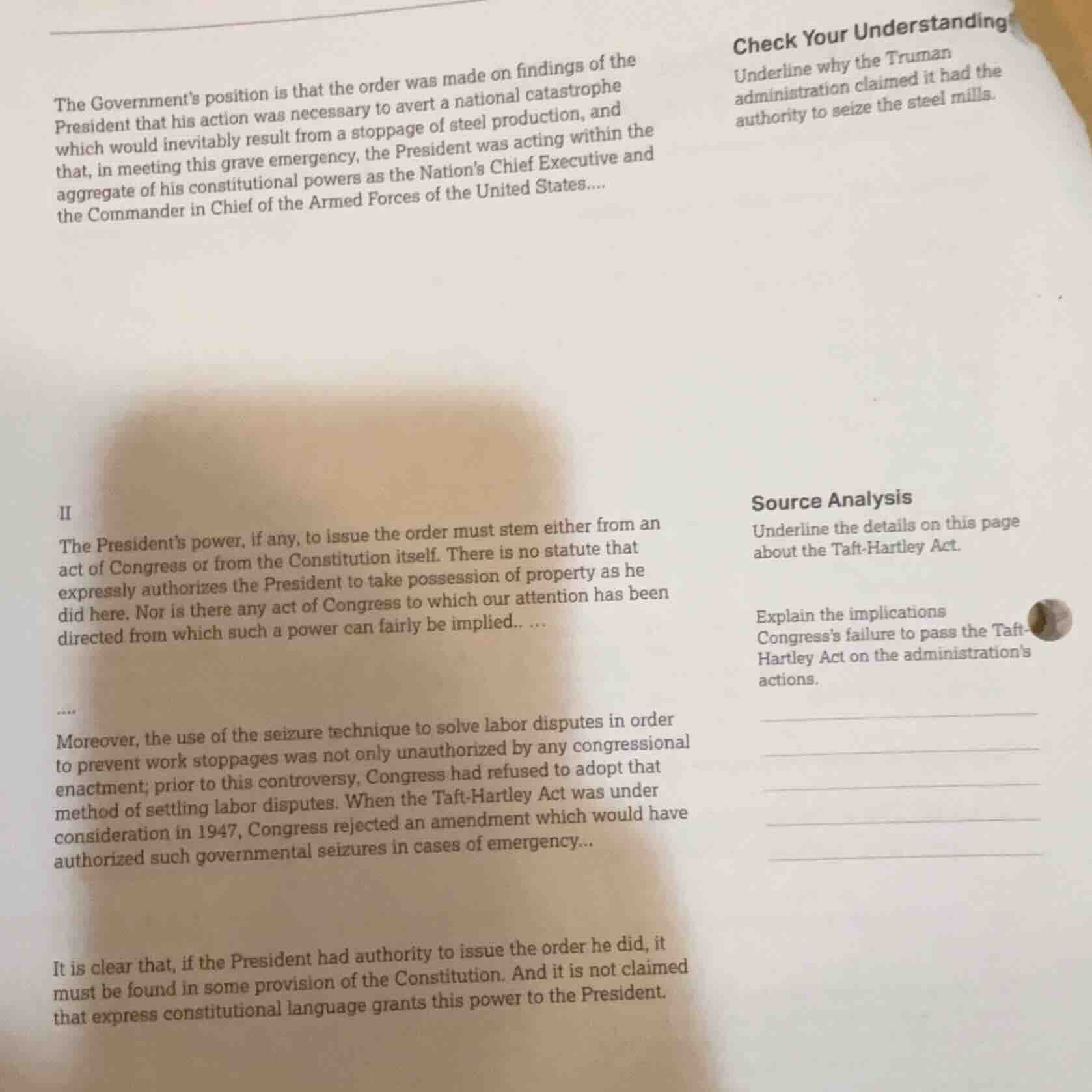
the governments position is that the order was made on findings of the president that his action was necessary to avert a national catastrophe which would inevitably result from a stoppage of steel production, and that, in meeting this grave emergency, the president was acting within the aggregate of his constitutional powers as the nations chief executive and the commander in chief of the armed forces of the united states....
ii
the presidents power, if any, to issue the order must stem either from an act of congress or from the constitution itself. there is no statute that expressly authorizes the president to take possession of property as he did here. nor is there any act of congress to which our attention has been directed from which such a power can fairly be implied.. ...
....
moreover, the use of the seizure technique to solve labor disputes in order to prevent work stoppages was not only unauthorized by any congressional enactment; prior to this controversy, congress had refused to adopt that method of settling labor disputes. when the taft - hartley act was under consideration in 1947, congress rejected an amendment which would have authorized such governmental seizures in cases of emergency...
it is clear that, if the president had authority to issue the order he did, it must be found in some provision of the constitution. and it is not claimed that express constitutional language grants this power to the president.
check your understanding
underline why the truman administration claimed it had the authority to seize the steel mills.
source analysis
underline the details on this page about the taft - hartley act.
explain the implications congresss failure to pass the taft - hartley act on the administrations actions.
Source Analysis - Underline details about Taft - Hartley Act
The relevant sentence is: "When the Taft - Hartley Act was under consideration in 1947, Congress rejected an amendment which would have authorized such governmental seizures in cases of emergency."
of implications of Congress's failure to pass Taft - Hartley Act amendment on administration's actions
- Lack of Congressional Authorization: The administration (Truman's) action of seizing steel mills had no express or implied congressional authorization. Since Congress rejected the Taft - Hartley Act amendment that would have allowed governmental seizures in emergencies, the administration couldn't rely on congressional statute for the seizure.
- Reliance on Constitutional Powers: This forced the administration to claim the action was within the President's constitutional powers as Chief Executive and Commander - in - Chief, as there was no statutory basis (due to Congress's rejection of the relevant Taft - Hartley amendment) to justify the seizure.
- Legal and Political Scrutiny: The failure of Congress to pass the amendment meant the administration's action was more likely to face legal challenges (as seen in the constitutional analysis in the text) and political scrutiny, as it was acting without clear congressional backing for this specific emergency - seizure power.

Snap & solve any problem in the app
Get step-by-step solutions on Sovi AI
Photo-based solutions with guided steps
Explore more problems and detailed explanations
- Underlined detail about Taft - Hartley Act: "When the Taft - Hartley Act was under consideration in 1947, Congress rejected an amendment which would have authorized such governmental seizures in cases of emergency."
- Implications: The administration lacked statutory authorization for the steel mill seizure (due to Congress's rejection of the Taft - Hartley amendment), so it had to rely on claimed constitutional powers. This exposed the action to legal and political scrutiny, as there was no clear congressional mandate for the emergency seizure method used.