QUESTION IMAGE
Question
grammar passage
print your own equipment
the “maker movement” is a technology - oriented extension of the traditional “do - it - yourself (diy)” movement. the maker movement often involves specific pursuits in electronics, cnc (computer numerical control) tools such as mills and laser cutters, and 3 - d printing and related technologies.
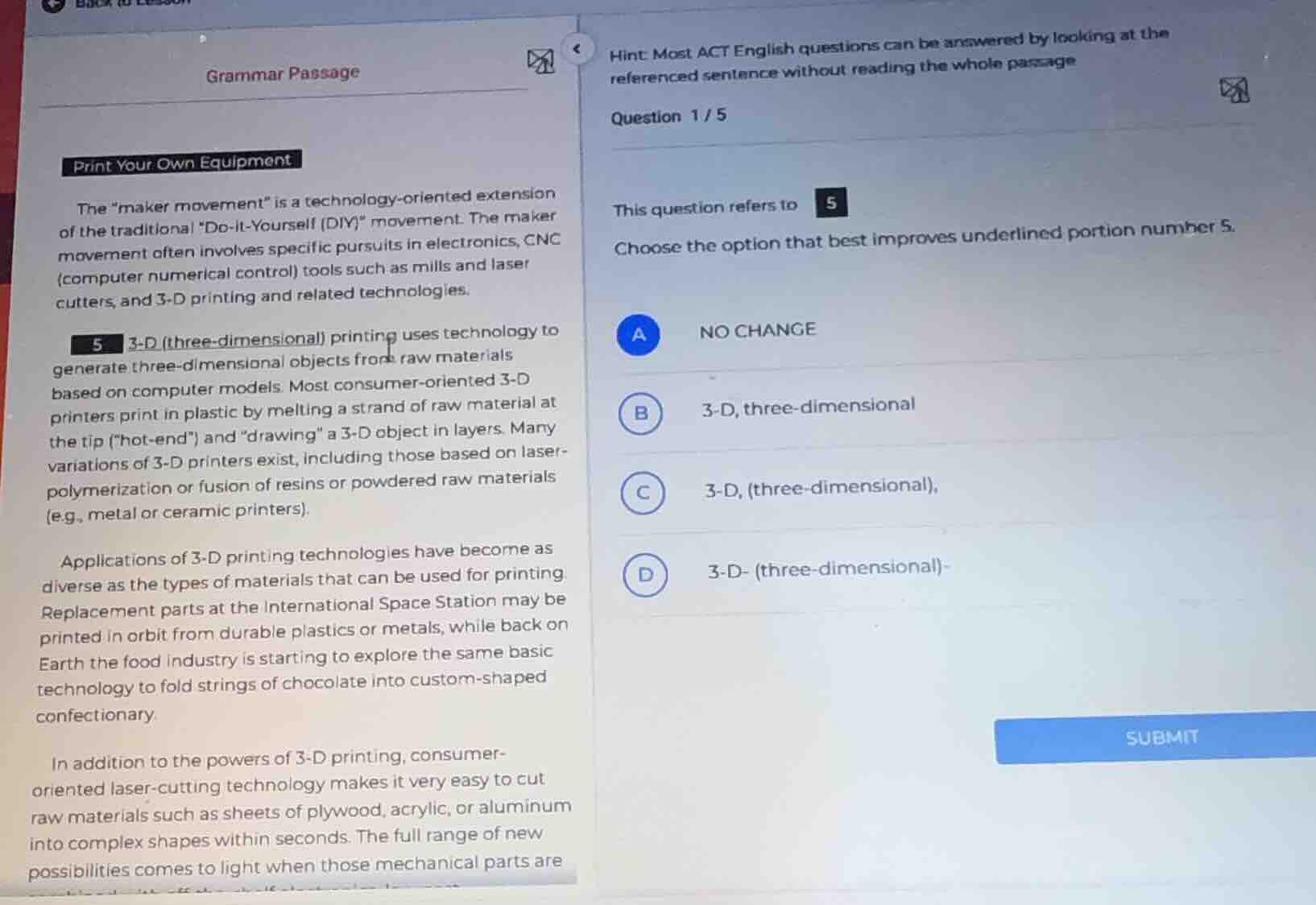
5 3 - d (three - dimensional) printing uses technology to generate three - dimensional objects from raw materials based on computer models. most consumer - oriented 3 - d printers print in plastic by melting a strand of raw material at the tip (“hot - end”) and “drawing” a 3 - d object in layers. many variations of 3 - d printers exist, including those based on laser - polymerization or fusion of resins or powdered raw materials (e.g., metal or ceramic printers).
applications of 3 - d printing technologies have become as diverse as the types of materials that can be used for printing. replacement parts at the international space station may be printed in orbit from durable plastics or metals, while back on earth the food industry is starting to explore the same basic technology to fold strings of chocolate into custom - shaped confectionary.
in addition to the powers of 3 - d printing, consumer - oriented laser - cutting technology makes it very easy to cut raw materials such as sheets of plywood, acrylic, or aluminum into complex shapes within seconds. the full range of new possibilities comes to light when those mechanical parts are
hint: most act english questions can be answered by looking at the referenced sentence without reading the whole passage
question 1 / 5
this question refers to 5
choose the option that best improves underlined portion number 5.
a no change
b 3 - d, three - dimensional
c 3 - d, (three - dimensional),
d 3 - d - (three - dimensional) -
To determine the correct option, we analyze the punctuation for the parenthetical explanation. The phrase "3 - D" is being defined by "(three - dimensional)". In standard English punctuation, when a parenthetical explanation follows an abbreviation, we use a comma after the abbreviation only if the parenthetical is non - essential and the sentence structure requires it? No, actually, the correct way is that when we have an abbreviation followed by a parenthetical definition, we should use a comma after the abbreviation before the parenthetical? Wait, no. Let's look at the options:
- Option A: "3 - D (three - dimensional) printing" – this is correct. The parenthetical (three - dimensional) is an explanation of 3 - D, and the punctuation here is standard. The parenthetical is not set off with extra commas because it is a direct explanation of the abbreviation.
- Option B: "3 - D, three - dimensional" – this would be incorrect as it would make the sentence read "3 - D, three - dimensional printing" which is grammatically incorrect. It would split the subject "3 - D printing" incorrectly.
- Option C: "3 - D, (three - dimensional), " – the extra commas are incorrect. The parenthetical explanation should be directly attached to the abbreviation without unnecessary commas that would disrupt the sentence flow.
- Option D: "3 - D - (three - dimensional) - " – the hyphens are incorrect. They do not serve a purpose here and make the sentence structure wrong.
So the original (Option A) is correct as the parenthetical is properly used to define "3 - D" without incorrect punctuation.

Snap & solve any problem in the app
Get step-by-step solutions on Sovi AI
Photo-based solutions with guided steps
Explore more problems and detailed explanations
A. NO CHANGE