QUESTION IMAGE
Question
grammar passage
short - term memory
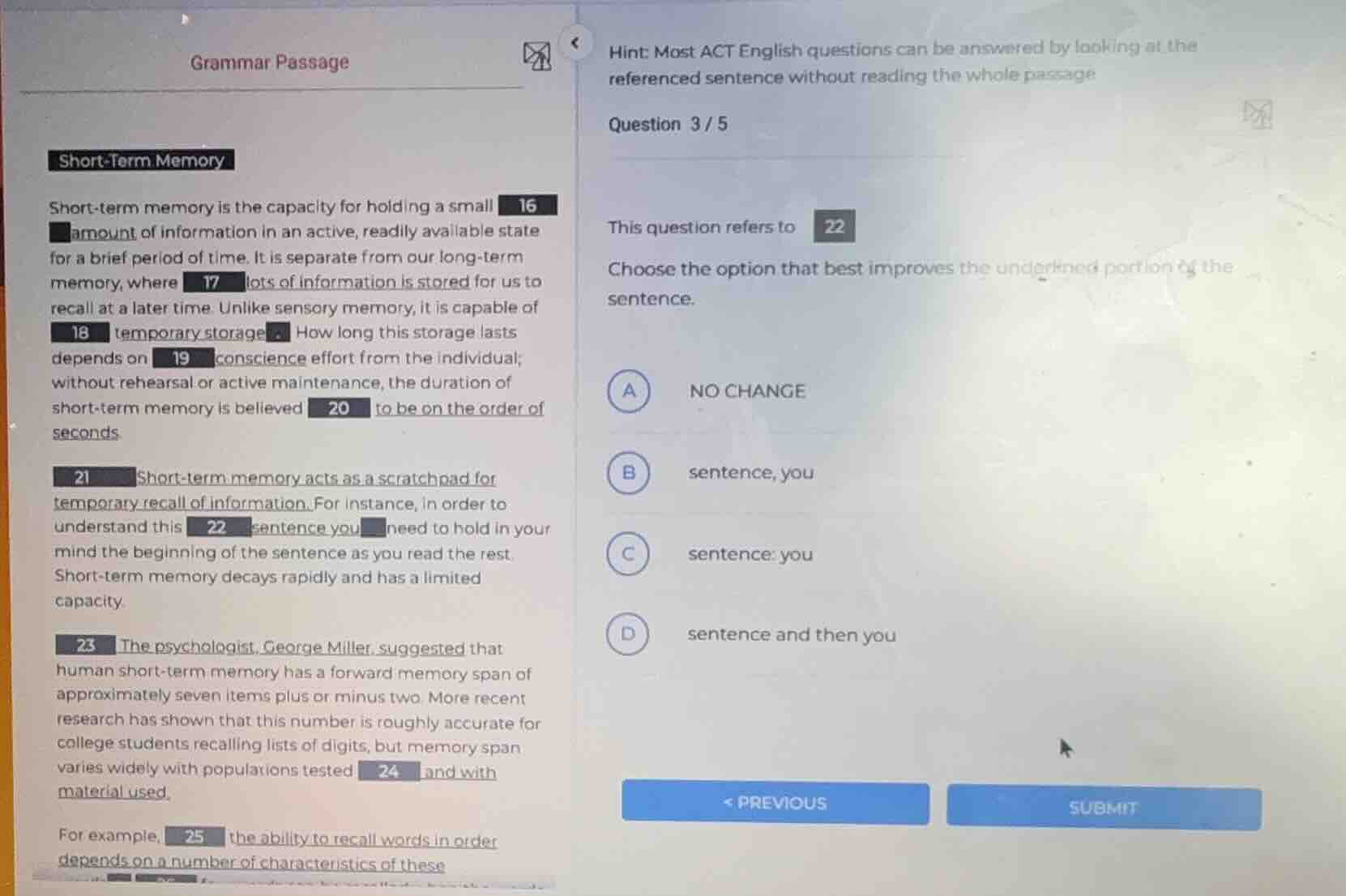
short - term memory is the capacity for holding a small 16 amount of information in an active, readily available state for a brief period of time. it is separate from our long - term memory, where 17 lots of information is stored for us to recall at a later time. unlike sensory memory, it is capable of 18 temporary storage. how long this storage lasts depends on 19 conscience effort from the individual; without rehearsal or active maintenance, the duration of short - term memory is believed 20 to be on the order of seconds.
21 short - term memory acts as a scratchpad for temporary recall of information. for instance, in order to understand this 22 sentence you need to hold in your mind the beginning of the sentence as you read the rest. short - term memory decays rapidly and has a limited capacity.
23 the psychologist, george miller, suggested that human short - term memory has a forward memory span of approximately seven items plus or minus two. more recent research has shown that this number is roughly accurate for college students recalling lists of digits, but memory span varies widely with populations tested 24 and with material used.
for example, 25 the ability to recall words in order depends on a number of characteristics of these
hint: most act english questions can be answered by looking at the referenced sentence without reading the whole passage
question 3 / 5
this question refers to 22
choose the option that best improves the underlined portion of the sentence.
a no change
b sentence, you
c sentence: you
d sentence and then you
< previous submit
To determine the correct option, we analyze the sentence structure. The original underlined part is "sentence you" (from the context: "in order to understand this 22 sentence you need..."). We need to check if a punctuation mark is needed between "sentence" and "you".
- Option A: "NO CHANGE" would leave it as "sentence you", which is a run - on (missing appropriate punctuation between the noun "sentence" and the subject "you" of the next clause).
- Option B: "sentence, you" uses a comma, but the relationship between "sentence" and "you" here is not a comma - splice - appropriate relationship (it's not two independent clauses that can be joined with a comma).
- Option C: "sentence: you" uses a colon. A colon can be used to introduce an explanation or a related clause. Here, "you need to hold... " explains what is needed to understand the sentence, so the colon is appropriate.
- Option D: "sentence and then you" adds unnecessary words ("and then") and creates an awkward construction.

Snap & solve any problem in the app
Get step-by-step solutions on Sovi AI
Photo-based solutions with guided steps
Explore more problems and detailed explanations
C. sentence: you