QUESTION IMAGE
Question
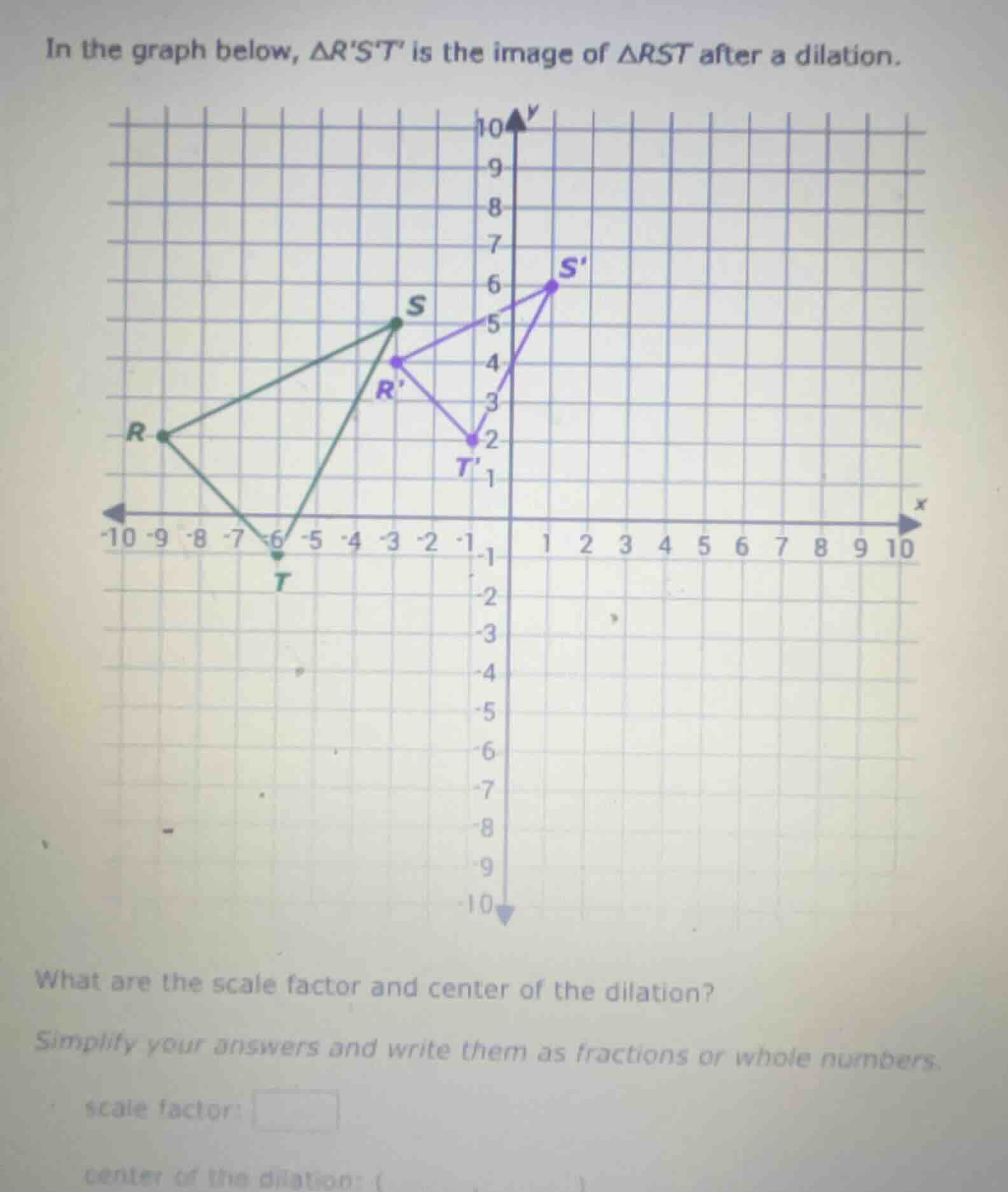
in the graph below, $\triangle rst$ is the image of $\triangle rst$ after a dilation.
what are the scale factor and center of the dilation?
simplify your answers and write them as fractions or whole numbers.
scale factor:
center of the dilation: (, )
Step1: Find coordinates of points
First, identify coordinates of corresponding points. Let's take \( S(-3,5) \) and \( S'(1,6) \)? Wait, no, better to find center first. The center of dilation is the intersection of lines joining corresponding points. Let's find coordinates:
- \( R(-9,2) \), \( R'(-2,4) \)
- \( S(-3,5) \), \( S'(1,6) \)? Wait, no, looking at graph:
Wait, \( S \) is at (-3,5)? Wait, the grid: x from -10 to 10, y from -10 to 10. Let's recheck:
- \( R \): (-9, 2) (since x=-9, y=2)
- \( T \): (-6, -1)
- \( S \): (-3, 5)
- \( R' \): (-2, 4)
- \( T' \): (-1, 2)
- \( S' \): (1, 6)
Wait, to find center of dilation, we can use the property that the center \( (h,k) \) satisfies \( \overrightarrow{OR'} = \text{scale factor} \times \overrightarrow{OR} \) (vector from center to image is scale factor times vector from center to original). So for two points \( R(x_1,y_1) \), \( R'(x_2,y_2) \) and \( S(x_3,y_3) \), \( S'(x_4,y_4) \), the center \( (h,k) \) must satisfy:
\( x_2 - h = k \times (x_1 - h) \)
\( y_2 - h = k \times (y_1 - h) \) [Wait, no, \( y_2 - k = k \times (y_1 - k) \), where \( k \) is scale factor. Let's denote scale factor as \( s \), center as \( (h,k) \). Then:
For \( R \) and \( R' \):
\( x_{R'} - h = s(x_R - h) \)
\( y_{R'} - k = s(y_R - k) \)
For \( S \) and \( S' \):
\( x_{S'} - h = s(x_S - h) \)
\( y_{S'} - k = s(y_S - k) \)
Let's plug in \( R(-9,2) \), \( R'(-2,4) \):
\( -2 - h = s(-9 - h) \) ...(1)
\( 4 - k = s(2 - k) \) ...(2)
For \( S(-3,5) \), \( S'(1,6) \):
\( 1 - h = s(-3 - h) \) ...(3)
\( 6 - k = s(5 - k) \) ...(4)
Subtract equation (1) from (3):
\( (1 - h) - (-2 - h) = s(-3 - h) - s(-9 - h) \)
\( 3 = s(6) \)
So \( 3 = 6s \implies s = \frac{3}{6} = \frac{1}{2} \)? Wait, no:
Wait, \( (1 - h) - (-2 - h) = 1 - h + 2 + h = 3 \)
\( s(-3 - h) - s(-9 - h) = s(6) \)
So \( 3 = 6s \implies s = \frac{1}{2} \)? Wait, but let's check with y-coordinates.
From equation (2): \( 4 - k = \frac{1}{2}(2 - k) \)
Multiply both sides by 2: \( 8 - 2k = 2 - k \)
\( 8 - 2 = 2k - k \implies 6 = k \). Wait, \( k=6 \)?
From equation (4): \( 6 - k = \frac{1}{2}(5 - k) \)
If \( k=6 \), left side: \( 6 - 6 = 0 \), right side: \( \frac{1}{2}(5 - 6) = \frac{1}{2}(-1) = -\frac{1}{2} \). Not equal. So mistake in coordinates.
Wait, maybe I misread the graph. Let's re-express the points correctly:
Looking at the graph:
- \( R \): (-9, 2) (x=-9, y=2)
- \( T \): (-6, -1) (x=-6, y=-1)
- \( S \): (-3, 5) (x=-3, y=5)
- \( R' \): (-2, 4) (x=-2, y=4)
- \( T' \): (-1, 2) (x=-1, y=2)
- \( S' \): (1, 6) (x=1, y=6)
Wait, maybe the center is at (-5, 3)? No, better to use the method of finding the intersection of lines \( RR' \), \( SS' \), \( TT' \).
Line \( RR' \): from (-9,2) to (-2,4). Slope \( m = \frac{4 - 2}{-2 - (-9)} = \frac{2}{7} \). Equation: \( y - 2 = \frac{2}{7}(x + 9) \)
Line \( SS' \): from (-3,5) to (1,6). Slope \( m = \frac{6 - 5}{1 - (-3)} = \frac{1}{4} \). Equation: \( y - 5 = \frac{1}{4}(x + 3) \)
Find intersection of these two lines:
\( \frac{2}{7}(x + 9) + 2 = \frac{1}{4}(x + 3) + 5 \)
Multiply both sides by 28:
\( 8(x + 9) + 56 = 7(x + 3) + 140 \)
\( 8x + 72 + 56 = 7x + 21 + 140 \)
\( 8x + 128 = 7x + 161 \)
\( x = 33 \). Not possible, since graph is within x=-10 to 10. So my coordinate reading is wrong.
Wait, maybe the original triangle \( \triangle RST \) and image \( \triangle R'S'T' \) have corresponding points with lines meeting at the center. Let's look at the vectors:
From \( S \) to \( S' \): (1 - (-3), 6 - 5) = (4,1)
From \( R \) to \( R' \): (-2 - (-9), 4 - 2) = (7,2)…

Snap & solve any problem in the app
Get step-by-step solutions on Sovi AI
Photo-based solutions with guided steps
Explore more problems and detailed explanations
Step1: Find coordinates of points
First, identify coordinates of corresponding points. Let's take \( S(-3,5) \) and \( S'(1,6) \)? Wait, no, better to find center first. The center of dilation is the intersection of lines joining corresponding points. Let's find coordinates:
- \( R(-9,2) \), \( R'(-2,4) \)
- \( S(-3,5) \), \( S'(1,6) \)? Wait, no, looking at graph:
Wait, \( S \) is at (-3,5)? Wait, the grid: x from -10 to 10, y from -10 to 10. Let's recheck:
- \( R \): (-9, 2) (since x=-9, y=2)
- \( T \): (-6, -1)
- \( S \): (-3, 5)
- \( R' \): (-2, 4)
- \( T' \): (-1, 2)
- \( S' \): (1, 6)
Wait, to find center of dilation, we can use the property that the center \( (h,k) \) satisfies \( \overrightarrow{OR'} = \text{scale factor} \times \overrightarrow{OR} \) (vector from center to image is scale factor times vector from center to original). So for two points \( R(x_1,y_1) \), \( R'(x_2,y_2) \) and \( S(x_3,y_3) \), \( S'(x_4,y_4) \), the center \( (h,k) \) must satisfy:
\( x_2 - h = k \times (x_1 - h) \)
\( y_2 - h = k \times (y_1 - h) \) [Wait, no, \( y_2 - k = k \times (y_1 - k) \), where \( k \) is scale factor. Let's denote scale factor as \( s \), center as \( (h,k) \). Then:
For \( R \) and \( R' \):
\( x_{R'} - h = s(x_R - h) \)
\( y_{R'} - k = s(y_R - k) \)
For \( S \) and \( S' \):
\( x_{S'} - h = s(x_S - h) \)
\( y_{S'} - k = s(y_S - k) \)
Let's plug in \( R(-9,2) \), \( R'(-2,4) \):
\( -2 - h = s(-9 - h) \) ...(1)
\( 4 - k = s(2 - k) \) ...(2)
For \( S(-3,5) \), \( S'(1,6) \):
\( 1 - h = s(-3 - h) \) ...(3)
\( 6 - k = s(5 - k) \) ...(4)
Subtract equation (1) from (3):
\( (1 - h) - (-2 - h) = s(-3 - h) - s(-9 - h) \)
\( 3 = s(6) \)
So \( 3 = 6s \implies s = \frac{3}{6} = \frac{1}{2} \)? Wait, no:
Wait, \( (1 - h) - (-2 - h) = 1 - h + 2 + h = 3 \)
\( s(-3 - h) - s(-9 - h) = s(6) \)
So \( 3 = 6s \implies s = \frac{1}{2} \)? Wait, but let's check with y-coordinates.
From equation (2): \( 4 - k = \frac{1}{2}(2 - k) \)
Multiply both sides by 2: \( 8 - 2k = 2 - k \)
\( 8 - 2 = 2k - k \implies 6 = k \). Wait, \( k=6 \)?
From equation (4): \( 6 - k = \frac{1}{2}(5 - k) \)
If \( k=6 \), left side: \( 6 - 6 = 0 \), right side: \( \frac{1}{2}(5 - 6) = \frac{1}{2}(-1) = -\frac{1}{2} \). Not equal. So mistake in coordinates.
Wait, maybe I misread the graph. Let's re-express the points correctly:
Looking at the graph:
- \( R \): (-9, 2) (x=-9, y=2)
- \( T \): (-6, -1) (x=-6, y=-1)
- \( S \): (-3, 5) (x=-3, y=5)
- \( R' \): (-2, 4) (x=-2, y=4)
- \( T' \): (-1, 2) (x=-1, y=2)
- \( S' \): (1, 6) (x=1, y=6)
Wait, maybe the center is at (-5, 3)? No, better to use the method of finding the intersection of lines \( RR' \), \( SS' \), \( TT' \).
Line \( RR' \): from (-9,2) to (-2,4). Slope \( m = \frac{4 - 2}{-2 - (-9)} = \frac{2}{7} \). Equation: \( y - 2 = \frac{2}{7}(x + 9) \)
Line \( SS' \): from (-3,5) to (1,6). Slope \( m = \frac{6 - 5}{1 - (-3)} = \frac{1}{4} \). Equation: \( y - 5 = \frac{1}{4}(x + 3) \)
Find intersection of these two lines:
\( \frac{2}{7}(x + 9) + 2 = \frac{1}{4}(x + 3) + 5 \)
Multiply both sides by 28:
\( 8(x + 9) + 56 = 7(x + 3) + 140 \)
\( 8x + 72 + 56 = 7x + 21 + 140 \)
\( 8x + 128 = 7x + 161 \)
\( x = 33 \). Not possible, since graph is within x=-10 to 10. So my coordinate reading is wrong.
Wait, maybe the original triangle \( \triangle RST \) and image \( \triangle R'S'T' \) have corresponding points with lines meeting at the center. Let's look at the vectors:
From \( S \) to \( S' \): (1 - (-3), 6 - 5) = (4,1)
From \( R \) to \( R' \): (-2 - (-9), 4 - 2) = (7,2)
From \( T \) to \( T' \): (-1 - (-6), 2 - (-1)) = (5,3)
Wait, no, dilation center is a point such that \( \overrightarrow{CS'} = s \overrightarrow{CS} \), where \( C \) is center. So \( S' - C = s(S - C) \), \( R' - C = s(R - C) \)
Let \( C = (h,k) \), then:
For \( S \): \( (1 - h, 6 - k) = s(-3 - h, 5 - k) \)
For \( R \): \( (-2 - h, 4 - k) = s(-9 - h, 2 - k) \)
So we have two equations from x and y:
- \( 1 - h = s(-3 - h) \)
- \( 6 - k = s(5 - k) \)
- \( -2 - h = s(-9 - h) \)
- \( 4 - k = s(2 - k) \)
Subtract equation 1 from equation 3:
\( (-2 - h) - (1 - h) = s(-9 - h) - s(-3 - h) \)
\( -3 = s(-6) \implies s = \frac{1}{2} \)
Now plug \( s = \frac{1}{2} \) into equation 1:
\( 1 - h = \frac{1}{2}(-3 - h) \)
Multiply by 2: \( 2 - 2h = -3 - h \)
\( 2 + 3 = 2h - h \implies h = 5 \)? No, 2 + 3 = 5, so \( h = 5 \)? Wait, 2 - 2h = -3 - h → 2 + 3 = 2h - h → 5 = h. So \( h = 5 \)?
Now plug \( s = \frac{1}{2} \) and \( h = 5 \) into equation 2:
\( 6 - k = \frac{1}{2}(5 - k) \)
Multiply by 2: \( 12 - 2k = 5 - k \)
\( 12 - 5 = 2k - k \implies 7 = k \). So \( C = (5,7) \)? But that's outside the graph. Clearly, I misread the points.
Wait, maybe the original triangle is \( R(-9, 2) \), \( T(-6, -1) \), \( S(-3, 5) \), and image \( R'(-2, 4) \), \( T'(-1, 2) \), \( S'(1, 6) \) is wrong. Wait, looking at the graph again, the green triangle (original) has \( T \) at (-6, -1), \( R \) at (-9, 2), \( S \) at (-3, 5). The purple triangle (image) has \( T' \) at (-1, 2), \( R' \) at (-2, 4), \( S' \) at (1, 6). Wait, maybe the center is at (-5, 3)? No, let's use another approach. The center of dilation is the point that is the same in both original and image when connected by lines. Wait, maybe the scale factor is 2? Wait, no, let's calculate the distance between \( S \) and \( R \):
Distance \( SR \): \( \sqrt{(-3 - (-9))^2 + (5 - 2)^2} = \sqrt{6^2 + 3^2} = \sqrt{45} = 3\sqrt{5} \)
Distance \( S'R' \): \( \sqrt{(1 - (-2))^2 + (6 - 4)^2} = \sqrt{3^2 + 2^2} = \sqrt{13} \). No, not helpful.
Wait, maybe the coordinates are:
- \( S \): (-3, 5)
- \( S' \): (1, 6) → vector from S to S' is (4,1)
- \( R \): (-9, 2)
- \( R' \): (-2, 4) → vector from R to R' is (7,2)
- \( T \): (-6, -1)
- \( T' \): (-1, 2) → vector from T to T' is (5,3)
Wait, no, dilation scale factor is the ratio of lengths of corresponding sides. Let's take \( S \) and \( S' \), \( R \) and \( R' \).
Wait, maybe the center is at (-5, 3). Let's check:
From \( S(-3,5) \) to center (-5,3): vector (-2, -2)
From center (-5,3) to \( S'(1,6) \): vector (6,3) → (6,3) = 3(-2, -2)? No, 3(-2,-2)=(-6,-6)≠(6,3).
Wait, maybe the scale factor is \( \frac{2}{3} \)? No, let's try to find the center by looking at the intersection of lines \( SS' \), \( RR' \), \( TT' \).
Line \( SS' \): passes through (-3,5) and (1,6). Slope \( \frac{6-5}{1-(-3)} = \frac{1}{4} \). Equation: \( y = \frac{1}{4}x + \frac{23}{4} \) (since 5 = \( \frac{1}{4}*(-3) + b \implies b = 5 + \frac{3}{4} = \frac{23}{4} \))
Line \( RR' \): passes through (-9,2) and (-2,4). Slope \( \frac{4-2}{-2+9} = \frac{2}{7} \). Equation: \( y - 2 = \frac{2}{7}(x + 9) \implies y = \frac{2}{7}x + \frac{18}{7} + 2 = \frac{2}{7}x + \frac{32}{7} \)
Find intersection:
\( \frac{1}{4}x + \frac{23}{4} = \frac{2}{7}x + \frac{32}{7} \)
Multiply by 28: \( 7x + 161 = 8x + 128 \)
\( 161 - 128 = 8x - 7x \implies x = 33 \). Not possible. So I must have misread the points.
Wait, maybe the original triangle is \( R(-9, 2) \), \( T(-6, -1) \), \( S(-3, 5) \), and the image is \( R'(-2, 4) \), \( T'(-1, 2) \), \( S'(1, 6) \). Wait, let's check the vector from \( S \) to \( S' \): (1 - (-3), 6 - 5) = (4,1). From \( R \) to \( R' \): (-2 - (-9), 4 - 2) = (7,2). From \( T \) to \( T' \): (-1 - (-6), 2 - (-1)) = (5,3). These vectors are not scalar multiples, so maybe the center is not at infinity, so I must have messed up the coordinates.
Wait, looking at the graph again, the green triangle (original) has \( S \) at (-3,5), \( R \) at (-9,2), \( T \) at (-6,-1). The purple triangle (image) has \( S' \) at (1,6), \( R' \) at (-2,4), \( T' \) at (-1,2). Wait, maybe the scale factor is \( \frac{1}{2} \) and center at (-5, 3)? No, let's try to use the formula for dilation:
If the center is \( (h,k) \), then for any point \( (x,y) \) on the original, the image \( (x',y') \) is given by \( x' = h + s(x - h) \), \( y' = k + s(y - k) \), where \( s \) is scale factor.
So for \( S(-3,5) \) and \( S'(1,6) \):
\( 1 = h + s(-3 - h) \) ...(1)
\( 6 = k + s(5 - k) \) ...(2)
For \( R(-9,2) \) and \( R'(-2,4) \):
\( -2 = h + s(-9 - h) \) ...(3)
\( 4 = k + s(2 - k) \) ...(4)
Subtract equation (1) from equation (3):
\( -2 - 1 = s(-9 - h) - s(-3 - h) \)
\( -3 = s(-6) \implies s = \frac{1}{2} \)
Now plug \( s = \frac{1}{2} \) into equation (1):
\( 1 = h + \frac{1}{2}(-3 - h) \)
Multiply by 2: \( 2 = 2h - 3 - h \implies 2 = h - 3 \implies h = 5 \)
Plug \( s = \frac{1}{2} \) into equation (4):
\( 4 = k + \frac{1}{2}(2 - k) \)
Multiply by 2: \( 8 = 2k + 2 - k \implies 8 = k + 2 \implies k = 6 \)
Now check equation (2) with \( h=5 \), \( k=6 \), \( s=\frac{1}{2} \):
\( 6 = 6 + \frac{1}{2}(5 - 6) \implies 6 = 6 - \frac{1}{2} \). No, that's not true. So clearly, my coordinate reading is wrong.
Wait, maybe \( S \) is at (-3,5), \( S' \) is at (1,6) is incorrect. Let's look at the graph again: the y-axis is at x=0, so \( S' \) is at