QUESTION IMAGE
Question
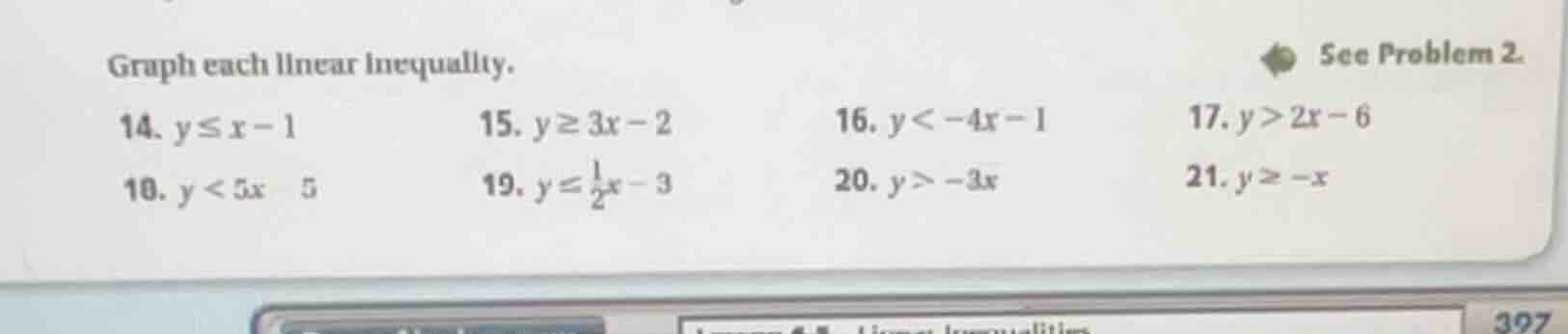
graph each linear inequality.
- ( y leq x - 1 )
- ( y geq 3x - 2 )
- ( y < -4x - 1 )
- ( y > 2x - 6 )
- ( y < 5x - 5 )
- ( y geq \frac{1}{2}x - 3 )
- ( y > -3x )
- ( y geq -x )
see problem 2.
Step1: Analyze boundary line type
For each inequality:
- $\leq$ / $\geq$: Solid boundary line (equal included)
- $<$ / $>$: Dashed boundary line (equal excluded)
Step2: Graph boundary line
For each $y = mx + b$:
- Plot y-intercept $(0, b)$
- Use slope $m=\frac{\text{rise}}{\text{run}}$ to plot 2nd point
- Draw line (solid/dashed per Step1)
Step3: Test point for shading
Use $(0,0)$ (if not on line):
- Substitute into inequality. If true, shade side with $(0,0)$; if false, shade opposite side.
---
For 14. $y \leq x - 1$
Step1: Solid boundary line
$y = x - 1$ (solid, $\leq$)
Step2: Plot boundary line
Y-intercept: $(0, -1)$, slope $m=1$. Plot $(1,0)$, draw solid line.
Step3: Shade correct region
Test $(0,0)$: $0 \leq 0 -1 \to 0 \leq -1$ (false). Shade below line.
---
For 15. $y \geq 3x - 2$
Step1: Solid boundary line
$y = 3x - 2$ (solid, $\geq$)
Step2: Plot boundary line
Y-intercept: $(0, -2)$, slope $m=3$. Plot $(1,1)$, draw solid line.
Step3: Shade correct region
Test $(0,0)$: $0 \geq 0 -2 \to 0 \geq -2$ (true). Shade above line.
---
For 16. $y < -4x - 1$
Step1: Dashed boundary line
$y = -4x - 1$ (dashed, $<$)
Step2: Plot boundary line
Y-intercept: $(0, -1)$, slope $m=-4$. Plot $(1, -5)$, draw dashed line.
Step3: Shade correct region
Test $(0,0)$: $0 < 0 -1 \to 0 < -1$ (false). Shade below line.
---
For 17. $y > 2x - 6$
Step1: Dashed boundary line
$y = 2x - 6$ (dashed, $>$)
Step2: Plot boundary line
Y-intercept: $(0, -6)$, slope $m=2$. Plot $(3,0)$, draw dashed line.
Step3: Shade correct region
Test $(0,0)$: $0 > 0 -6 \to 0 > -6$ (true). Shade above line.
---
For 18. $y < 5x - 5$
Step1: Dashed boundary line
$y = 5x - 5$ (dashed, $<$)
Step2: Plot boundary line
Y-intercept: $(0, -5)$, slope $m=5$. Plot $(1,0)$, draw dashed line.
Step3: Shade correct region
Test $(0,0)$: $0 < 0 -5 \to 0 < -5$ (false). Shade below line.
---
For 19. $y \leq \frac{1}{2}x - 3$
Step1: Solid boundary line
$y = \frac{1}{2}x - 3$ (solid, $\leq$)
Step2: Plot boundary line
Y-intercept: $(0, -3)$, slope $m=\frac{1}{2}$. Plot $(2, -2)$, draw solid line.
Step3: Shade correct region
Test $(0,0)$: $0 \leq 0 -3 \to 0 \leq -3$ (false). Shade below line.
---
For 20. $y > -3x$
Step1: Dashed boundary line
$y = -3x$ (dashed, $>$)
Step2: Plot boundary line
Y-intercept: $(0,0)$, slope $m=-3$. Plot $(1, -3)$, draw dashed line.
Step3: Shade correct region
Test $(1,0)$: $0 > -3(1) \to 0 > -3$ (true). Shade above line.
---
For 21. $y \geq -x$
Step1: Solid boundary line
$y = -x$ (solid, $\geq$)
Step2: Plot boundary line
Y-intercept: $(0,0)$, slope $m=-1$. Plot $(1, -1)$, draw solid line.
Step3: Shade correct region
Test $(0,1)$: $1 \geq 0$ (true). Shade above line.

Snap & solve any problem in the app
Get step-by-step solutions on Sovi AI
Photo-based solutions with guided steps
Explore more problems and detailed explanations
- Solid line $y=x-1$, shade below the line.
- Solid line $y=3x-2$, shade above the line.
- Dashed line $y=-4x-1$, shade below the line.
- Dashed line $y=2x-6$, shade above the line.
- Dashed line $y=5x-5$, shade below the line.
- Solid line $y=\frac{1}{2}x-3$, shade below the line.
- Dashed line $y=-3x$, shade above the line.
- Solid line $y=-x$, shade above the line.