QUESTION IMAGE
Question
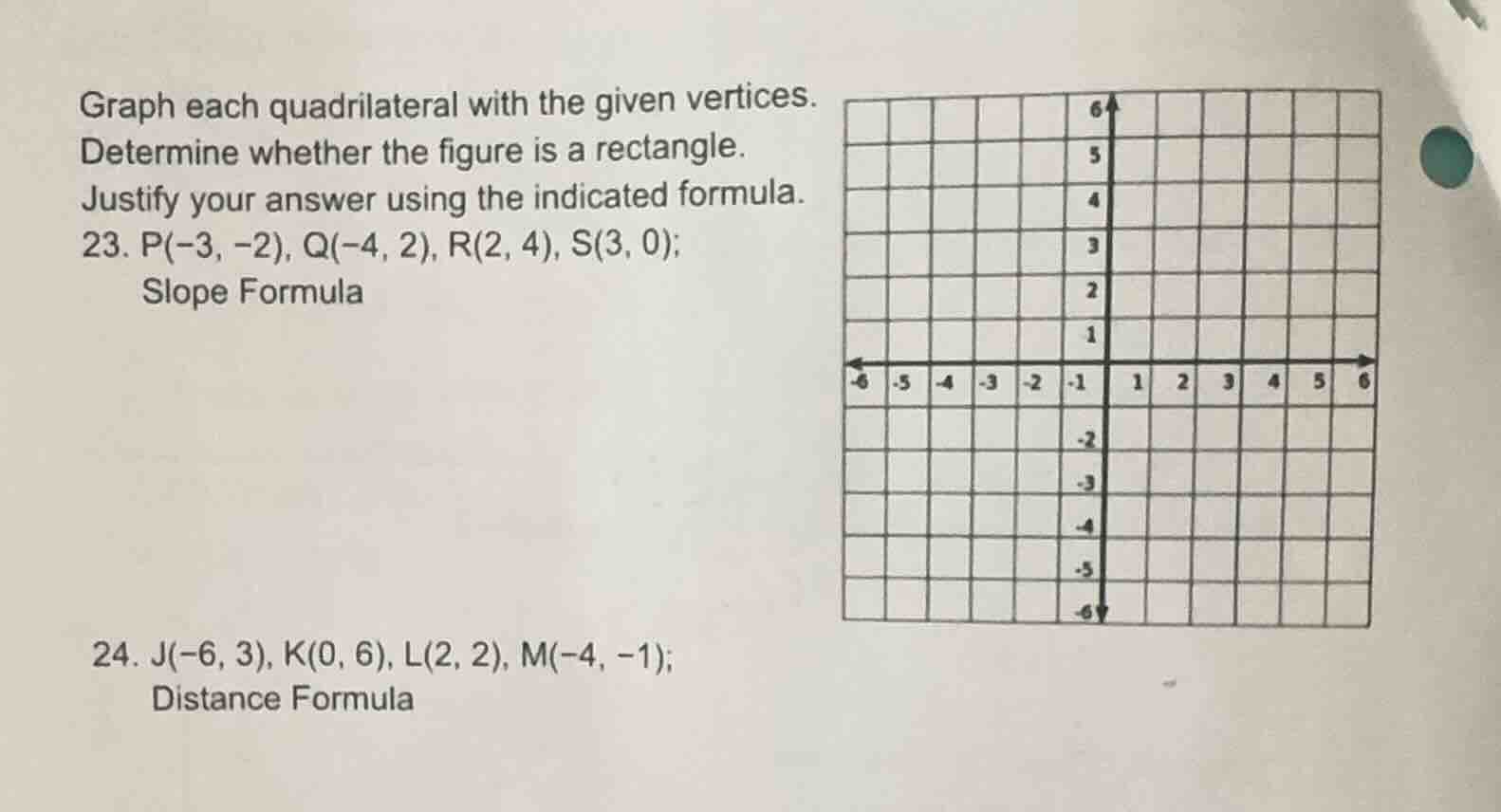
graph each quadrilateral with the given vertices.
determine whether the figure is a rectangle.
justify your answer using the indicated formula.
- p(-3, -2), q(-4, 2), r(2, 4), s(3, 0);
slope formula
- j(-6, 3), k(0, 6), l(2, 2), m(-4, -1);
distance formula
For Problem 23:
Step1: Define slope formula
Slope formula: $m=\frac{y_2-y_1}{x_2-x_1}$
Step2: Calculate slope of PQ
Points $P(-3,-2), Q(-4,2)$:
$m_{PQ}=\frac{2-(-2)}{-4-(-3)}=\frac{4}{-1}=-4$
Step3: Calculate slope of QR
Points $Q(-4,2), R(2,4)$:
$m_{QR}=\frac{4-2}{2-(-4)}=\frac{2}{6}=\frac{1}{3}$
Step4: Calculate slope of RS
Points $R(2,4), S(3,0)$:
$m_{RS}=\frac{0-4}{3-2}=\frac{-4}{1}=-4$
Step5: Calculate slope of SP
Points $S(3,0), P(-3,-2)$:
$m_{SP}=\frac{-2-0}{-3-3}=\frac{-2}{-6}=\frac{1}{3}$
Step6: Check perpendicularity
Perpendicular slopes multiply to $-1$.
$m_{PQ} \times m_{QR} = -4 \times \frac{1}{3}=-\frac{4}{3}
eq -1$
$m_{QR} \times m_{RS} = \frac{1}{3} \times -4=-\frac{4}{3}
eq -1$
Step1: Define distance formula
Distance formula: $d=\sqrt{(x_2-x_1)^2+(y_2-y_1)^2}$
Step2: Calculate length of JK
Points $J(-6,3), K(0,6)$:
$d_{JK}=\sqrt{(0-(-6))^2+(6-3)^2}=\sqrt{36+9}=\sqrt{45}=3\sqrt{5}$
Step3: Calculate length of KL
Points $K(0,6), L(2,2)$:
$d_{KL}=\sqrt{(2-0)^2+(2-6)^2}=\sqrt{4+16}=\sqrt{20}=2\sqrt{5}$
Step4: Calculate length of LM
Points $L(2,2), M(-4,-1)$:
$d_{LM}=\sqrt{(-4-2)^2+(-1-2)^2}=\sqrt{36+9}=\sqrt{45}=3\sqrt{5}$
Step5: Calculate length of MJ
Points $M(-4,-1), J(-6,3)$:
$d_{MJ}=\sqrt{(-6-(-4))^2+(3-(-1))^2}=\sqrt{4+16}=\sqrt{20}=2\sqrt{5}$
Step6: Calculate diagonal JL
Points $J(-6,3), L(2,2)$:
$d_{JL}=\sqrt{(2-(-6))^2+(2-3)^2}=\sqrt{64+1}=\sqrt{65}$
Step7: Calculate diagonal KM
Points $K(0,6), M(-4,-1)$:
$d_{KM}=\sqrt{(-4-0)^2+(-1-6)^2}=\sqrt{16+49}=\sqrt{65}$
Step8: Verify rectangle conditions
In a rectangle, opposite sides are equal, and diagonals are equal. Here, $d_{JK}=d_{LM}$, $d_{KL}=d_{MJ}$, and $d_{JL}=d_{KM}$.

Snap & solve any problem in the app
Get step-by-step solutions on Sovi AI
Photo-based solutions with guided steps
Explore more problems and detailed explanations
The quadrilateral PQRS is not a rectangle. Opposite sides are parallel (equal slopes), but adjacent sides are not perpendicular (their slopes do not multiply to -1).
---