QUESTION IMAGE
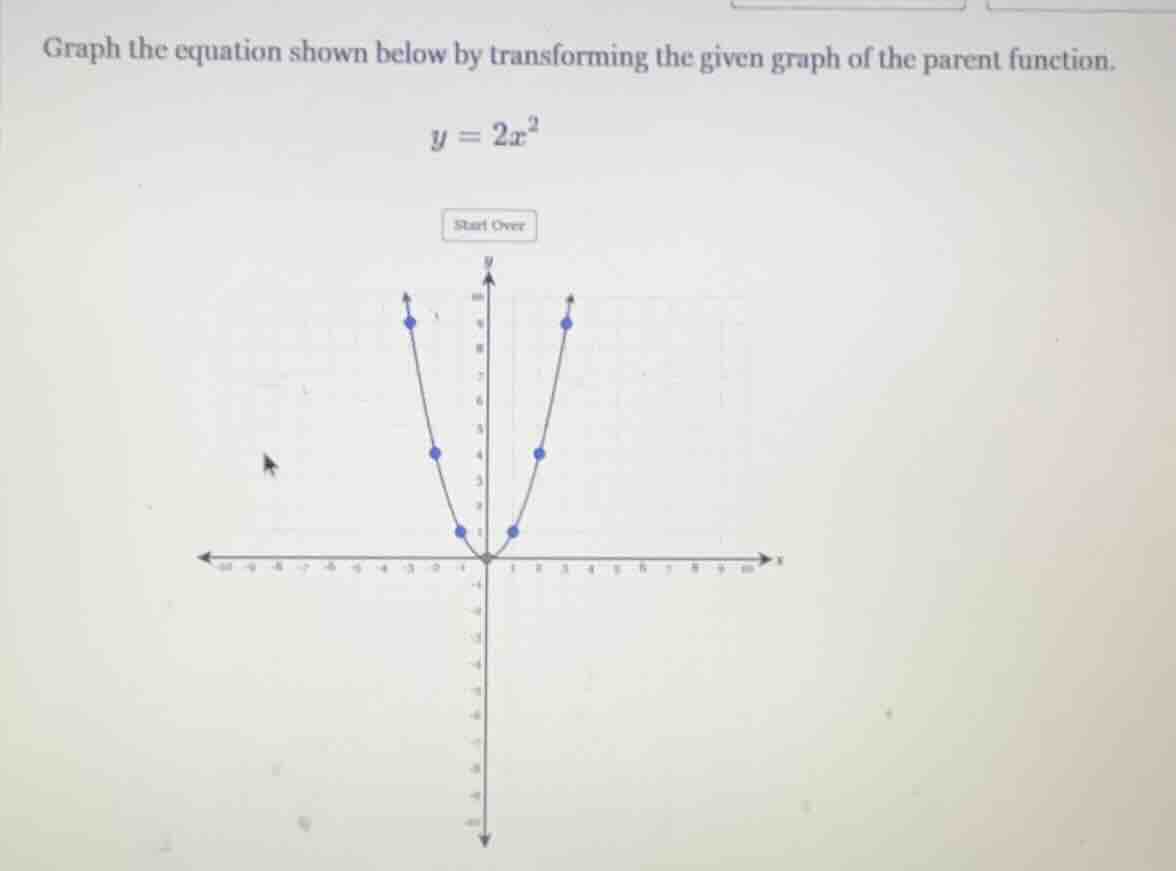
Question
graph the equation shown below by transforming the given graph of the parent function.
$y = 2x^2$
Step1: Identify the parent function
The parent function for a quadratic function is \( y = x^2 \), which is a parabola opening upwards with vertex at the origin \((0,0)\).
Step2: Analyze the transformation for \( y = 2x^2 \)
For a function of the form \( y = a x^2 \), the value of \( a \) affects the vertical stretch or compression of the parent function \( y = x^2 \). If \( |a|>1 \), the graph is vertically stretched (narrower) compared to the parent function. Here, \( a = 2 \), so we need to vertically stretch the graph of \( y = x^2 \) by a factor of 2.
Step3: Determine key points transformation
- For the parent function \( y = x^2 \), when \( x = 0 \), \( y = 0 \); when \( x = 1 \), \( y = 1 \); when \( x = 2 \), \( y = 4 \); when \( x = 3 \), \( y = 9 \), etc.
- For \( y = 2x^2 \), when \( x = 0 \), \( y = 2(0)^2=0 \) (vertex remains at \((0,0)\)). When \( x = 1 \), \( y = 2(1)^2 = 2 \); when \( x = 2 \), \( y = 2(2)^2=8 \); when \( x = 3 \), \( y = 2(3)^2 = 18 \), etc. But looking at the given graph, the points plotted seem to be for \( x=\pm1,\pm2,\pm3 \) with \( y \) values as per \( y = 2x^2 \) (e.g., at \( x = 1 \), \( y = 2 \); \( x = 2 \), \( y = 8 \); \( x = 3 \), \( y = 18 \) but in the graph, the top points are at \( x=\pm3 \), \( y = 18 \)? Wait, no, the graph in the image has points at \( x=\pm1 \) (y=2?), \( x=\pm2 \) (y=8?), \( x=\pm3 \) (y=18?) but the y-axis is labeled with numbers. Wait, maybe the graph is already showing the transformed graph. But the process is: take the parent graph \( y = x^2 \), and for each \( x \)-value, multiply the \( y \)-value by 2 to get the corresponding point on \( y = 2x^2 \). So the vertex stays at \((0,0)\), and the parabola is narrower (vertically stretched) because the coefficient 2 is greater than 1.
Step4: Sketch the transformed graph
Plot the vertex at \((0,0)\). Then, for \( x = 1 \), plot \((1, 2)\); for \( x = - 1 \), plot \((-1, 2)\); for \( x = 2 \), plot \((2, 8)\); for \( x = - 2 \), plot \((-2, 8)\); for \( x = 3 \), plot \((3, 18)\); for \( x = - 3 \), plot \((-3, 18)\), etc. Connect these points with a smooth curve, which will be a parabola opening upwards, narrower than \( y = x^2 \), with vertex at the origin.

Snap & solve any problem in the app
Get step-by-step solutions on Sovi AI
Photo-based solutions with guided steps
Explore more problems and detailed explanations
To graph \( y = 2x^2 \) from the parent function \( y = x^2 \):
- Vertex: Remains at \((0,0)\) (since there is no horizontal/vertical shift).
- Vertical Stretch: The graph of \( y = x^2 \) is vertically stretched by a factor of 2 (because \( a = 2 > 1 \)). For each \( x \)-value, the \( y \)-value of \( y = x^2 \) is multiplied by 2.
- Key Points: Plot \((0,0)\), \((\pm1, 2)\), \((\pm2, 8)\), \((\pm3, 18)\), etc., and draw a smooth, upward - opening parabola through these points (narrower than \( y = x^2 \)).