QUESTION IMAGE
Question
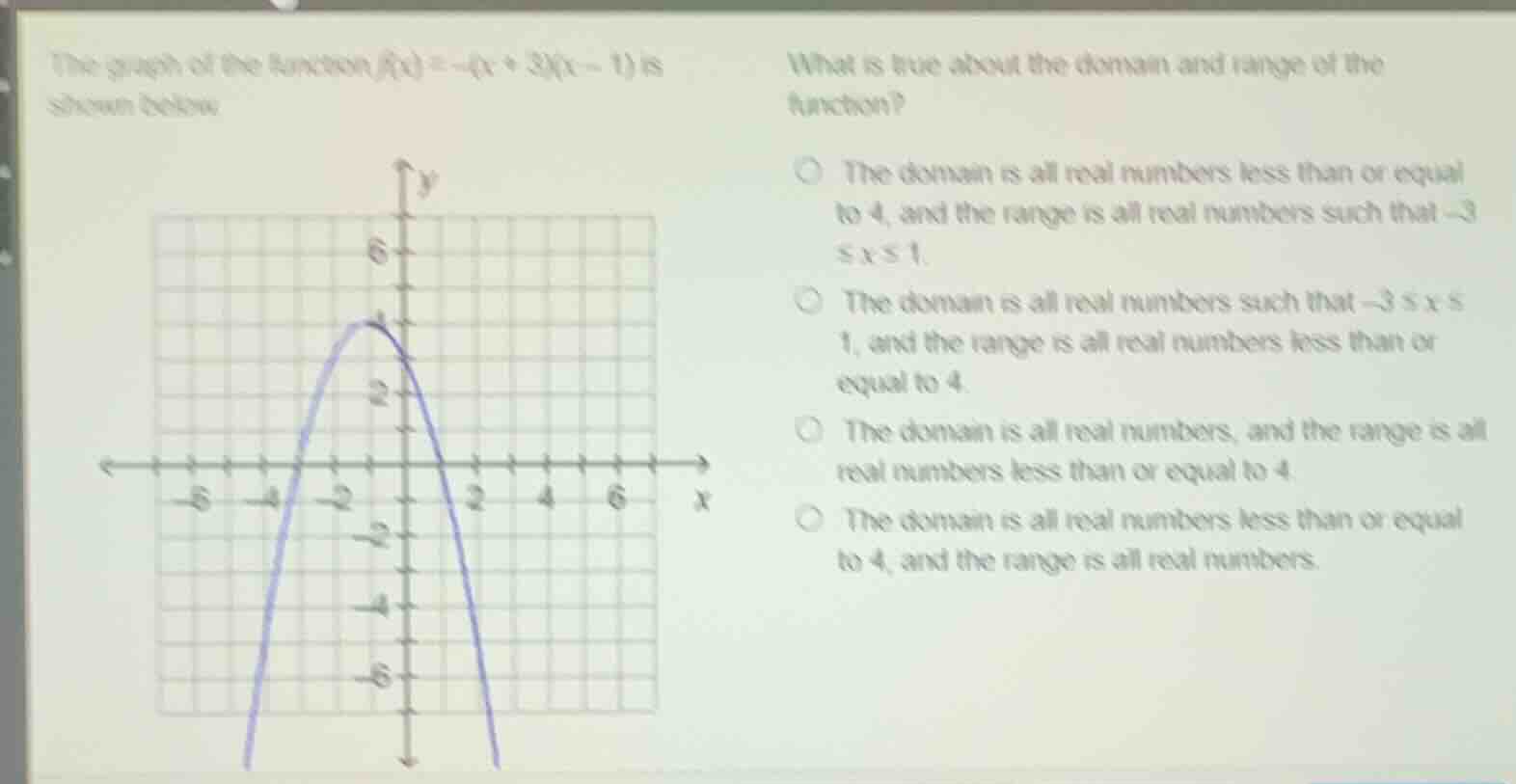
the graph of the function $f(x) = -(x + 3)(x - 1)$ is shown below
graph of a parabola opening downward with vertex at (-1, 4), x-intercepts at -3 and 1, y-intercept visible
what is true about the domain and range of the function?
- the domain is all real numbers less than or equal to 4, and the range is all real numbers such that $-3 \leq x \leq 1$.
- the domain is all real numbers such that $-3 \leq x \leq 1$, and the range is all real numbers less than or equal to 4.
- the domain is all real numbers, and the range is all real numbers less than or equal to 4.
- the domain is all real numbers less than or equal to 4, and the range is all real numbers.
Step1: Analyze the function type
The function \( f(x)=-(x + 3)(x - 1) \) is a quadratic function (since it is a product of two linear terms, and when expanded, it will be a polynomial of degree 2). The general form of a quadratic function is \( y = ax^{2}+bx + c \), and its graph is a parabola. For any quadratic function, there are no restrictions on the values of \( x \) (the input) that we can plug in. So, the domain of a quadratic function is all real numbers.
Step2: Analyze the range of the quadratic function
First, let's expand the function \( f(x)=-(x + 3)(x - 1) \).
Using the distributive property (FOIL method):
\( (x + 3)(x - 1)=x^{2}-x + 3x-3=x^{2}+2x - 3 \)
Then, \( f(x)=-(x^{2}+2x - 3)=-x^{2}-2x + 3 \)
For a quadratic function in the form \( y = ax^{2}+bx + c \), the vertex of the parabola (which gives the maximum or minimum value of the function) has its \( x \)-coordinate at \( x=-\frac{b}{2a} \). Here, \( a=-1 \), \( b = - 2 \), so:
\( x=-\frac{-2}{2\times(-1)}=-\frac{-2}{-2}=-1 \)
Now, we find the \( y \)-coordinate of the vertex by plugging \( x = - 1 \) into the function:
\( f(-1)=-(-1)^{2}-2\times(-1)+3=-1 + 2 + 3=4 \)
Since \( a=-1<0 \), the parabola opens downward. This means the maximum value of the function is \( y = 4 \), and the function can take any value less than or equal to 4 (since it opens downward and extends infinitely in the downward direction). So, the range is all real numbers less than or equal to 4.
Step3: Evaluate the options
- Option 1: Says domain is all real numbers less than or equal to 4 (wrong, domain of quadratic is all real numbers) and range is \( - 3\leq x\leq1 \) (range is about \( y \)-values, not \( x \)-values, so wrong).
- Option 2: Says domain is \( -3\leq x\leq1 \) (wrong, domain of quadratic is all real numbers) and range is all real numbers less than or equal to 4 (range is correct, but domain is wrong).
- Option 3: Says domain is all real numbers (correct) and range is all real numbers less than or equal to 4 (correct).
- Option 4: Says domain is all real numbers less than or equal to 4 (wrong) and range is all real numbers (wrong, since the parabola opens downward, it has a maximum value, so range is not all real numbers).

Snap & solve any problem in the app
Get step-by-step solutions on Sovi AI
Photo-based solutions with guided steps
Explore more problems and detailed explanations
The domain is all real numbers, and the range is all real numbers less than or equal to 4. (The corresponding option, assuming the options are labeled as above, would be the third option: "The domain is all real numbers, and the range is all real numbers less than or equal to 4.")