QUESTION IMAGE
Question
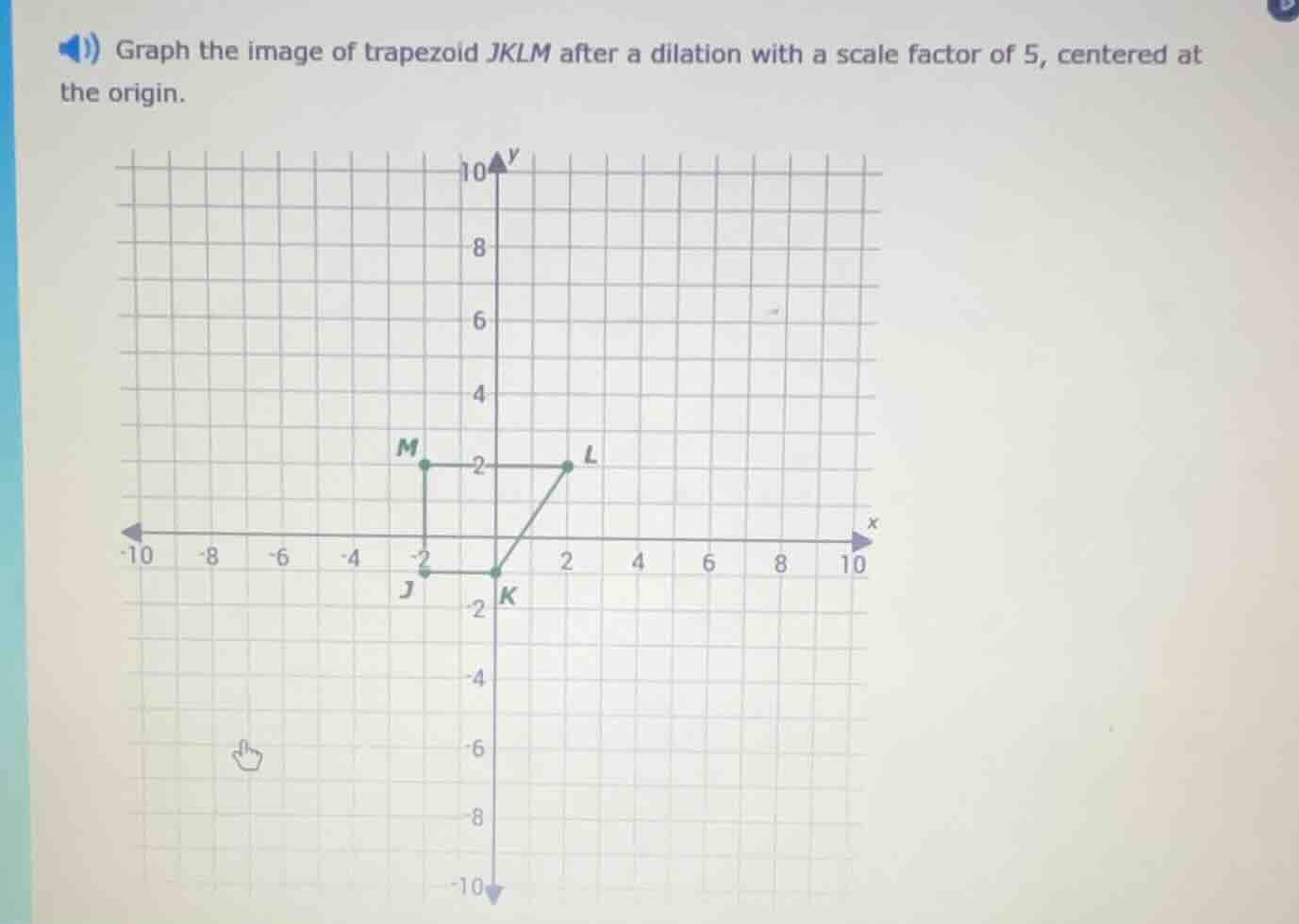
graph the image of trapezoid jklm after a dilation with a scale factor of 5, centered at the origin.
Step1: Identify coordinates of vertices
First, find the coordinates of trapezoid \(JKLM\):
- \(J(-2, -1)\) (Wait, looking at the graph, \(J\) is at \((-2, -1)\)? Wait, no, the grid: \(J\) is at \((-2, -1)\)? Wait, the graph: \(J\) is at \((-2, -1)\)? Wait, let's check again. The points:
- \(J\): x=-2, y=-1? Wait, no, the grid lines. Let's see: \(J\) is at (-2, -1)? Wait, the y-axis: the bottom of the grid, \(J\) is at (-2, -1)? Wait, maybe I misread. Wait, the points:
- \(J\): (-2, -1)? No, looking at the graph, \(J\) is at (-2, -1)? Wait, no, the coordinates:
Wait, \(J\) is at \((-2, -1)\)? Wait, no, the graph: \(J\) is at (-2, -1)? Wait, maybe:
- \(J\): (-2, -1)
- \(K\): (0, -1)
- \(L\): (2, 2)
- \(M\): (-2, 2)
Wait, that makes sense for a trapezoid. Let's confirm: \(J(-2, -1)\), \(K(0, -1)\), \(L(2, 2)\), \(M(-2, 2)\). Yes, because \(JK\) is horizontal (from x=-2 to 0, y=-1), \(ML\) is horizontal (from x=-2 to 2, y=2), and \(JM\) and \(KL\) are the legs.
Step2: Apply dilation formula
Dilation centered at the origin with scale factor \(k\) transforms a point \((x, y)\) to \((k \cdot x, k \cdot y)\). So scale factor \(k = 5\).
So for each point:
- \(J(-2, -1)\): new coordinates \(J' = (5 \cdot (-2), 5 \cdot (-1)) = (-10, -5)\)
- \(K(0, -1)\): new coordinates \(K' = (5 \cdot 0, 5 \cdot (-1)) = (0, -5)\)
- \(L(2, 2)\): new coordinates \(L' = (5 \cdot 2, 5 \cdot 2) = (10, 10)\)
- \(M(-2, 2)\): new coordinates \(M' = (5 \cdot (-2), 5 \cdot 2) = (-10, 10)\)
Wait, wait, maybe I misread the original coordinates. Let's check again. Wait, the original points:
Looking at the graph, \(J\) is at (-2, -1)? No, maybe \(J\) is at (-2, -1)? Wait, no, the y-axis: the point \(J\) is at (-2, -1), \(K\) at (0, -1), \(L\) at (2, 2), \(M\) at (-2, 2). Yes, that's a trapezoid with \(JK\) and \(ML\) as the two bases (horizontal), and \(JM\) and \(KL\) as the legs.
So applying dilation with scale factor 5:
- \(J(-2, -1)\) → \(J' = (5(-2), 5(-1)) = (-10, -5)\)
- \(K(0, -1)\) → \(K' = (50, 5(-1)) = (0, -5)\)
- \(L(2, 2)\) → \(L' = (52, 52) = (10, 10)\)
- \(M(-2, 2)\) → \(M' = (5(-2), 52) = (-10, 10)\)
Now, to graph these points:
- \(J'(-10, -5)\): 10 units left on x, 5 units down on y.
- \(K'(0, -5)\): on y-axis, 5 units down.
- \(L'(10, 10)\): 10 units right, 10 units up.
- \(M'(-10, 10)\): 10 units left, 10 units up.
Then connect \(J'K'L'M'J'\) to form the dilated trapezoid.

Snap & solve any problem in the app
Get step-by-step solutions on Sovi AI
Photo-based solutions with guided steps
Explore more problems and detailed explanations
The dilated trapezoid \(J'K'L'M'\) has vertices at \(J'(-10, -5)\), \(K'(0, -5)\), \(L'(10, 10)\), and \(M'(-10, 10)\). To graph it, plot these points and connect them in order.