QUESTION IMAGE
Question
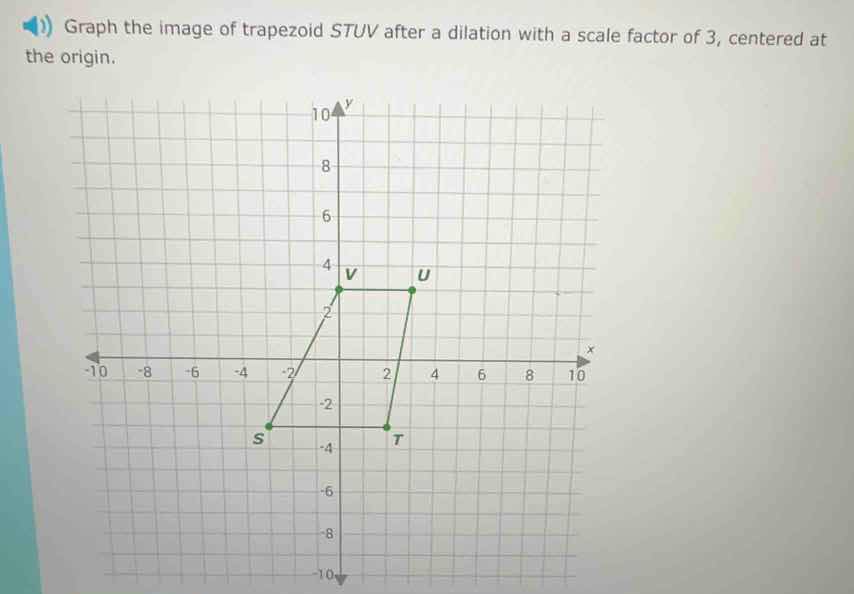
graph the image of trapezoid stuv after a dilation with a scale factor of 3, centered at the origin.
Step1: Identify coordinates of vertices
First, find the coordinates of trapezoid \( STUV \):
- \( S(-3, -3) \) (assuming each grid is 1 unit, from the graph: S is at x=-3, y=-3)
- \( T(3, -3) \) (T is at x=3, y=-3)
- \( U(3, 3) \) (U is at x=3, y=3)
- \( V(-1, 3) \) (V is at x=-1, y=3) Wait, correction: Looking at the graph, V is at (0, 3)? Wait no, the green dots: V is at (0, 3)? Wait the original graph: V is at (0, 3)? Wait no, the user's graph: V is at (0, 3)? Wait no, the x-axis: from -10 to 10, y-axis -10 to 10. Let's recheck:
Looking at the graph:
- \( S \): x=-3, y=-3 (since it's 3 units left on x, 3 units down on y)
- \( T \): x=3, y=-3 (3 units right, 3 units down)
- \( U \): x=3, y=3 (3 units right, 3 units up)
- \( V \): x=0, y=3 (0 on x, 3 on y) Wait, the green dot for V is at (0, 3), U at (3, 3), T at (3, -3), S at (-3, -3). Yes, that makes sense. So coordinates:
\( S(-3, -3) \), \( T(3, -3) \), \( U(3, 3) \), \( V(0, 3) \).
Step2: Apply dilation with scale factor 3, centered at origin
Dilation rule: \((x, y) \to (3x, 3y)\) (since scale factor \( k = 3 \), centered at origin).
- For \( S(-3, -3) \): \( (3 \times -3, 3 \times -3) = (-9, -9) \)
- For \( T(3, -3) \): \( (3 \times 3, 3 \times -3) = (9, -9) \)
- For \( U(3, 3) \): \( (3 \times 3, 3 \times 3) = (9, 9) \)
- For \( V(0, 3) \): \( (3 \times 0, 3 \times 3) = (0, 9) \)
Wait, correction: Wait original V is at (0, 3)? Wait no, in the graph, V is at (0, 3), U at (3, 3), T at (3, -3), S at (-3, -3). Yes. So:
\( S(-3, -3) \), \( T(3, -3) \), \( U(3, 3) \), \( V(0, 3) \).
Step3: Dilate each vertex
Dilation with scale factor 3, center at origin: \((x, y) \to (3x, 3y)\)
- \( S(-3, -3) \): \( 3 \times -3 = -9 \), \( 3 \times -3 = -9 \) → \( S'(-9, -9) \)
- \( T(3, -3) \): \( 3 \times 3 = 9 \), \( 3 \times -3 = -9 \) → \( T'(9, -9) \)
- \( U(3, 3) \): \( 3 \times 3 = 9 \), \( 3 \times 3 = 9 \) → \( U'(9, 9) \)
- \( V(0, 3) \): \( 3 \times 0 = 0 \), \( 3 \times 3 = 9 \) → \( V'(0, 9) \)
Step4: Plot the new vertices
Plot \( S'(-9, -9) \), \( T'(9, -9) \), \( U'(9, 9) \), \( V'(0, 9) \) and connect them to form the dilated trapezoid.

Snap & solve any problem in the app
Get step-by-step solutions on Sovi AI
Photo-based solutions with guided steps
Explore more problems and detailed explanations
The dilated trapezoid \( S'T'U'V' \) has vertices at \( S'(-9, -9) \), \( T'(9, -9) \), \( U'(9, 9) \), \( V'(0, 9) \). To graph it, plot these points and connect \( S' \) to \( T' \) to \( U' \) to \( V' \) to \( S' \).