QUESTION IMAGE
Question
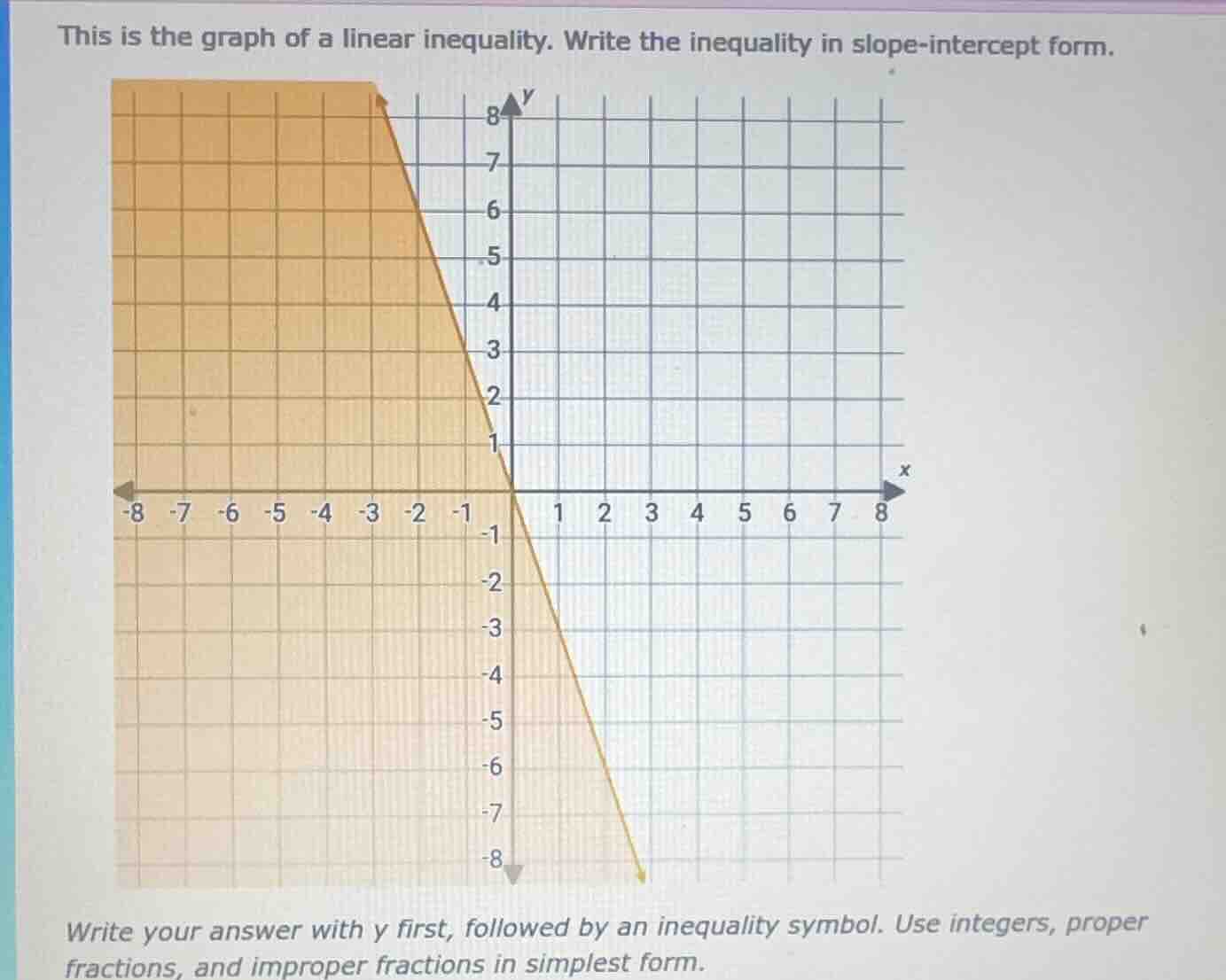
this is the graph of a linear inequality. write the inequality in slope - intercept form.
write your answer with y first, followed by an inequality symbol. use integers, proper fractions, and improper fractions in simplest form.
Step1: Find the slope of the line
The line passes through (0, 0) and (1, -3) (we can see from the graph, when x increases by 1, y decreases by 3). The slope \( m = \frac{y_2 - y_1}{x_2 - x_1} = \frac{-3 - 0}{1 - 0} = -3 \).
Step2: Determine the y-intercept
The line passes through the origin (0,0), so the y-intercept \( b = 0 \). The equation of the line in slope-intercept form is \( y = -3x + 0 \) or \( y = -3x \).
Step3: Determine the inequality symbol
The shaded region is to the left of the line (or above? Wait, looking at the graph, the line is decreasing, and the shaded area includes the region where, for a given x, y is greater than or equal to the line? Wait, no, let's check a test point. Let's take (0, 1) which is in the shaded region. Plug into \( y \) and \( -3x \): \( 1 \) vs \( -3(0)=0 \). So \( 1 \geq 0 \)? Wait, no, wait the line is solid? Wait the graph shows a solid line? Wait the original graph: the line is a solid or dashed? Wait the problem's graph: the line is a solid line? Wait the user's graph: the line is a solid line? Wait the graph provided: the line is a solid line? Wait, looking at the graph, the line is a solid line? Wait, no, the user's graph: the line is a solid line? Wait, the problem says "linear inequality" and the graph has a solid line? Wait, no, in the graph, the line is a solid line? Wait, let's re-examine. The line passes through (0,0) and (1, -3), and the shaded area is on the left side of the line. Wait, when x = -1, y on the line is \( y = -3(-1) = 3 \). The shaded area at x = -1 includes[SSE onError error]

Snap & solve any problem in the app
Get step-by-step solutions on Sovi AI
Photo-based solutions with guided steps
Explore more problems and detailed explanations
Step1: Find the slope of the line
The line passes through (0, 0) and (1, -3) (we can see from the graph, when x increases by 1, y decreases by 3). The slope \( m = \frac{y_2 - y_1}{x_2 - x_1} = \frac{-3 - 0}{1 - 0} = -3 \).
Step2: Determine the y-intercept
The line passes through the origin (0,0), so the y-intercept \( b = 0 \). The equation of the line in slope-intercept form is \( y = -3x + 0 \) or \( y = -3x \).
Step3: Determine the inequality symbol
The shaded region is to the left of the line (or above? Wait, looking at the graph, the line is decreasing, and the shaded area includes the region where, for a given x, y is greater than or equal to the line? Wait, no, let's check a test point. Let's take (0, 1) which is in the shaded region. Plug into \( y \) and \( -3x \): \( 1 \) vs \( -3(0)=0 \). So \( 1 \geq 0 \)? Wait, no, wait the line is solid? Wait the graph shows a solid line? Wait the original graph: the line is a solid or dashed? Wait the problem's graph: the line is a solid line? Wait the user's graph: the line is a solid line? Wait the graph provided: the line is a solid line? Wait, looking at the graph, the line is a solid line? Wait, no, the user's graph: the line is a solid line? Wait, the problem says "linear inequality" and the graph has a solid line? Wait, no, in the graph, the line is a solid line? Wait, let's re-examine. The line passes through (0,0) and (1, -3), and the shaded area is on the left side of the line. Wait, when x = -1, y on the line is \( y = -3(-1) = 3 \). The shaded area at x = -1 includes[SSE onError error]