QUESTION IMAGE
Question
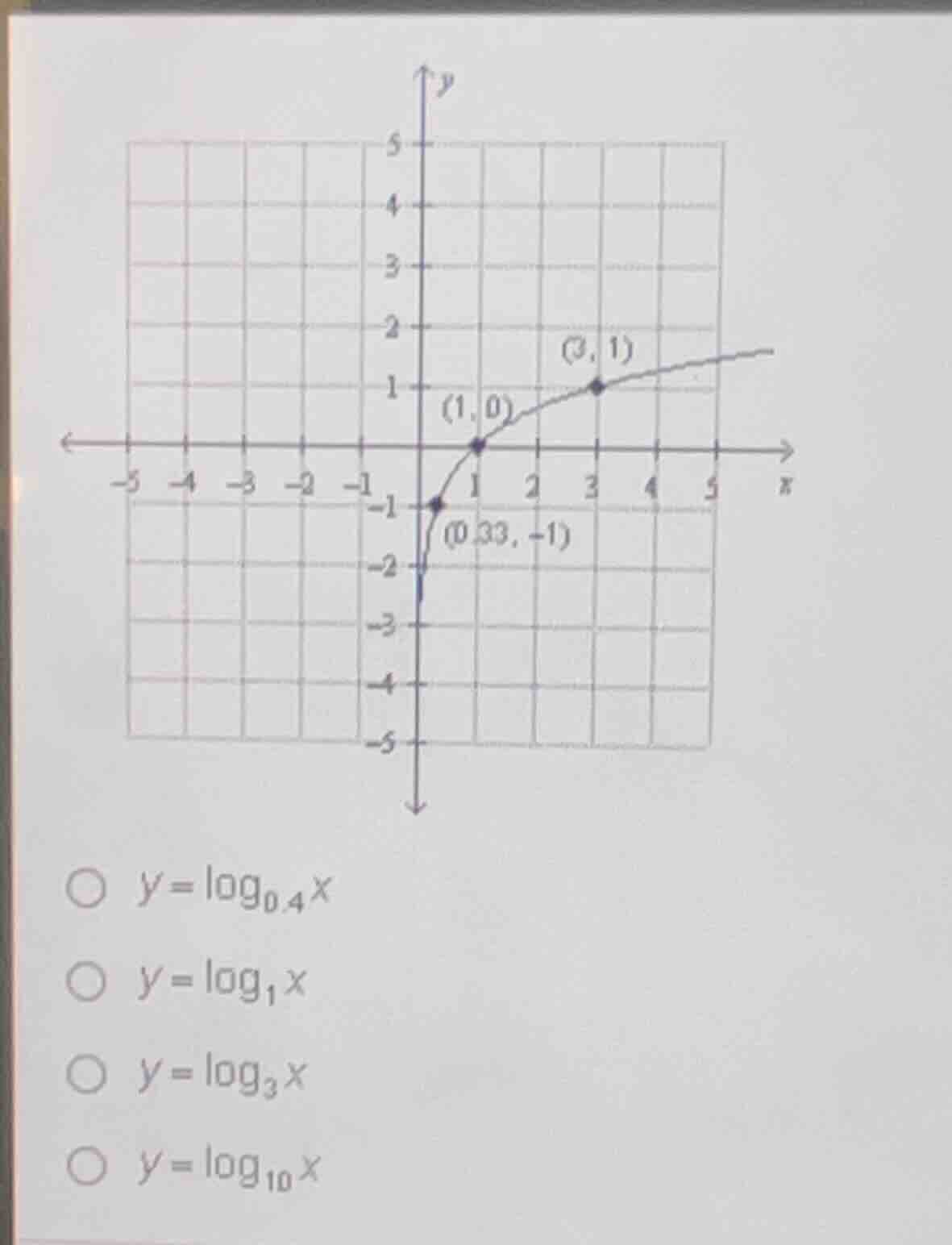
graph with points (1, 0), (3, 1), (0.33, -1). options: ( y = log_{0.4} x ), ( y = log_{1} x ), ( y = log_{3} x ), ( y = log_{10} x )
Step1: Recall log function properties
For a logarithmic function \( y = \log_b x \), when \( x = 1 \), \( y = 0 \) (since \( \log_b 1 = 0 \) for any \( b>0, b
eq1 \)). When \( y = 1 \), \( x = b \) (since \( \log_b b = 1 \)).
Step2: Analyze the graph
From the graph, we see the point \( (3, 1) \). So when \( y = 1 \), \( x = 3 \). Using the property \( \log_b b = 1 \), this means \( b = 3 \), so the function should be \( y=\log_3 x \). Let's check other options:
- For \( y = \log_{0.4}x \), it should be a decreasing function (since \( 0 < 0.4 < 1 \)), but the graph is increasing, so eliminate.
- \( y = \log_1 x \) is undefined (base of log can't be 1), eliminate.
- For \( y=\log_{10}x \), when \( y = 1 \), \( x = 10 \), but the graph has \( x = 3 \) when \( y = 1 \), so eliminate.

Snap & solve any problem in the app
Get step-by-step solutions on Sovi AI
Photo-based solutions with guided steps
Explore more problems and detailed explanations
\( y = \log_3 x \) (the option \( y=\log_3 x \))