QUESTION IMAGE
Question
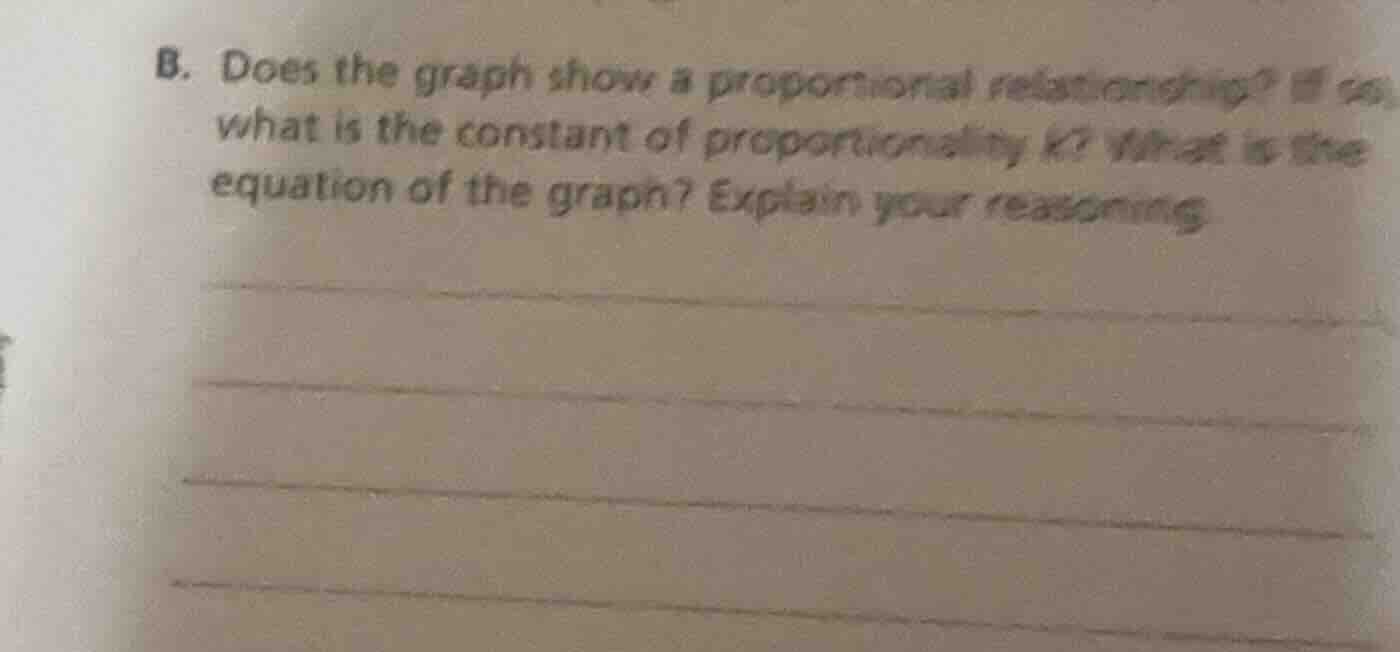
b. does the graph show a proportional relationship? if so, what is the constant of proportionality ( k )? what is the equation of the graph? explain your reasoning.
To determine if a graph shows a proportional relationship, we use the following reasoning (assuming we had a graph, for example, a line through the origin with points like (1, 2), (2, 4), etc.):
Step 1: Check for Proportionality
A proportional relationship has a graph that is a straight line passing through the origin \((0,0)\). The equation for a proportional relationship is \(y = kx\), where \(k\) is the constant of proportionality.
Step 2: Find the Constant of Proportionality (\(k\))
If we have two points \((x_1, y_1)\) and \((x_2, y_2)\) on the line, \(k=\frac{y}{x}\) (since \(y = kx\) implies \(k=\frac{y}{x}\)). For example, if the graph passes through \((1, 3)\), then \(k=\frac{3}{1}=3\).
Step 3: Write the Equation
Using \(y = kx\), substitute \(k\) with the value found. If \(k = 3\), the equation is \(y = 3x\).
Since the graph isn't provided, here's a general approach:
- Proportional Check: A proportional graph is a straight line through \((0,0)\).
- Constant of Proportionality: \(k=\frac{y}{x}\) for any point \((x,y)\) on the line.
- Equation: \(y = kx\) with the calculated \(k\).
For example, if the graph has points \((2, 6)\), then \(k=\frac{6}{2}=3\), so the equation is \(y = 3x\), and it is proportional.
If you provide the graph or specific points, we can calculate \(k\) and confirm the equation.

Snap & solve any problem in the app
Get step-by-step solutions on Sovi AI
Photo-based solutions with guided steps
Explore more problems and detailed explanations
To determine if a graph shows a proportional relationship, we use the following reasoning (assuming we had a graph, for example, a line through the origin with points like (1, 2), (2, 4), etc.):
Step 1: Check for Proportionality
A proportional relationship has a graph that is a straight line passing through the origin \((0,0)\). The equation for a proportional relationship is \(y = kx\), where \(k\) is the constant of proportionality.
Step 2: Find the Constant of Proportionality (\(k\))
If we have two points \((x_1, y_1)\) and \((x_2, y_2)\) on the line, \(k=\frac{y}{x}\) (since \(y = kx\) implies \(k=\frac{y}{x}\)). For example, if the graph passes through \((1, 3)\), then \(k=\frac{3}{1}=3\).
Step 3: Write the Equation
Using \(y = kx\), substitute \(k\) with the value found. If \(k = 3\), the equation is \(y = 3x\).
Since the graph isn't provided, here's a general approach:
- Proportional Check: A proportional graph is a straight line through \((0,0)\).
- Constant of Proportionality: \(k=\frac{y}{x}\) for any point \((x,y)\) on the line.
- Equation: \(y = kx\) with the calculated \(k\).
For example, if the graph has points \((2, 6)\), then \(k=\frac{6}{2}=3\), so the equation is \(y = 3x\), and it is proportional.
If you provide the graph or specific points, we can calculate \(k\) and confirm the equation.