QUESTION IMAGE
Question
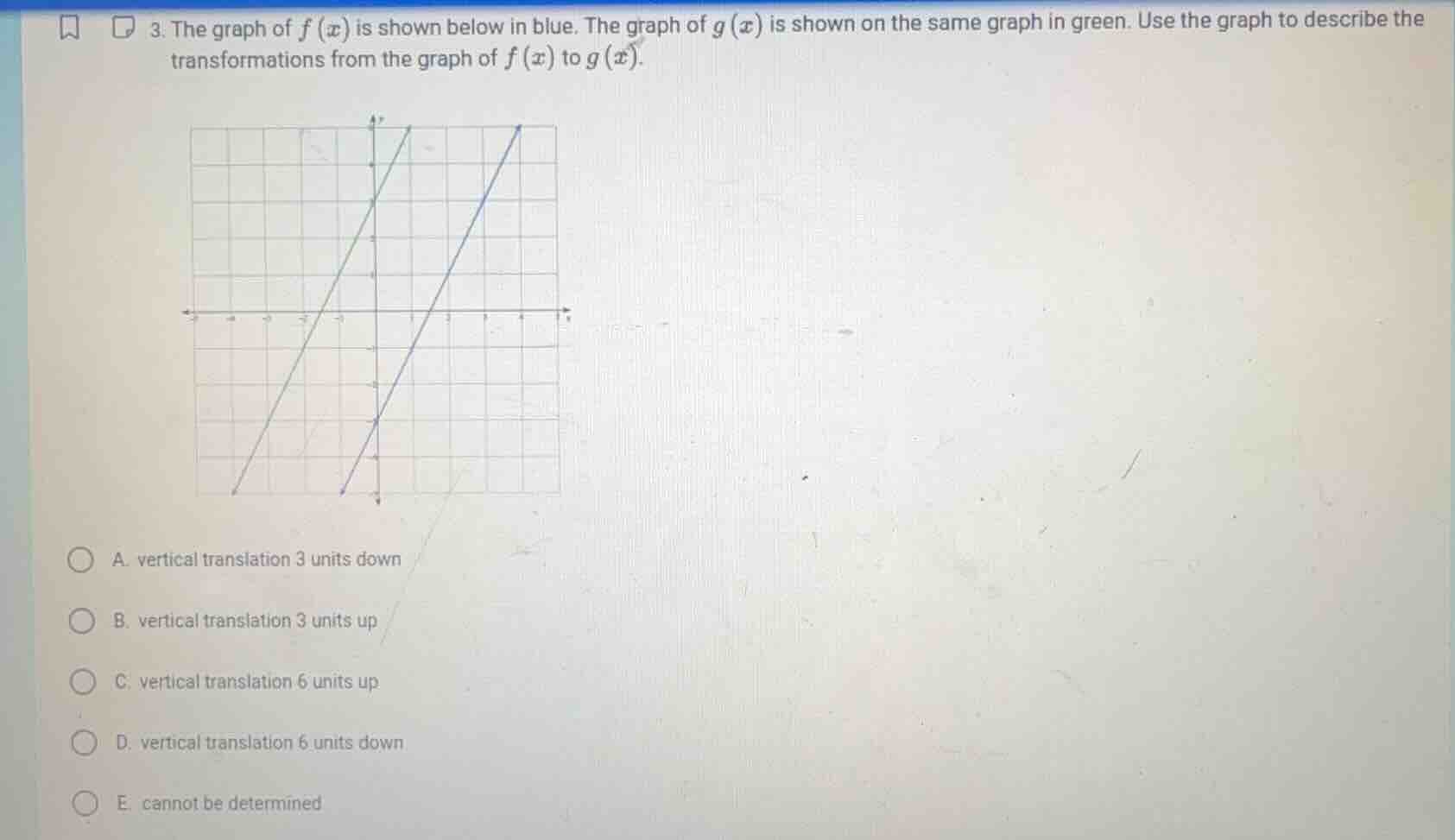
- the graph of ( f(x) ) is shown below in blue. the graph of ( g(x) ) is shown on the same graph in green. use the graph to describe the transformations from the graph of ( f(x) ) to ( g(x) ).
a. vertical translation 3 units down
b. vertical translation 3 units up
c. vertical translation 6 units up
d. vertical translation 6 units down
e. cannot be determined
To determine the transformation from \( f(x) \) (blue) to \( g(x) \) (green), we analyze their vertical positions. The \( y \)-intercept of \( f(x) \) is at \( (0, 3) \) (or similar, but comparing vertical shifts: the green line is 6 units below the blue line? Wait, no—wait, looking at the graph, the blue line has a higher \( y \)-intercept than the green. Wait, actually, let's check the vertical shift. If we take a point on \( f(x) \) and see where it maps on \( g(x) \). For example, the \( y \)-intercept of \( f(x) \) (blue) is at \( y = 3 \) (or maybe \( y = 3 \) when \( x=0 \)), and \( g(x) \) (green) has \( y \)-intercept at \( y = -3 \)? Wait, no, the grid: each square is 1 unit. Wait, the blue line passes through \( (0, 3) \) (assuming), and the green line passes through \( (0, -3) \)? Wait, no, the vertical distance between the two lines: from the blue's \( y \)-intercept to green's is 6 units down? Wait, no, let's re-examine. Wait, the options: D is vertical translation 6 units down. Wait, maybe the blue line has a \( y \)-intercept at \( y = 3 \), and green at \( y = -3 \), so the shift is 6 units down. So the transformation from \( f(x) \) to \( g(x) \) is a vertical translation 6 units down. So the correct option is D.

Snap & solve any problem in the app
Get step-by-step solutions on Sovi AI
Photo-based solutions with guided steps
Explore more problems and detailed explanations
D. vertical translation 6 units down