QUESTION IMAGE
Question
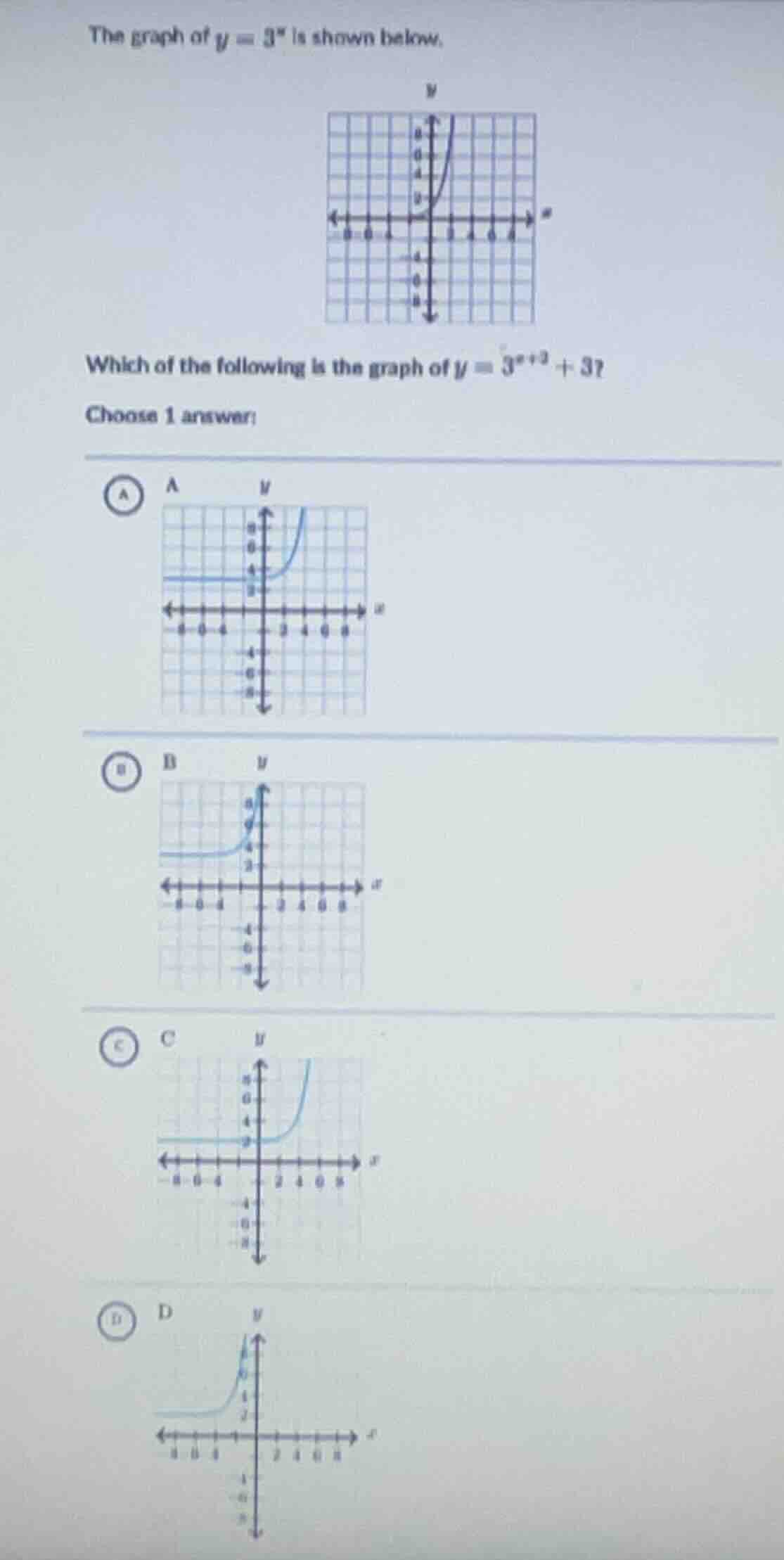
the graph of $y = 3^x$ is shown below.
graph of $y = 3^x$
which of the following is the graph of $y = 3^{x + 3} + 3$?
choose 1 answer:
a graph a
b graph b
c graph c
d graph d
Step1: Analyze horizontal shift
For the function \( y = 3^{x + 3}+3 \), compared to \( y = 3^{x} \), the \( x+3 \) inside the exponent means a horizontal shift. The rule for horizontal shifts is: if we have \( y = f(x + h) \), it's a shift of \( h \) units to the left (when \( h>0 \)). Here, \( h = 3 \), so the graph of \( y = 3^{x} \) shifts 3 units to the left.
Step2: Analyze vertical shift
The \( +3 \) at the end means a vertical shift. The rule for vertical shifts is: if we have \( y = f(x)+k \), it's a shift of \( k \) units up (when \( k>0 \)). Here, \( k = 3 \), so the graph shifts 3 units up.
Step3: Check the y - intercept (optional but helpful)
For \( y = 3^{x} \), when \( x = 0 \), \( y=3^{0}=1 \). For \( y = 3^{x + 3}+3 \), when \( x=- 3 \), \( y = 3^{-3 + 3}+3=3^{0}+3=1 + 3=4 \)? Wait, no, let's find the y - intercept (x = 0) for \( y=3^{x + 3}+3 \). When \( x = 0 \), \( y=3^{0 + 3}+3=27 + 3=30 \)? Wait, maybe better to look at the horizontal asymptote. The horizontal asymptote of \( y = 3^{x} \) is \( y = 0 \). For \( y=3^{x+3}+3 \), the horizontal asymptote is \( y=3 \) (since the \( +3 \) shifts the asymptote up 3 units) and the graph is shifted 3 units left.
Looking at the options:
- Option A: Horizontal asymptote seems to be around \( y = 3 \) (vertical shift up 3) and shifted left? Wait, no, let's re - evaluate. Wait, the original function \( y = 3^{x} \) has a y - intercept at (0,1). After shifting left 3 units and up 3 units: the point (0,1) on \( y = 3^{x} \) moves to \( (0 - 3,1 + 3)=(-3,4) \). Now let's check the options:
- Option B: The graph seems to have a horizontal asymptote and a shift that doesn't match.
- Option C: The horizontal asymptote is \( y = 3 \) (vertical shift up 3) and the graph is shifted left (since the "start" of the exponential growth is shifted left) and the shape. Wait, no, let's think again. Wait, the function \( y=3^{x+3}+3=3^{3}\times3^{x}+3 = 27\times3^{x}+3 \). But the key shifts: left 3, up 3. The horizontal asymptote is \( y = 3 \), and the graph is an exponential growth shifted left 3 and up 3. Looking at the options, the graph with horizontal asymptote \( y = 3 \) (so the graph approaches \( y = 3 \) as \( x
ightarrow-\infty \)) and shifted left (so the "rise" of the exponential happens earlier (more to the left)) and up 3. Option C has a horizontal asymptote around \( y = 3 \) and the shape consistent with left shift and up shift. Wait, maybe I made a mistake earlier. Wait, the correct analysis:
The parent function \( y = 3^{x} \): domain \( \mathbb{R} \), range \( (0,\infty) \), horizontal asymptote \( y = 0 \), increasing, passes through (0,1).
For \( y=3^{x + 3}+3 \):
- Horizontal asymptote: As \( x
ightarrow-\infty \), \( 3^{x+3}
ightarrow0 \), so \( y
ightarrow3 \). So horizontal asymptote \( y = 3 \).
- When \( x=-3 \), \( y=3^{-3 + 3}+3=1 + 3=4 \).
- The graph is obtained by shifting \( y = 3^{x} \) 3 units left (so the point (0,1) on \( y = 3^{x} \) goes to (- 3,1) and then up 3 units to (-3,4)) and 3 units up.
Now looking at the options:
- Option A: The horizontal asymptote is around \( y = 3 \), but the shape of the exponential part: when we shift left 3 and up 3, the exponential growth should start (in terms of the "steep" part) more to the left. Wait, maybe the correct answer is C? Wait, no, let's check the options again. Wait, maybe I messed up the shift direction. Wait, \( y = f(x + h) \) is left shift, \( y = f(x - h) \) is right shift. So \( y=3^{x+3}=3^{x-(-3)} \), so it's a shift 3 units to the left. And \( +3 \) is up 3 units.
Looking at th…

Snap & solve any problem in the app
Get step-by-step solutions on Sovi AI
Photo-based solutions with guided steps
Explore more problems and detailed explanations
C