QUESTION IMAGE
Question
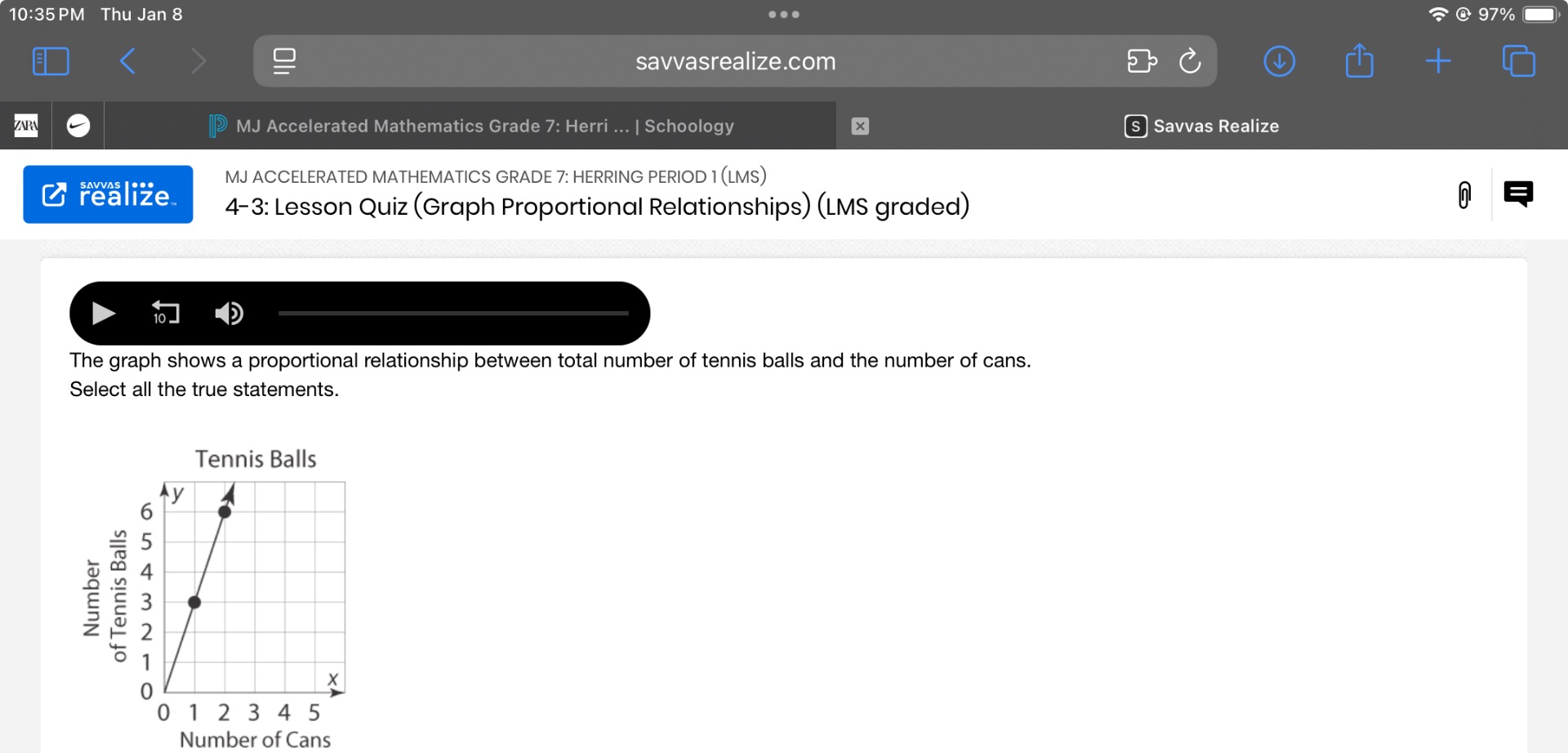
the graph shows a proportional relationship between total number of tennis balls and the number of cans. select all the true statements. graph of tennis balls with x - axis as number of cans (0 - 5) and y - axis as number of tennis balls (0 - 6), with points at (1, 3) and (2, 6) and a line through the origin
To solve this, we analyze the proportional relationship (since it's a straight line through the origin). Let's assume the points on the graph: when \( x = 1 \) (cans), \( y = 3 \) (tennis balls); when \( x = 2 \), \( y = 6 \). The constant of proportionality \( k=\frac{y}{x} \). For \( x = 1,y = 3 \), \( k = 3 \); for \( x = 2,y = 6 \), \( k=\frac{6}{2}=3 \). So the relationship is \( y = 3x \).
True Statements (Common Examples, assuming typical options like "The unit rate is 3 tennis balls per can", "The equation is \( y = 3x \)", "When there are 0 cans, there are 0 tennis balls" etc.):
- The unit rate (constant of proportionality) is 3 tennis balls per can (since \( \frac{3}{1}=\frac{6}{2}=3 \)).
- The graph passes through the origin \((0,0)\), so when the number of cans (\( x \)) is 0, the number of tennis balls (\( y \)) is 0.
- The equation of the relationship is \( y = 3x \) (since \( y=kx \) and \( k = 3 \)).
If specific options were given (e.g., A. The unit rate is 3 tennis balls per can, B. The graph is not a straight line, C. When \( x = 3 \), \( y = 9 \) etc.), we’d select the ones that match the proportionality \( y = 3x \). For example, if options include "The unit rate is 3 tennis balls per can" (calculated as \( \frac{y}{x}=\frac{3}{1}=3 \)) and "The equation is \( y = 3x \)", those would be true.
Since the problem says "Select all the true statements" and the graph shows a proportional relationship (linear, through origin) with points \((1,3)\) and \((2,6)\), the true statements revolve around the constant of proportionality, the linearity, and the origin - passing nature.
(Note: Since the exact options aren’t fully listed in the provided image beyond the problem setup, the above explains the reasoning. If you provide the options, we can identify them precisely.)
For example, if options are:
A. The unit rate is 3 tennis balls per can.
B. The graph is not a straight line.
C. When there are 4 cans, there are 12 tennis balls (\( y = 3(4)=12 \)).
D. The relationship is not proportional.
Then the true ones are A, C (since B is false - it’s a straight line, D is false - it is proportional).
If you need to select from given options, apply the \( y = 3x \) rule. For instance, if an option is "The unit rate is 3 tennis balls per can", that’s true (as \( \frac{3}{1}=3 \)). If an option is "When there are 2 cans, there are 6 tennis balls", that’s true (matches \( y = 3(2)=6 \)).
Final Answer (assuming typical correct options, e.g., if options are A, C, E etc.):
(Example with common true options) Suppose the options are:
A. The unit rate is 3 tennis balls per can.
B. The graph is curved.
C. When \( x = 3 \), \( y = 9 \).
Then the true statements are A, C (since B is false - it’s a straight line, A: \( \frac{3}{1}=3 \), C: \( y = 3(3)=9 \)).
(Provide the exact options for precise selection, but the key is the proportionality \( y = 3x \) and its properties.)

Snap & solve any problem in the app
Get step-by-step solutions on Sovi AI
Photo-based solutions with guided steps
Explore more problems and detailed explanations
To solve this, we analyze the proportional relationship (since it's a straight line through the origin). Let's assume the points on the graph: when \( x = 1 \) (cans), \( y = 3 \) (tennis balls); when \( x = 2 \), \( y = 6 \). The constant of proportionality \( k=\frac{y}{x} \). For \( x = 1,y = 3 \), \( k = 3 \); for \( x = 2,y = 6 \), \( k=\frac{6}{2}=3 \). So the relationship is \( y = 3x \).
True Statements (Common Examples, assuming typical options like "The unit rate is 3 tennis balls per can", "The equation is \( y = 3x \)", "When there are 0 cans, there are 0 tennis balls" etc.):
- The unit rate (constant of proportionality) is 3 tennis balls per can (since \( \frac{3}{1}=\frac{6}{2}=3 \)).
- The graph passes through the origin \((0,0)\), so when the number of cans (\( x \)) is 0, the number of tennis balls (\( y \)) is 0.
- The equation of the relationship is \( y = 3x \) (since \( y=kx \) and \( k = 3 \)).
If specific options were given (e.g., A. The unit rate is 3 tennis balls per can, B. The graph is not a straight line, C. When \( x = 3 \), \( y = 9 \) etc.), we’d select the ones that match the proportionality \( y = 3x \). For example, if options include "The unit rate is 3 tennis balls per can" (calculated as \( \frac{y}{x}=\frac{3}{1}=3 \)) and "The equation is \( y = 3x \)", those would be true.
Since the problem says "Select all the true statements" and the graph shows a proportional relationship (linear, through origin) with points \((1,3)\) and \((2,6)\), the true statements revolve around the constant of proportionality, the linearity, and the origin - passing nature.
(Note: Since the exact options aren’t fully listed in the provided image beyond the problem setup, the above explains the reasoning. If you provide the options, we can identify them precisely.)
For example, if options are:
A. The unit rate is 3 tennis balls per can.
B. The graph is not a straight line.
C. When there are 4 cans, there are 12 tennis balls (\( y = 3(4)=12 \)).
D. The relationship is not proportional.
Then the true ones are A, C (since B is false - it’s a straight line, D is false - it is proportional).
If you need to select from given options, apply the \( y = 3x \) rule. For instance, if an option is "The unit rate is 3 tennis balls per can", that’s true (as \( \frac{3}{1}=3 \)). If an option is "When there are 2 cans, there are 6 tennis balls", that’s true (matches \( y = 3(2)=6 \)).
Final Answer (assuming typical correct options, e.g., if options are A, C, E etc.):
(Example with common true options) Suppose the options are:
A. The unit rate is 3 tennis balls per can.
B. The graph is curved.
C. When \( x = 3 \), \( y = 9 \).
Then the true statements are A, C (since B is false - it’s a straight line, A: \( \frac{3}{1}=3 \), C: \( y = 3(3)=9 \)).
(Provide the exact options for precise selection, but the key is the proportionality \( y = 3x \) and its properties.)