QUESTION IMAGE
Question
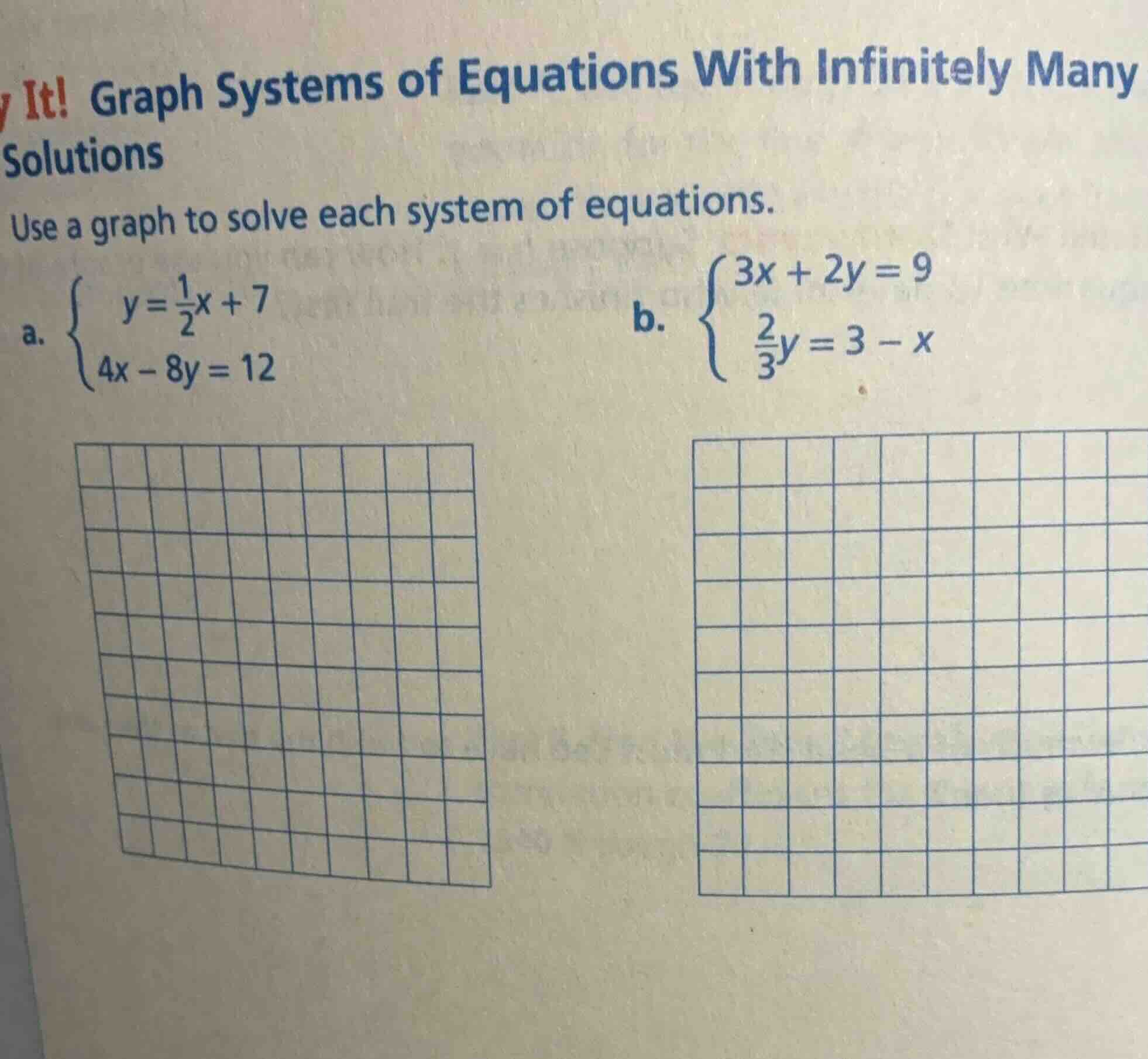
y it! graph systems of equations with infinitely many solutions
use a graph to solve each system of equations.
a. \\(\
\\)
b. \\(\
\\)
Part a
Step1: Rewrite the second equation
We have the system \(
\). Let's rewrite the second equation in slope - intercept form (\(y=mx + b\), where \(m\) is the slope and \(b\) is the y - intercept).
Starting with \(4x-8y = 12\), we subtract \(4x\) from both sides: \(-8y=-4x + 12\). Then divide both sides by \(-8\): \(y=\frac{-4x + 12}{-8}=\frac{1}{2}x-\frac{3}{2}\).
Step2: Analyze the slopes and y - intercepts
The first equation \(y=\frac{1}{2}x + 7\) has a slope \(m_1=\frac{1}{2}\) and a y - intercept \(b_1 = 7\). The second equation \(y=\frac{1}{2}x-\frac{3}{2}\) has a slope \(m_2=\frac{1}{2}\) and a y - intercept \(b_2=-\frac{3}{2}\).
Since the slopes are equal (\(m_1 = m_2=\frac{1}{2}\)) and the y - intercepts are different (\(b_1
eq b_2\)), the two lines are parallel. Parallel lines do not intersect, so the system of equations has no solution.
Part b
Step1: Rewrite the second equation
We have the system \(
\). Let's rewrite both equations in slope - intercept form.
For the first equation \(3x + 2y=9\), subtract \(3x\) from both sides: \(2y=-3x + 9\). Divide both sides by \(2\): \(y=-\frac{3}{2}x+\frac{9}{2}\).
For the second equation \(\frac{2}{3}y=3 - x\), multiply both sides by \(\frac{3}{2}\) to solve for \(y\): \(y=\frac{3}{2}(3 - x)=-\frac{3}{2}x+\frac{9}{2}\).
Step2: Analyze the slopes and y - intercepts
The first equation \(y =-\frac{3}{2}x+\frac{9}{2}\) has a slope \(m_1=-\frac{3}{2}\) and a y - intercept \(b_1=\frac{9}{2}\). The second equation \(y=-\frac{3}{2}x+\frac{9}{2}\) has a slope \(m_2 =-\frac{3}{2}\) and a y - intercept \(b_2=\frac{9}{2}\).
Since the slopes are equal (\(m_1=m_2 =-\frac{3}{2}\)) and the y - intercepts are equal (\(b_1 = b_2=\frac{9}{2}\)), the two lines are the same. So the system of equations has infinitely many solutions.

Snap & solve any problem in the app
Get step-by-step solutions on Sovi AI
Photo-based solutions with guided steps
Explore more problems and detailed explanations
a. No solution (the two lines are parallel).
b. Infinitely many solutions (the two lines are coincident).