QUESTION IMAGE
Question
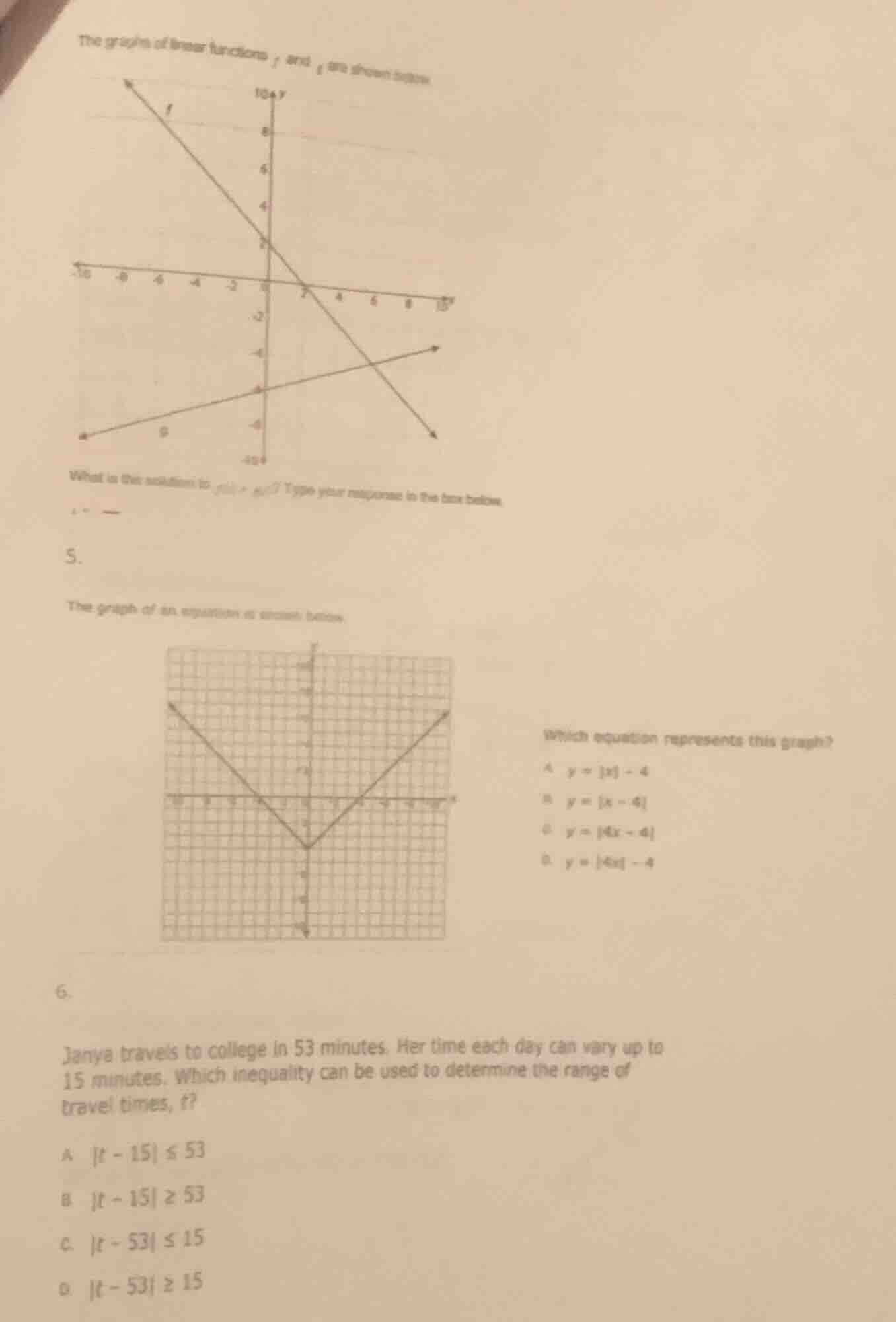
the graphs of linear functions f and g are shown below
what is the solution to f(x) = g(x)? type your response in the box below.
x =
5.
the graph of an equation is shown below.
which equation represents this graph?
a ( y = |x| - 4 )
b ( y = |x - 4| )
c ( y = |4x - 4| )
d ( y = |4x| - 4 )
6.
janya travels to college in 53 minutes. her time each day can vary up to 15 minutes. which inequality can be used to determine the range of travel times, t?
a ( |t - 15| leq 53 )
b ( |t - 15| geq 53 )
c ( |t - 53| leq 15 )
d ( |t - 53| geq 15 )
Question 4 (assuming the first graph question about \( f(x) = g(x) \))
Step1: Find intersection of \( f \) and \( g \)
The solution to \( f(x) = g(x) \) is the \( x \)-coordinate of the intersection point of the two linear functions' graphs. From the graph, the lines intersect at \( x = 2 \)? Wait, no, looking at the axes, the intersection is at \( x = 2 \)? Wait, the first graph: function \( f \) and \( g \), their intersection—wait, the graph shows the lines crossing at \( x = 2 \)? Wait, no, let's check the axes. The \( x \)-axis has marks, and the intersection point's \( x \)-value: looking at the graph, the two lines intersect at \( x = 2 \)? Wait, maybe I misread. Wait, the first graph: the line \( f \) and \( g \), their intersection is at \( x = 2 \)? Wait, no, let's see: the \( y \)-intercept of \( f \) is 2, and \( g \) is -5? Wait, no, the graph: the two lines cross at \( x = 2 \)? Wait, maybe the correct \( x \) is 2? Wait, no, let's re-express. The solution to \( f(x) = g(x) \) is the \( x \)-value where the two graphs intersect. From the given graph, the intersection point is at \( x = 2 \)? Wait, maybe I made a mistake. Wait, the first graph: the lines intersect at \( x = 2 \)? Let me check again. The \( x \)-axis: from -10 to 10, and the intersection is at \( x = 2 \). So the solution is \( x = 2 \).
Step2: Confirm intersection
The graphs of \( f \) and \( g \) intersect at \( x = 2 \), so \( f(2) = g(2) \), hence the solution to \( f(x) = g(x) \) is \( x = 2 \).
- Recall the vertex form of absolute value function: \( y = |x - h| + k \), where \((h, k)\) is the vertex.
- From the graph, the vertex is at \((0, -4)\), so \( h = 0 \), \( k = -4 \).
- Check the slope: The graph has a slope of 1 on the right (since from vertex \((0, -4)\) to \((4, 0)\), rise over run is \( \frac{0 - (-4)}{4 - 0} = 1 \), same for left). So the equation should be \( y = |x| - 4 \) (since \( h = 0 \), \( k = -4 \), and slope 1, so no coefficient on \( x \) except the absolute value).
- Eliminate other options:
- Option B: \( y = |x - 4| \) has vertex at \((4, 0)\), not \((0, -4)\).
- Option C: \( y = |4x - 4| \) has vertex at \( x = 1 \), \( y = 0 \), not \((0, -4)\).
- Option D: \( y = |4x| - 4 \) has vertex at \((0, -4)\) but slope 4 (steeper), but the graph has slope 1 (from \((0, -4)\) to \((4, 0)\), slope \( \frac{4}{4} = 1 \)), so D would have slope 4, which is steeper. So A is correct.
- The absolute value inequality for a value \( t \) that varies by up to \( 15 \) minutes from a mean of \( 53 \) minutes is \( |t - 53| \leq 15 \).
- Explanation: \( |t - \text{mean}| \leq \text{variation} \) means \( t \) is within \( \text{variation} \) minutes of the mean. Here, mean is \( 53 \), variation is \( 15 \), so \( |t - 53| \leq 15 \), which is option C.
- Eliminate others:
- A: \( |t - 15| \leq 53 \) uses 15 as mean, incorrect.
- B: \( |t - 15| \geq 53 \) is about being at least 53 from 15, incorrect.
- D: \( |t - 53| \geq 15 \) means at least 15 minutes from 53, but the problem says "varies up to 15 minutes" (i.e., within 15 minutes), so \( \leq \), not \( \geq \).

Snap & solve any problem in the app
Get step-by-step solutions on Sovi AI
Photo-based solutions with guided steps
Explore more problems and detailed explanations
\( x = 2 \)