QUESTION IMAGE
Question
gravity is also responsible for the orbits of celestial objects beyond the solar system.
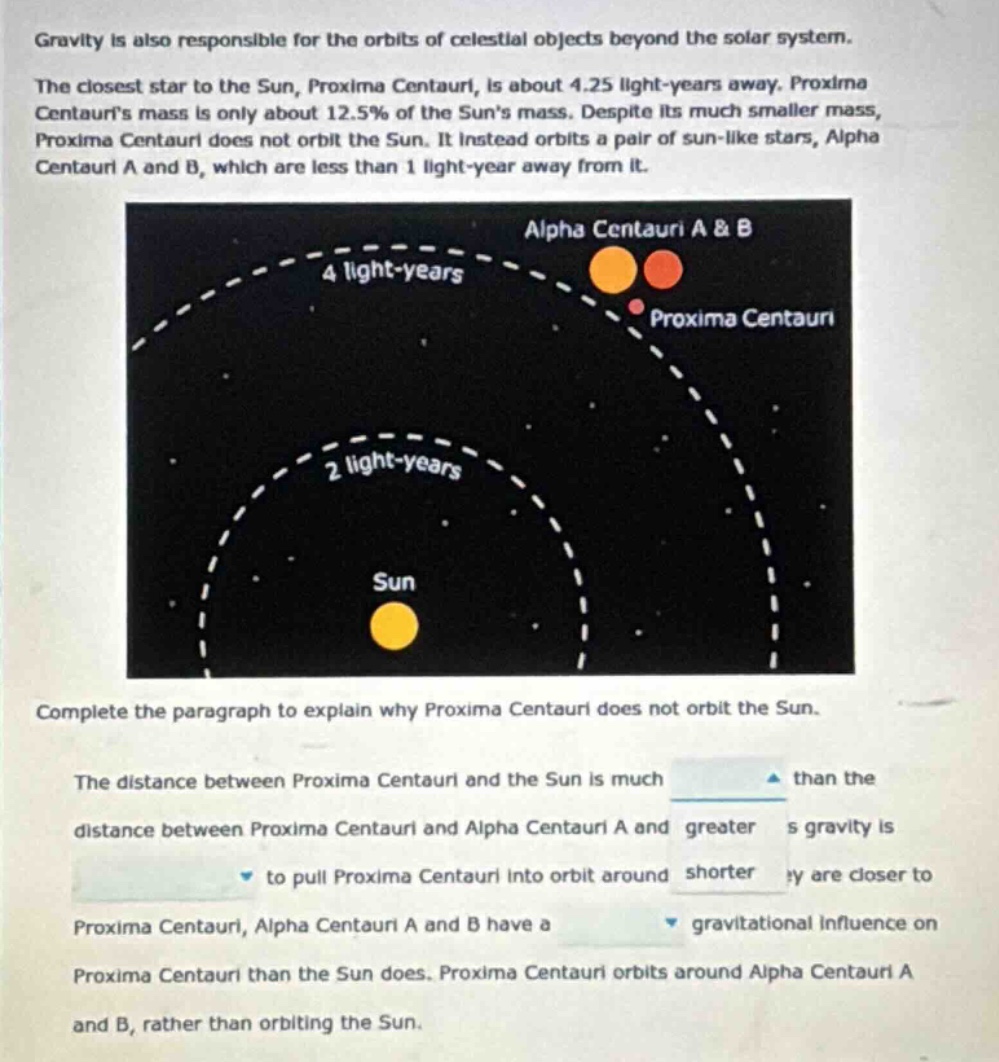
the closest star to the sun, proxima centauri, is about 4.25 light - years away. proxima centauri’s mass is only about 12.5% of the sun’s mass. despite its much smaller mass, proxima centauri does not orbit the sun. it instead orbits a pair of sun - like stars, alpha centauri a and b, which are less than 1 light - year away from it.
complete the paragraph to explain why proxima centauri does not orbit the sun.
the distance between proxima centauri and the sun is much
than the
distance between proxima centauri and alpha centauri a and greater s gravity is
to pull proxima centauri into orbit around shorter y are closer to
proxima centauri, alpha centauri a and b have a
gravitational influence on
proxima centauri than the sun does. proxima centauri orbits around alpha centauri a
and b, rather than orbiting the sun.
To solve this, we analyze the gravitational influence based on distance and mass:
Step 1: Distance Comparison
The distance between Proxima Centauri and the Sun is 4.25 light - years, and the distance between Proxima Centauri and Alpha Centauri A & B is less than 1 light - year. So the distance between Proxima Centauri and the Sun is much greater than the distance between Proxima Centauri and Alpha Centauri A and B.
Step 2: Gravitational Pull Feasibility
Gravity's strength decreases with distance. Since the Sun is much farther from Proxima Centauri, its gravity is too weak (or “not strong enough”) to pull Proxima Centauri into orbit around it.
Step 3: Gravitational Influence Comparison
Because Alpha Centauri A and B are closer to Proxima Centauri, their gravitational influence on Proxima Centauri is stronger than the Sun’s.

Snap & solve any problem in the app
Get step-by-step solutions on Sovi AI
Photo-based solutions with guided steps
Explore more problems and detailed explanations
First blank: greater
Second blank: too weak (or "not strong enough")
Third blank: stronger