QUESTION IMAGE
Question
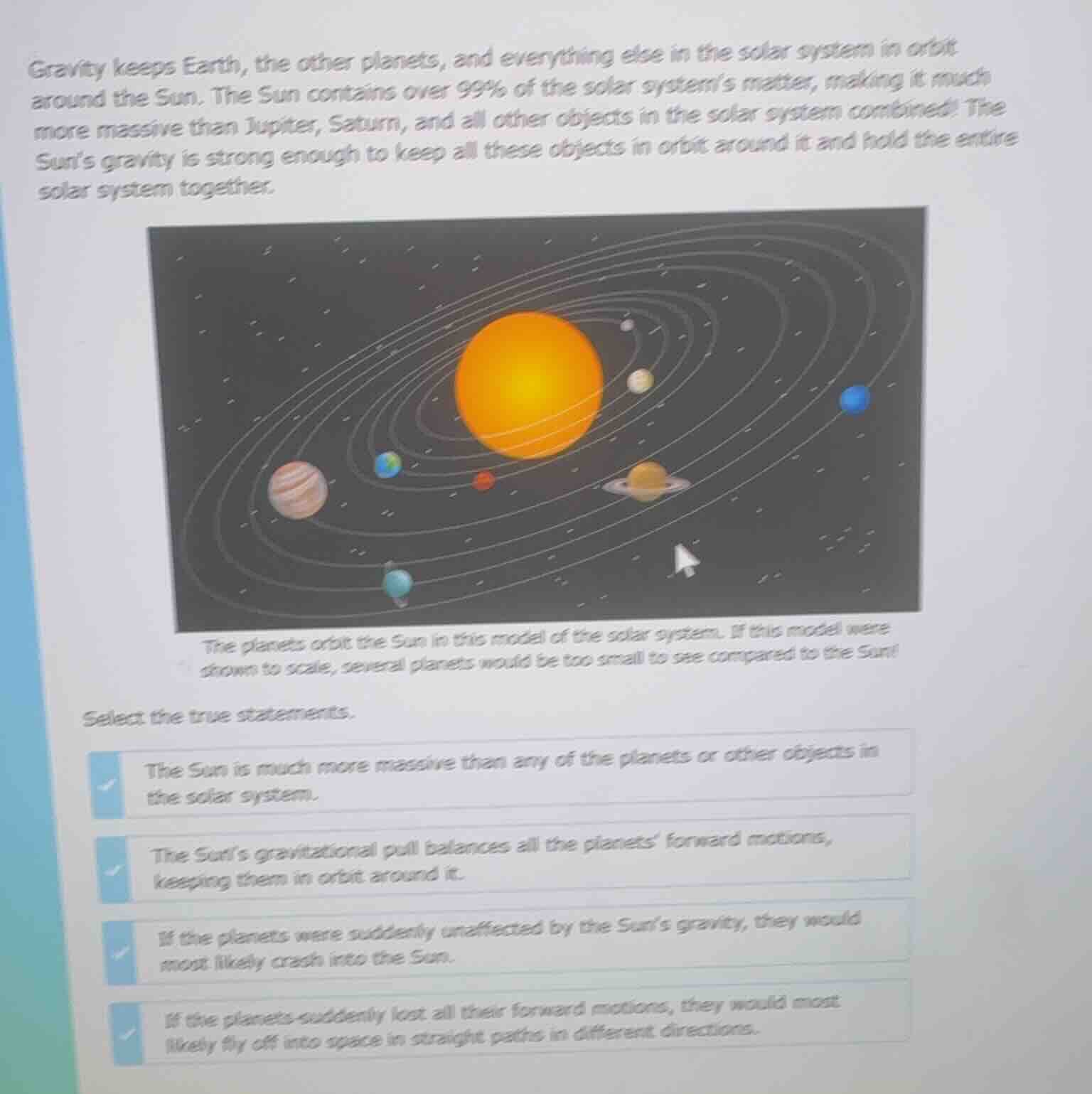
gravity keeps earth, the other planets, and everything else in the solar system in orbit around the sun. the sun contains over 99% of the solar system’s matter, making it much more massive than jupiter, saturn, and all other objects in the solar system combined! the sun’s gravity is strong enough to keep all these objects in orbit around it and hold the entire solar system together.
the planets orbit the sun in this model of the solar system. if this model were shown to scale, several planets would be too small to see compared to the sun!
select the true statements.
- the sun is much more massive than any of the planets or other objects in the solar system.
- the sun’s gravitational pull balances all the planets’ forward motions, keeping them in orbit around it.
- if the planets were suddenly unaffected by the sun’s gravity, they would most likely crash into the sun.
- if the planets suddenly lost all their forward motions, they would most likely fly off into space in straight paths in different directions.
Brief Explanations
- The text states the Sun has over 99% of the solar system's matter, so it is far more massive than any single object or combination of other objects.
- Orbit is the result of the Sun's gravitational pull balancing the planets' inertial forward motion, keeping them in a curved path around the Sun.
- If the Sun's gravity stopped acting on planets, their forward inertia would make them fly off in straight paths, not crash into the Sun.
- If planets lost their forward motion, the Sun's unbalanced gravity would pull them directly toward the Sun, not make them fly off into space.

Snap & solve any problem in the app
Get step-by-step solutions on Sovi AI
Photo-based solutions with guided steps
Explore more problems and detailed explanations
- A. The Sun is much more massive than any of the planets or other objects in the solar system.
- B. The Sun's gravitational pull balances all the planets' forward motions, keeping them in orbit around it.