QUESTION IMAGE
Question
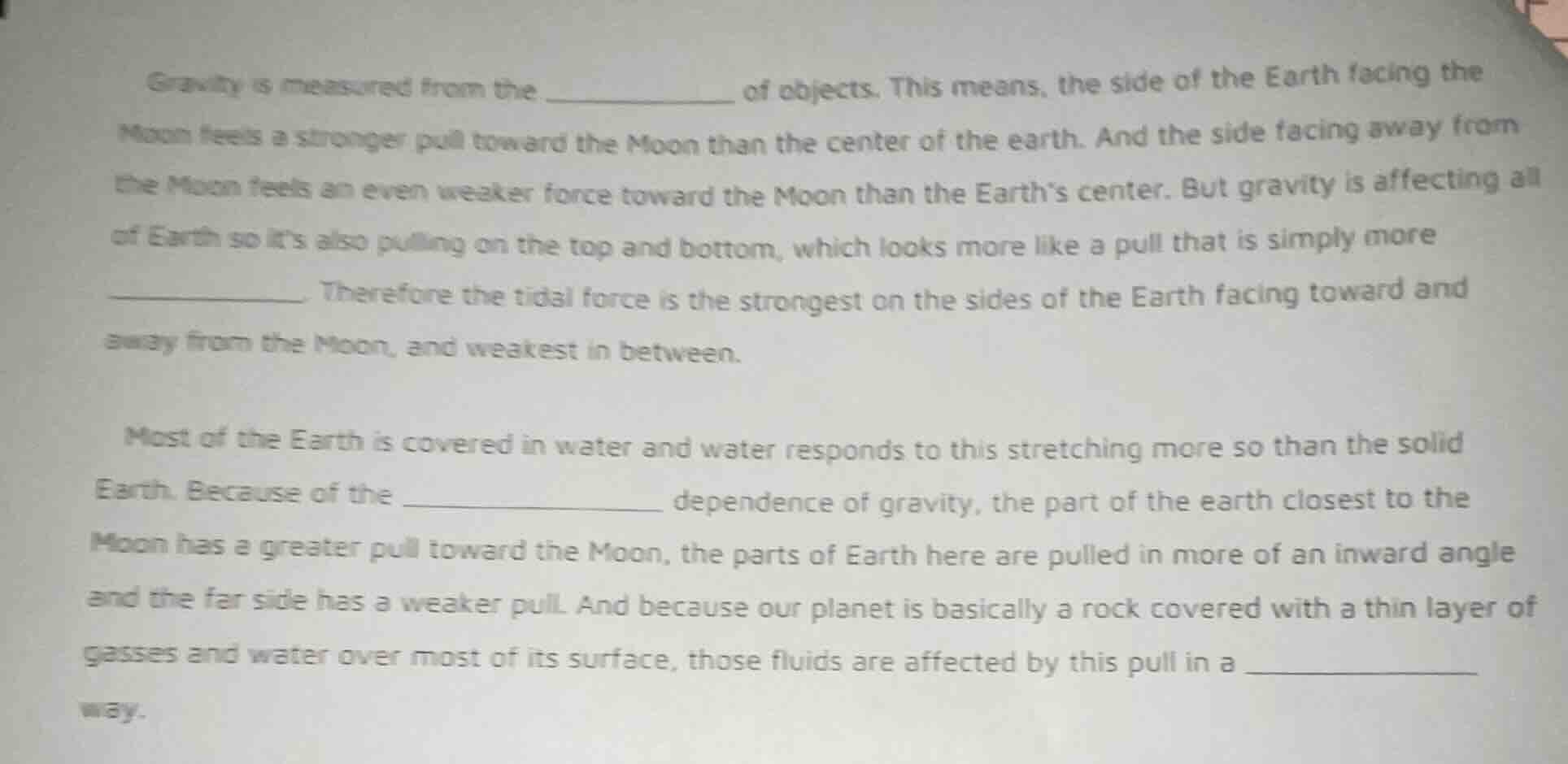
gravity is measured from the ________ of objects. this means, the side of the earth facing the moon feels a stronger pull toward the moon than the center of the earth. and the side facing away from the moon feels an even weaker force toward the moon than the earth’s center. but gravity is affecting all of earth so it’s also pulling on the top and bottom, which looks more like a pull that is simply more ________. therefore the tidal force is the strongest on the sides of the earth facing toward and away from the moon, and weakest in between.
most of the earth is covered in water and water responds to this stretching more so than the solid earth. because of the _____________ dependence of gravity, the part of the earth closest to the moon has a greater pull toward the moon, the parts of earth here are pulled in more of an inward angle and the far side has a weaker pull. and because our planet is basically a rock covered with a thin layer of gasses and water over most of its surface, those fluids are affected by this pull in a _____________ way.
- Gravity's strength is calculated relative to the center of mass of objects, which explains the differential pull on Earth's sides relative to the Moon.
- The uneven gravitational pull creates a stretching effect across the Earth, leading to tidal forces.
- Gravitational force follows an inverse square law, meaning it weakens with the square of distance from the source.
- Fluids like water respond to the uneven gravitational pull in a predictable, outward-bulging way, creating tides.

Snap & solve any problem in the app
Get step-by-step solutions on Sovi AI
Photo-based solutions with guided steps
Explore more problems and detailed explanations
- center
- intense on the sides
- inverse square
- predictable (or "bulging")