QUESTION IMAGE
Question
great depression 11 - minutes breakdown | wayground
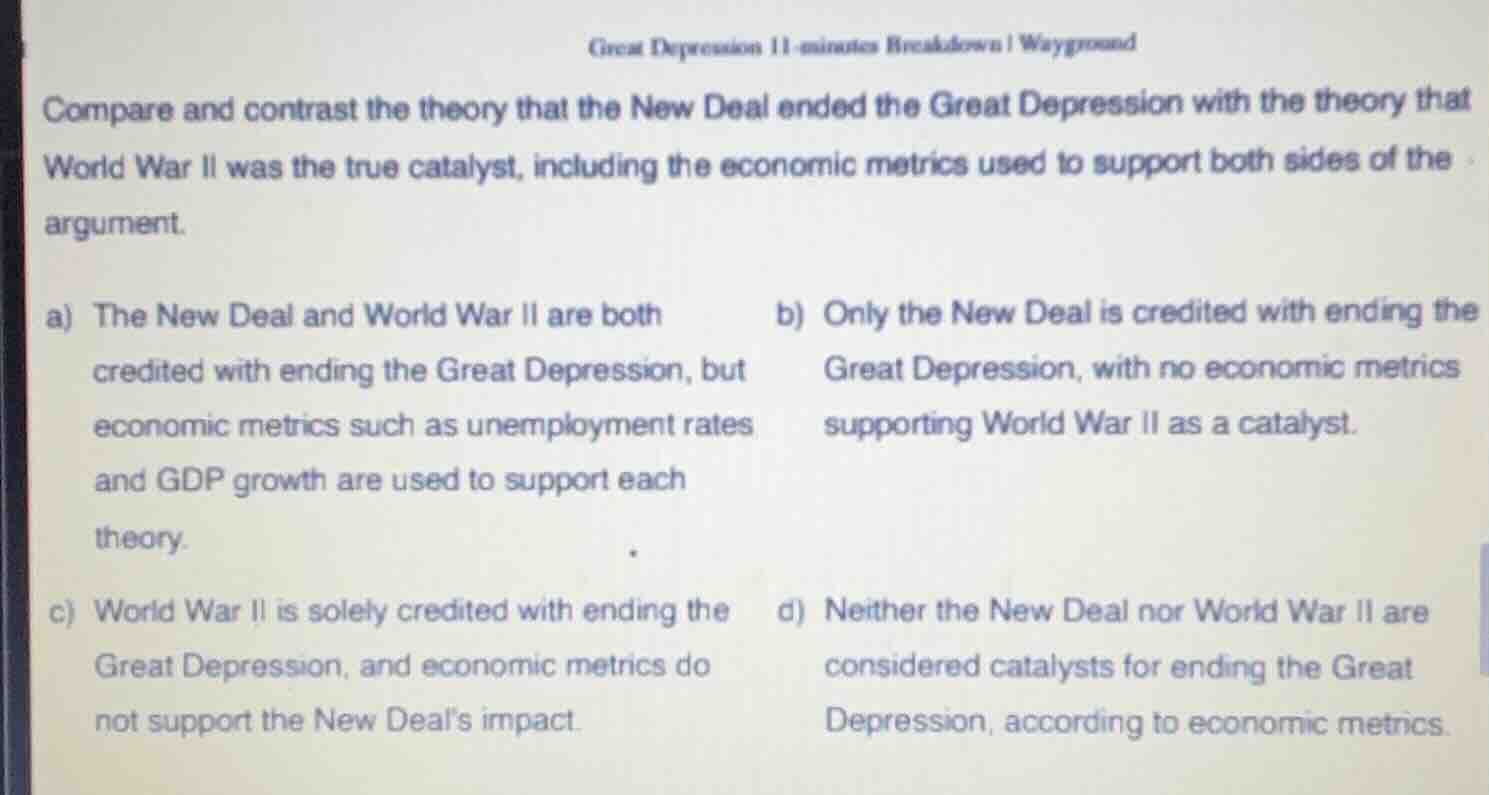
compare and contrast the theory that the new deal ended the great depression with the theory that world war ii was the true catalyst, including the economic metrics used to support both sides of the argument.
a) the new deal and world war ii are both credited with ending the great depression, but economic metrics such as unemployment rates and gdp growth are used to support each theory.
b) only the new deal is credited with ending the great depression, with no economic metrics supporting world war ii as a catalyst.
c) world war ii is solely credited with ending the great depression, and economic metrics do not support the new deal’s impact.
d) neither the new deal nor world war ii are considered catalysts for ending the great depression, according to economic metrics.
To solve this, we analyze each option:
- Option a: Both the New Deal and WWII are debated as catalysts for ending the Great Depression. Economic metrics like unemployment rates (e.g., New Deal programs aimed at job creation, WWII - related industrial expansion reducing unemployment) and GDP growth (New Deal's public works boosting GDP, WWII - driven production increasing GDP) are used to support each theory. This aligns with the question's request to compare the two theories and their supporting metrics.
- Option b: WWII had significant economic impacts (e.g., industrial mobilization, job creation) with metrics to support it, so this is incorrect.
- Option c: The New Deal did have economic impacts (e.g., relief, recovery programs) with supporting metrics, so saying metrics don't support it is wrong.
- Option d: Both had impacts on the economy during the Great Depression era, so this is incorrect.

Snap & solve any problem in the app
Get step-by-step solutions on Sovi AI
Photo-based solutions with guided steps
Explore more problems and detailed explanations
a) The New Deal and World War II are both credited with ending the Great Depression, but economic metrics such as unemployment rates and GDP growth are used to support each theory.