QUESTION IMAGE
Question
f(x) has a greater aroc than g(x) \square
g(x) has a greater aroc than f(x) \boxtimes
\underline{\hspace{\textwidth}}
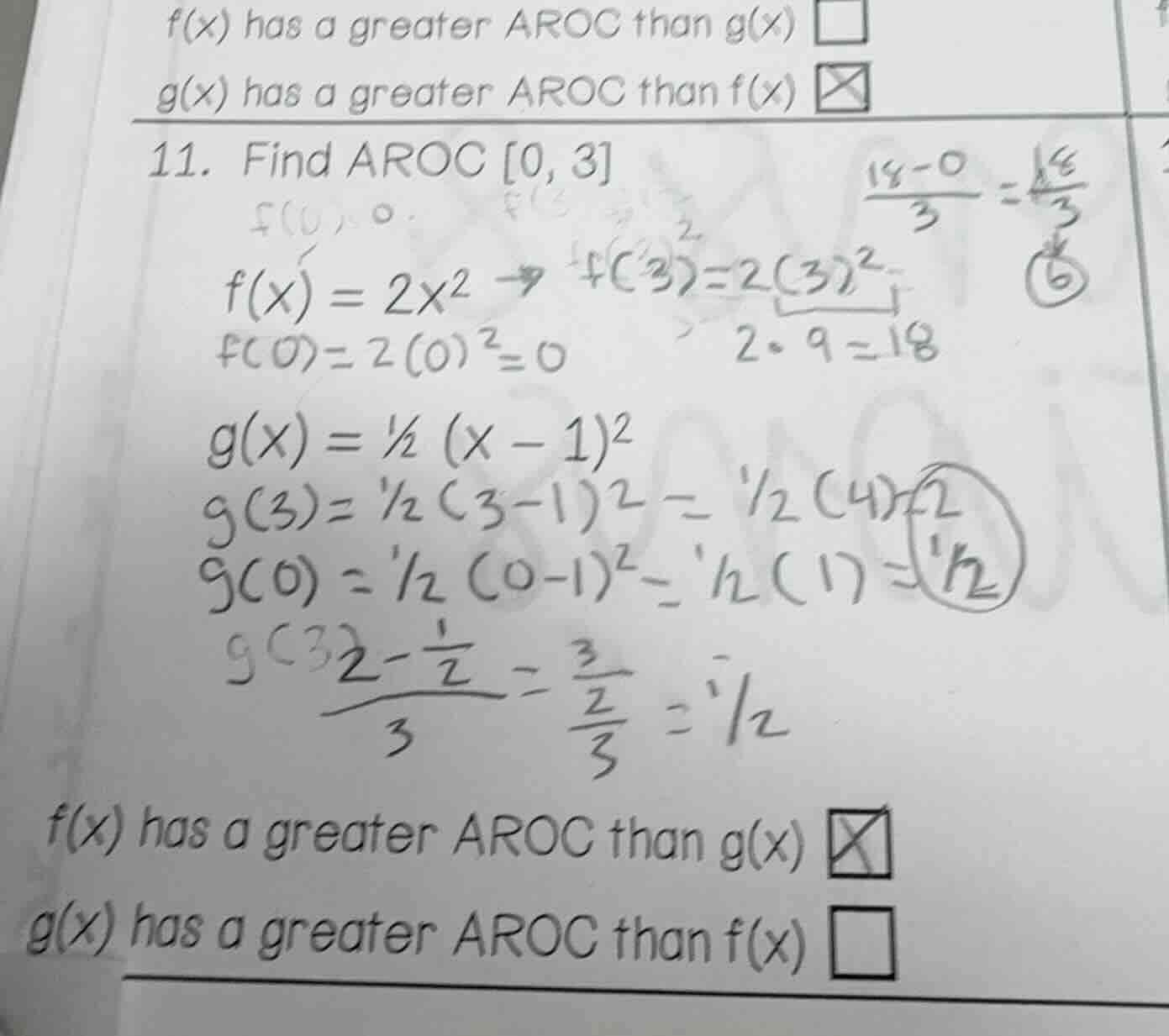
- find aroc 0, 3
f(x) = 2x^2 \to f(3)=2(3)^2
f(0)=2(0)^2=0 \hspace{2cm} 2\cdot 9 = 18
\frac{18 - 0}{3} = \frac{18}{3} = 6
g(x) = \frac{1}{2}(x - 1)^2
g(3)=\frac{1}{2}(3 - 1)^2 = \frac{1}{2}(4)=2
g(0)=\frac{1}{2}(0 - 1)^2 = \frac{1}{2}(1)=\frac{1}{2}
\frac{2 - \frac{1}{2}}{3} = \frac{\frac{3}{2}}{3} = \frac{1}{2}
f(x) has a greater aroc than g(x) \boxtimes
g(x) has a greater aroc than f(x) \square
\underline{\hspace{\textwidth}}
Step1: Recall AROC formula
The Average Rate of Change (AROC) of a function $h(x)$ on $[a,b]$ is $\frac{h(b)-h(a)}{b-a}$.
Step2: Calculate AROC for $f(x)$
First, find $f(3)$ and $f(0)$:
$f(3)=2(3)^2=18$, $f(0)=2(0)^2=0$
AROC of $f(x)$: $\frac{f(3)-f(0)}{3-0}=\frac{18-0}{3}=6$
Step3: Calculate AROC for $g(x)$
First, find $g(3)$ and $g(0)$:
$g(3)=\frac{1}{2}(3-1)^2=\frac{1}{2}(4)=2$, $g(0)=\frac{1}{2}(0-1)^2=\frac{1}{2}(1)=\frac{1}{2}$
AROC of $g(x)$: $\frac{g(3)-g(0)}{3-0}=\frac{2-\frac{1}{2}}{3}=\frac{\frac{3}{2}}{3}=\frac{1}{2}$
Step4: Compare the two AROCs
$6 > \frac{1}{2}$, so $f(x)$ has a greater AROC.

Snap & solve any problem in the app
Get step-by-step solutions on Sovi AI
Photo-based solutions with guided steps
Explore more problems and detailed explanations
AROC of $f(x)$ on $[0,3]$ is $6$, AROC of $g(x)$ on $[0,3]$ is $\frac{1}{2}$.
$f(x)$ has a greater AROC than $g(x)$