QUESTION IMAGE
Question
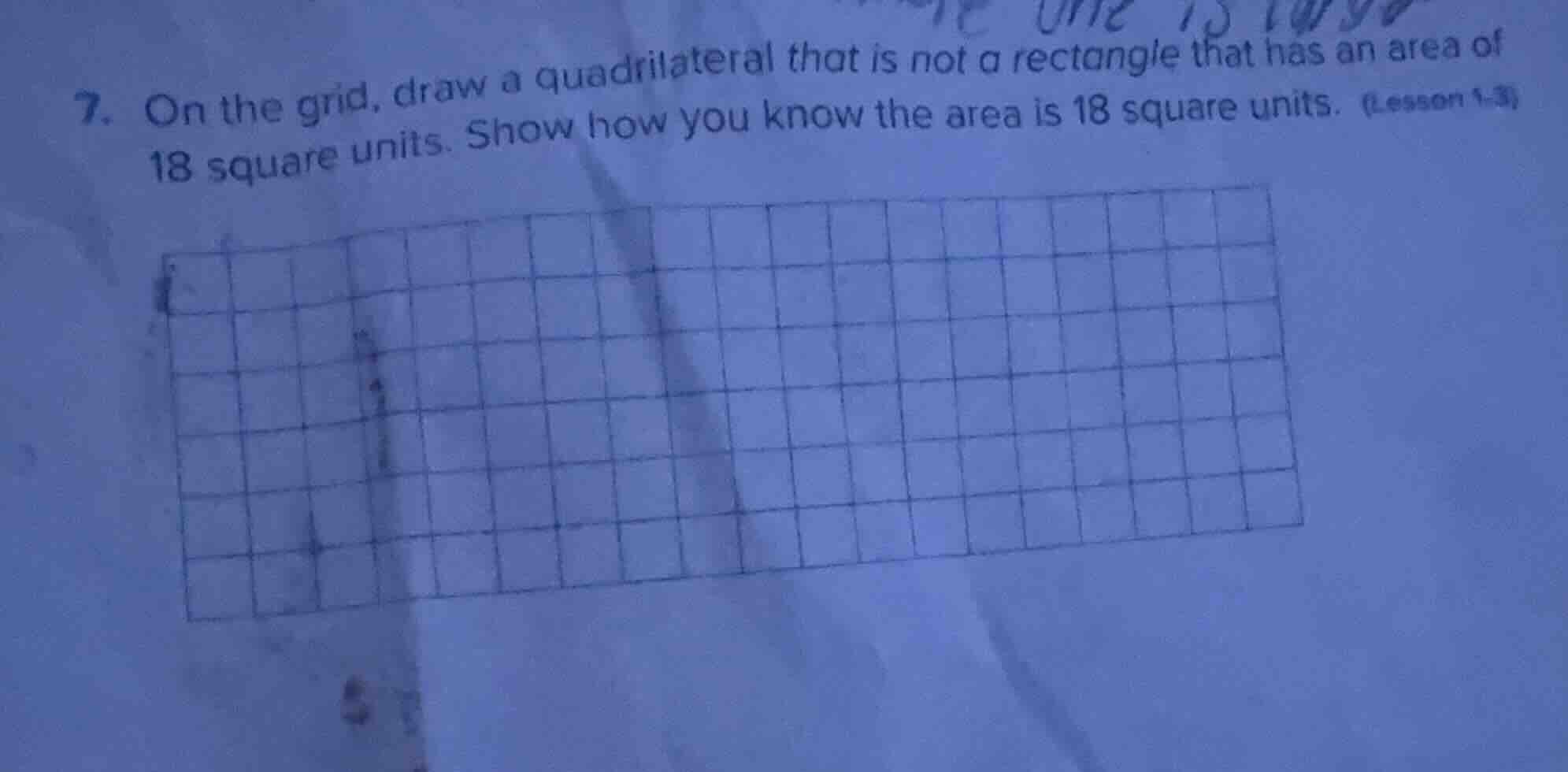
- on the grid, draw a quadrilateral that is not a rectangle that has an area of 18 square units. show how you know the area is 18 square units. (lesson 1-3)
Step1: Choose a quadrilateral type (e.g., parallelogram)
Let's pick a parallelogram. The formula for the area of a parallelogram is $A = base \times height$.
Step2: Select base and height values
Let's take base = 6 units and height = 3 units (since $6 \times 3 = 18$).
Step3: Draw the parallelogram on the grid
On the grid, plot a base of 6 grid squares (along the horizontal) and a height of 3 grid squares (vertical distance between the two parallel sides). Connect the vertices to form the parallelogram.
Step4: Verify the area
Using the formula for the area of a parallelogram, $A = base \times height$. Substituting base = 6 and height = 3, we get $A = 6 \times 3 = 18$ square units. Alternatively, we can count the number of unit squares covered by the parallelogram (by using the grid to ensure the base and height correspond to the grid units) to confirm the area is 18.

Snap & solve any problem in the app
Get step-by-step solutions on Sovi AI
Photo-based solutions with guided steps
Explore more problems and detailed explanations
A possible quadrilateral is a parallelogram with base 6 units and height 3 units (drawn on the grid as described). The area is 18 square units because using the formula for the area of a parallelogram ($A = base \times height$) with base = 6 and height = 3 gives $6 \times 3 = 18$ square units.