QUESTION IMAGE
Question
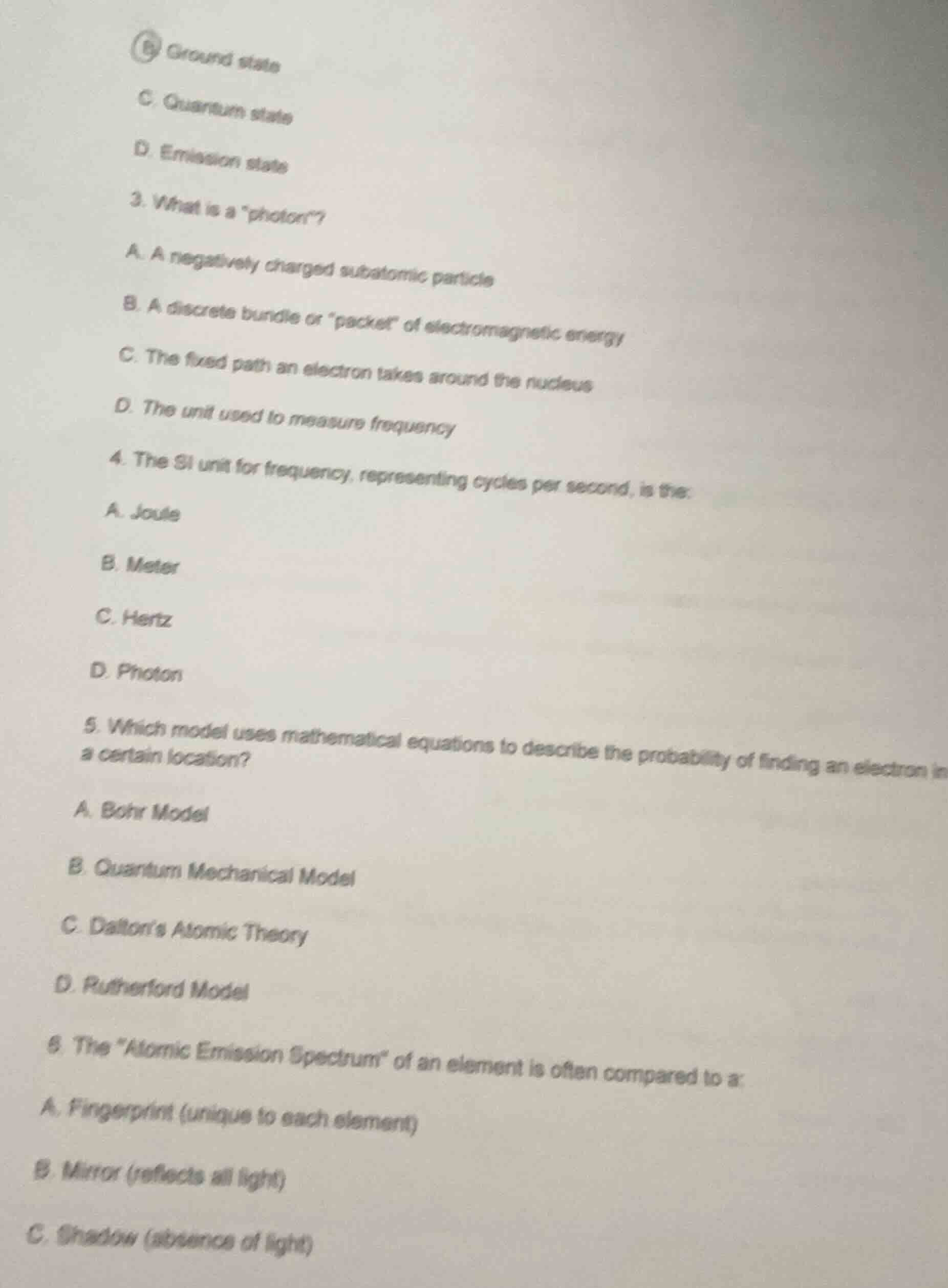
(b) ground state
c. quantum state
d. emission state
- what is a \photon\?
a. a negatively charged subatomic particle
b. a discrete bundle or \packet\ of electromagnetic energy
c. the fixed path an electron takes around the nucleus
d. the unit used to measure frequency
- the si unit for frequency, representing cycles per second, is the:
a. joule
b. meter
c. hertz
d. photon
- which model uses mathematical equations to describe the probability of finding an electron in a certain location?
a. bohr model
b. quantum mechanical model
c. dalton’s atomic theory
d. rutherford model
- the \atomic emission spectrum\ of an element is often compared to a:
a. fingerprint (unique to each element)
b. mirror (reflects all light)
c. shadow (absence of light)
Brief Explanations
- A photon is defined as a discrete packet of electromagnetic energy. Option A describes an electron, option C is a Bohr model electron path, option D is incorrect as frequency is measured in hertz.
- The SI unit for frequency (cycles per second) is the hertz. Joule is for energy, meter for length, and photon is a light particle, not a unit.
- The Quantum Mechanical Model uses mathematical equations (wave functions) to calculate the probability of finding an electron in a region. The Bohr model uses fixed orbits, Dalton's theory is about indivisible atoms, and Rutherford's model describes a nuclear atom without probability equations.
- Each element has a unique atomic emission spectrum, so it is compared to a fingerprint, which is unique to each individual. Mirrors and shadows do not match this unique identifying property.

Snap & solve any problem in the app
Get step-by-step solutions on Sovi AI
Photo-based solutions with guided steps
Explore more problems and detailed explanations
- B. A discrete bundle or "packet" of electromagnetic energy
- C. Hertz
- B. Quantum Mechanical Model
- A. Fingerprint (unique to each element)