QUESTION IMAGE
Question
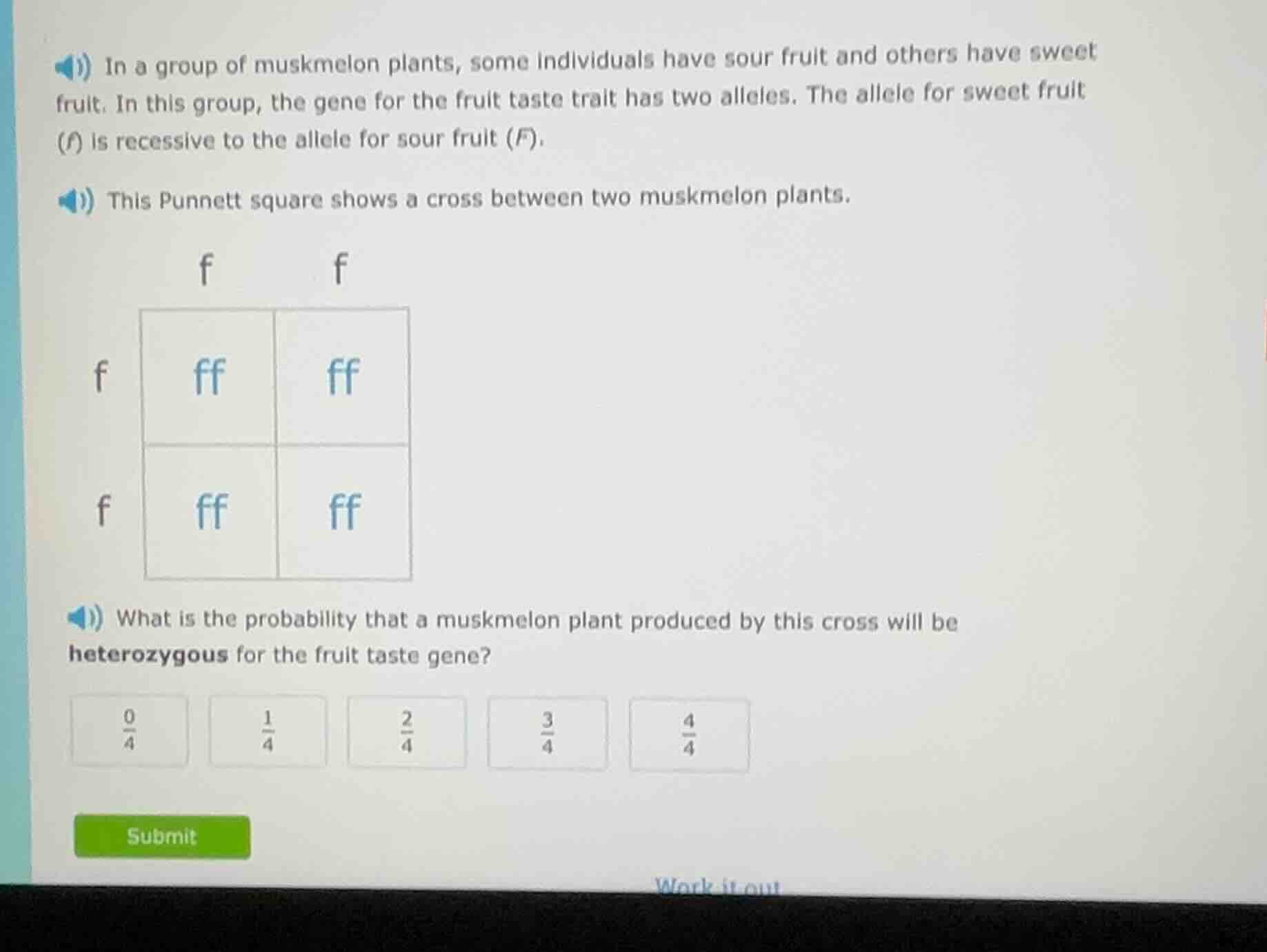
in a group of muskmelon plants, some individuals have sour fruit and others have sweet fruit. in this group, the gene for the fruit taste trait has two alleles. the allele for sweet fruit (f) is recessive to the allele for sour fruit (f). this punnett square shows a cross between two muskmelon plants. punnett square with f, f on top and f, f on side, all boxes ff what is the probability that a muskmelon plant produced by this cross will be heterozygous for the fruit taste gene? options: 0/4, 1/4, 2/4, 3/4, 4/4
Step1: Understand Heterozygous Definition
Heterozygous means having two different alleles (e.g., \(Ff\)). Here, the Punnett square shows all offspring as \(ff\) (homozygous recessive).
Step2: Count Heterozygous Offspring
In the Punnett square, all 4 boxes are \(ff\). So the number of heterozygous (\(Ff\)) offspring is 0.
Step3: Calculate Probability
Probability = \(\frac{\text{Number of heterozygous offspring}}{\text{Total offspring}}=\frac{0}{4}\).

Snap & solve any problem in the app
Get step-by-step solutions on Sovi AI
Photo-based solutions with guided steps
Explore more problems and detailed explanations
\(\frac{0}{4}\) (or 0 when simplified, but in the given options, it's \(\frac{0}{4}\))