QUESTION IMAGE
Question
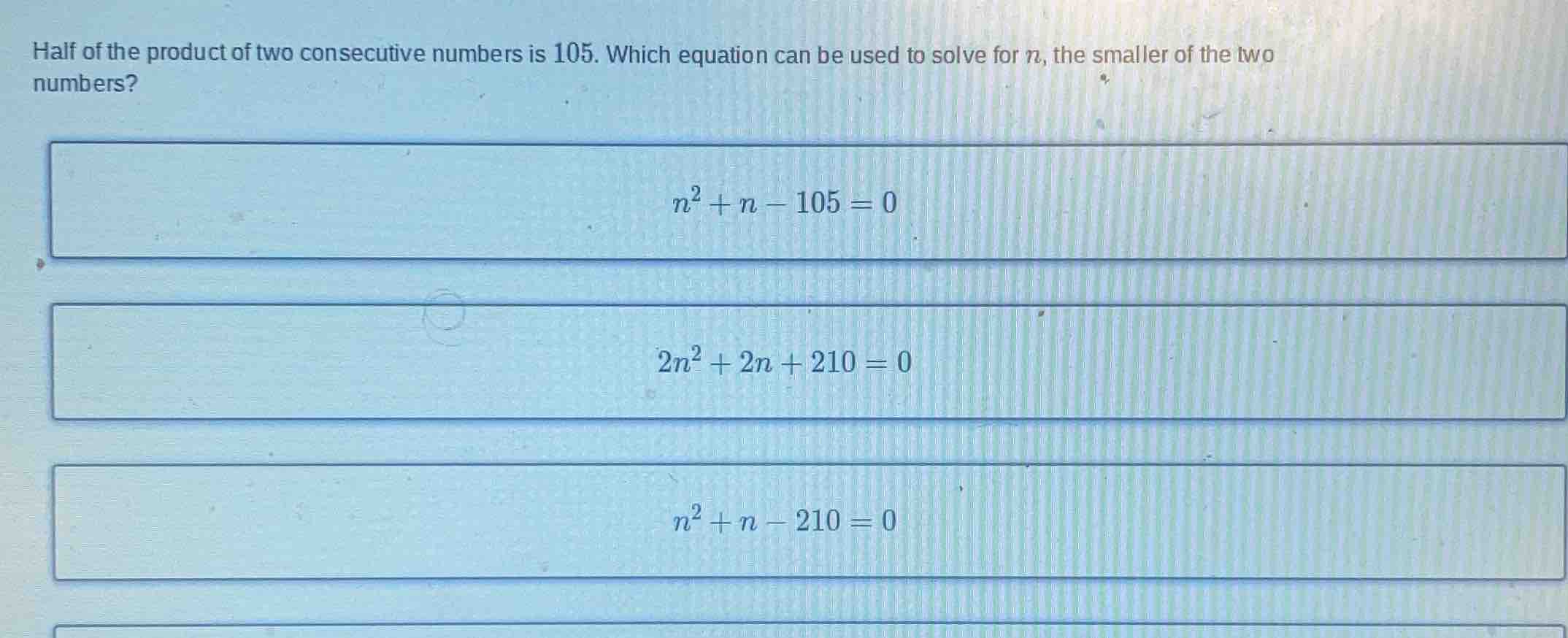
half of the product of two consecutive numbers is 105. which equation can be used to solve for n, the smaller of the two numbers?\\(n^2 + n - 105 = 0\\)\\(2n^2 + 2n + 210 = 0\\)\\(n^2 + n - 210 = 0\\)
Step1: Define consecutive numbers
Let the smaller number be \( n \), then the next consecutive number is \( n + 1 \).
Step2: Write the product of the two numbers
The product of the two consecutive numbers is \( n(n + 1) \).
Step3: Use the given condition "half of the product is 105"
Half of the product is \( \frac{1}{2}n(n + 1) \), and this is equal to 105. So we have the equation:
\[
\frac{1}{2}n(n + 1)=105
\]
Step4: Multiply both sides by 2 to eliminate the fraction
Multiplying both sides by 2 gives:
\[
n(n + 1)=210
\]
Step5: Expand the left - hand side
Expanding \( n(n + 1) \) using the distributive property \( a(b + c)=ab+ac \) (here \( a = n \), \( b=n \), \( c = 1 \)) gives \( n^{2}+n \). So the equation becomes:
\[
n^{2}+n = 210
\]
Step6: Rearrange the equation to standard quadratic form
Subtract 210 from both sides to get the quadratic equation in standard form \( ax^{2}+bx + c = 0 \) (where \( a = 1 \), \( b = 1 \), \( c=-210 \)):
\[
n^{2}+n - 210=0
\]

Snap & solve any problem in the app
Get step-by-step solutions on Sovi AI
Photo-based solutions with guided steps
Explore more problems and detailed explanations
\( n^{2}+n - 210 = 0 \) (the third option in the given choices)