QUESTION IMAGE
Question
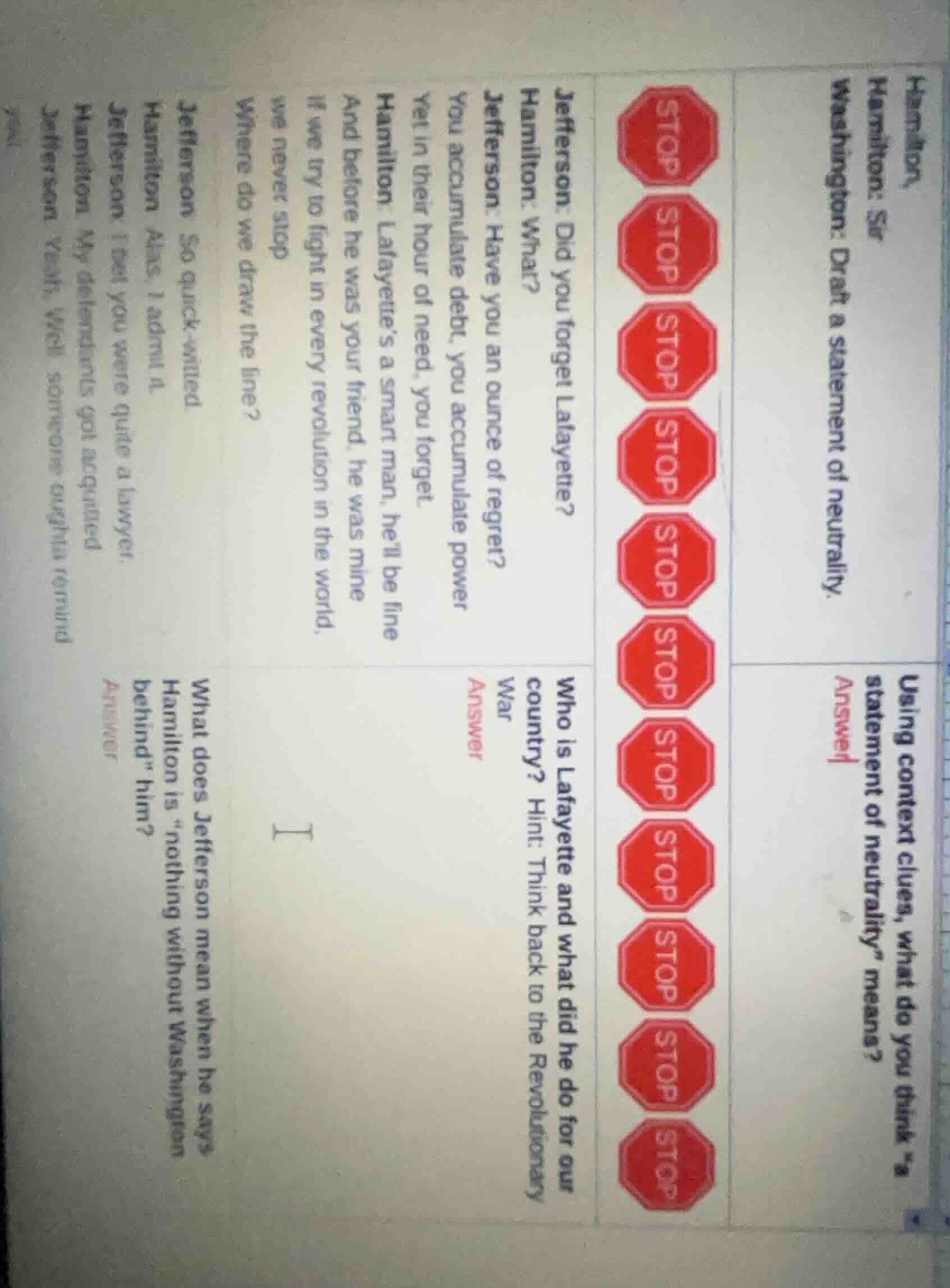
hamilton
hamilton: sir
washington: draft a statement of neutrality.
using context clues, what do you think “a statement of neutrality” means?
answer
jefferson: did you forget lafayette?
hamilton: what?
jefferson: have you an ounce of regret?
you accumulate debt, you accumulate power
yet in their hour of need, you forget.
hamilton: lafayette’s a smart man, he’ll be fine
and before he was your friend, he was mine
if we try to fight in every revolution in the world,
we never stop
where do we draw the line?
jefferson: so quick-willed
hamilton: alas, i admit it.
jefferson: i bet you were quite a lawyer.
hamilton: my defendants got acquitted
jefferson: yeah, well, someone oughta remind
who is lafayette and what did he do for our country? hint: think back to the revolutionary war
answer
what does jefferson mean when he says hamilton is “nothing without washington behind” him?
answer
1. Question: Using context clues, what do you think "a statement of neutrality" means?
The text involves historical figures (Hamilton, Washington) and the mention of "neutrality" in a historical context (likely around the Revolutionary War or early US foreign policy). A statement of neutrality would be a formal declaration that a country (here, the US) will not take sides in a conflict (like a war between other nations), remaining impartial and not participating in hostilities or aligning with either side. Context clues like Washington’s role and the historical period support this, as Washington’s Proclamation of Neutrality (1793) was to stay out of the war between France and Britain.
Lafayette (Marquis de Lafayette) was a French nobleman who fought alongside the American colonists during the Revolutionary War. He provided military leadership, strategic support, and helped secure French aid for the American cause. He was a key ally, serving under Washington, participating in battles, and using his influence in France to gain French troops, supplies, and naval support, which was crucial for the American victory (e.g., at Yorktown).
Jefferson’s statement implies that Hamilton’s influence, power, or success was heavily dependent on Washington’s support. Washington was a respected leader (Commander-in-Chief, first President), so Hamilton (as a political and financial figure) benefited from Washington’s approval, authority, and backing. Without Washington’s endorsement (or the power/legitimacy Washington provided), Hamilton’s initiatives (like financial plans, political influence) would have been weaker or less successful, as Washington’s prestige lent credibility to Hamilton’s work.

Snap & solve any problem in the app
Get step-by-step solutions on Sovi AI
Photo-based solutions with guided steps
Explore more problems and detailed explanations
A statement of neutrality is a formal declaration by a country (or entity) that it will remain impartial and not take sides in a conflict (such as a war), avoiding involvement in hostilities or aligning with any of the opposing parties. In the context of Washington’s time, it likely referred to the US declaring it would not participate in foreign wars (e.g., the conflict between France and Britain) and would stay out of such disputes.