QUESTION IMAGE
Question
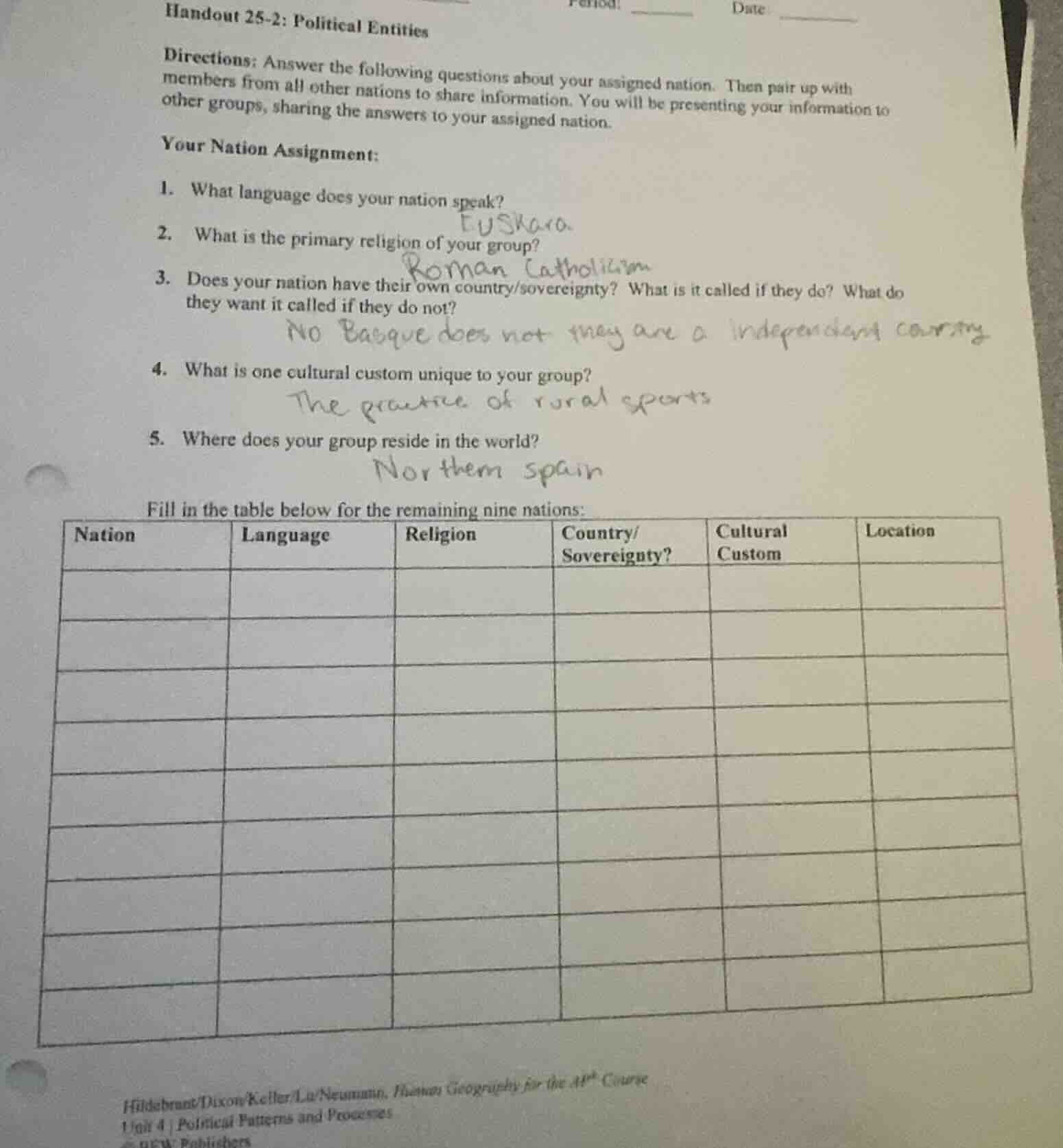
handout 25-2: political entities
directions: answer the following questions about your assigned nation. then pair up with members from all other nations to share information. you will be presenting your information to other groups, sharing the answers to your assigned nation.
your nation assignment:
- what language does your nation speak?
- what is the primary religion of your group?
- does your nation have their own country/sovereignty? what is it called if they do? what do they want it called if they do not?
- what is one cultural custom unique to your group?
- where does your group reside in the world?
fill in the table below for the remaining nine nations:
nation | language | religion | country/sovereignty? | cultural custom | location
hildebrandt/dixon/keller/la/neumann, human geography for the ap® course
unit 4 | political patterns and processes
To answer the questions about the assigned nation (Basque - related, as per the handwritten responses) and fill the table for other nations, we can use the following approach:
For the Assigned Nation (Basque - related, as per the handwritten answers):
- Language: Euskara (Basque language)
- Religion: Roman Catholicism
- Country/Sovereignty?: No (they are part of Spain and France; the handwritten response has a slight error - Basque regions are in northern Spain and southwestern France, not an independent country yet, but there is a movement for Basque autonomy/independence). If we follow the handwritten answer, it says "No Basque does not they are a independent country" (likely a typo, maybe meant "No, Basque does not have their own country; they are part of Spain/France" or the intended was "Yes, they want to be called [name of proposed country, e.g., Euskal Herria] if they do not have it yet").
- Cultural Custom: The practice of rural sports (like stone lifting, wood chopping, etc., which are traditional Basque rural sports)
- Location: Northern Spain (and southwestern France, but the handwritten answer says Northern Spain)
For Filling the Table for Other Nations:
We would need to research other nations (e.g., Kurdish, Tamil, Sikh, etc., which are other nations without full sovereignty or with unique cultural/religious/language aspects) and fill in the details:
| Nation | Language | Religion | Country/Sovereignty? | Cultural Custom | Location |
|---|---|---|---|---|---|
| Tamil | Tamil | Hinduism (majority), Islam, Christianity | Part of India (Tamil Nadu) and Sri Lanka (Northern and Eastern provinces; Sri Lankan Tamils have sought autonomy/independence) | Pongal festival, Bharatanatyam dance | South India, Sri Lanka |
| Sikh | Punjabi (Gurmukhi script) | Sikhism | Part of India (Punjab) | Baisakhi festival, Gatka (Sikh martial art) | North India |
| Catalan | Catalan | Roman Catholicism | Part of Spain (Catalonia); there is a movement for independence | Castells (human towers), La Sardana dance | Northeastern Spain |
| Scottish | Scottish Gaelic, English | Christianity (various denominations) | Part of the UK; there is a movement for independence (Scotland) | Highland games (like caber tossing), bagpipe music | Scotland (UK) |
| Palestinian | Arabic | Islam (Sunni majority), Christianity | No (part of Israel - Palestine conflict; seek statehood as Palestine) | Dabke dance, olive cultivation traditions | Middle East (Israel, West Bank, Gaza) |
| Kashmiri | Kashmiri, Urdu, English | Islam (majority), Hinduism, Sikhism | Part of India and Pakistan (Kashmir region is disputed between India, Pakistan, and China) | Wazwan (traditional Kashmiri feast), Rouf dance | Kashmir (India - Pakistan border region) |
| Baloch | Balochi | Islam (Sunni majority) | Part of Pakistan, Iran, and Afghanistan | Balochi folk music and dance, camel racing | Southwestern Asia (Pakistan, Iran, Afghanistan) |
| Berber (Amazigh) | Berber languages (e.g., Tamazight) | Islam (Sunni majority) | Part of North African countries (Morocco, Algeria, Tunisia, Libya, Egypt) | Traditional Berber music (like Ahwash), carpet weaving | North Africa |
If we were to correct the error in the "Country/Sovereignty?" for the Basque:
- A more accurate answer would be: No, they do not have the…

Snap & solve any problem in the app
Get step-by-step solutions on Sovi AI
Photo-based solutions with guided steps
Explore more problems and detailed explanations
To answer the questions about the assigned nation (Basque - related, as per the handwritten responses) and fill the table for other nations, we can use the following approach:
For the Assigned Nation (Basque - related, as per the handwritten answers):
- Language: Euskara (Basque language)
- Religion: Roman Catholicism
- Country/Sovereignty?: No (they are part of Spain and France; the handwritten response has a slight error - Basque regions are in northern Spain and southwestern France, not an independent country yet, but there is a movement for Basque autonomy/independence). If we follow the handwritten answer, it says "No Basque does not they are a independent country" (likely a typo, maybe meant "No, Basque does not have their own country; they are part of Spain/France" or the intended was "Yes, they want to be called [name of proposed country, e.g., Euskal Herria] if they do not have it yet").
- Cultural Custom: The practice of rural sports (like stone lifting, wood chopping, etc., which are traditional Basque rural sports)
- Location: Northern Spain (and southwestern France, but the handwritten answer says Northern Spain)
For Filling the Table for Other Nations:
We would need to research other nations (e.g., Kurdish, Tamil, Sikh, etc., which are other nations without full sovereignty or with unique cultural/religious/language aspects) and fill in the details:
| Nation | Language | Religion | Country/Sovereignty? | Cultural Custom | Location |
|---|---|---|---|---|---|
| Tamil | Tamil | Hinduism (majority), Islam, Christianity | Part of India (Tamil Nadu) and Sri Lanka (Northern and Eastern provinces; Sri Lankan Tamils have sought autonomy/independence) | Pongal festival, Bharatanatyam dance | South India, Sri Lanka |
| Sikh | Punjabi (Gurmukhi script) | Sikhism | Part of India (Punjab) | Baisakhi festival, Gatka (Sikh martial art) | North India |
| Catalan | Catalan | Roman Catholicism | Part of Spain (Catalonia); there is a movement for independence | Castells (human towers), La Sardana dance | Northeastern Spain |
| Scottish | Scottish Gaelic, English | Christianity (various denominations) | Part of the UK; there is a movement for independence (Scotland) | Highland games (like caber tossing), bagpipe music | Scotland (UK) |
| Palestinian | Arabic | Islam (Sunni majority), Christianity | No (part of Israel - Palestine conflict; seek statehood as Palestine) | Dabke dance, olive cultivation traditions | Middle East (Israel, West Bank, Gaza) |
| Kashmiri | Kashmiri, Urdu, English | Islam (majority), Hinduism, Sikhism | Part of India and Pakistan (Kashmir region is disputed between India, Pakistan, and China) | Wazwan (traditional Kashmiri feast), Rouf dance | Kashmir (India - Pakistan border region) |
| Baloch | Balochi | Islam (Sunni majority) | Part of Pakistan, Iran, and Afghanistan | Balochi folk music and dance, camel racing | Southwestern Asia (Pakistan, Iran, Afghanistan) |
| Berber (Amazigh) | Berber languages (e.g., Tamazight) | Islam (Sunni majority) | Part of North African countries (Morocco, Algeria, Tunisia, Libya, Egypt) | Traditional Berber music (like Ahwash), carpet weaving | North Africa |
If we were to correct the error in the "Country/Sovereignty?" for the Basque:
- A more accurate answer would be: No, they do not have their own sovereign country. They are part of Spain (Basque Country, Navarre) and France (Pays Basque). If they wanted their own country, it would likely be called "Euskal Herria" (Basque Country in Basque).
Final Answers for the Assigned Nation (Based on Handwritten Responses):
- Language: Euskara
- Religion: Roman Catholicism
- Country/Sovereignty?: No (with the note about the typo in the handwritten response)
- Cultural Custom: The practice of rural sports
- Location: Northern Spain
For the table, we can use the above - mentioned examples for other nations to fill in the details as needed.