QUESTION IMAGE
Question
hands - on lab
investigate observe
the structure of a vinyl
record and predict how
it functions.
advantages of digital signals
although they are not continuous signals, digital signals are
more reliable and efficient overall than analog signals, for
several reasons.
compatibility with computers computers process
digital signals, and computers are everywhere—on laps and
desktops, tucked in pockets, in car dashboards, and even on
refrigerator doors. it’s easier for computers and digital devices
to do what we want them to do without having to convert
analog signals first. using digital signals is more efficient.
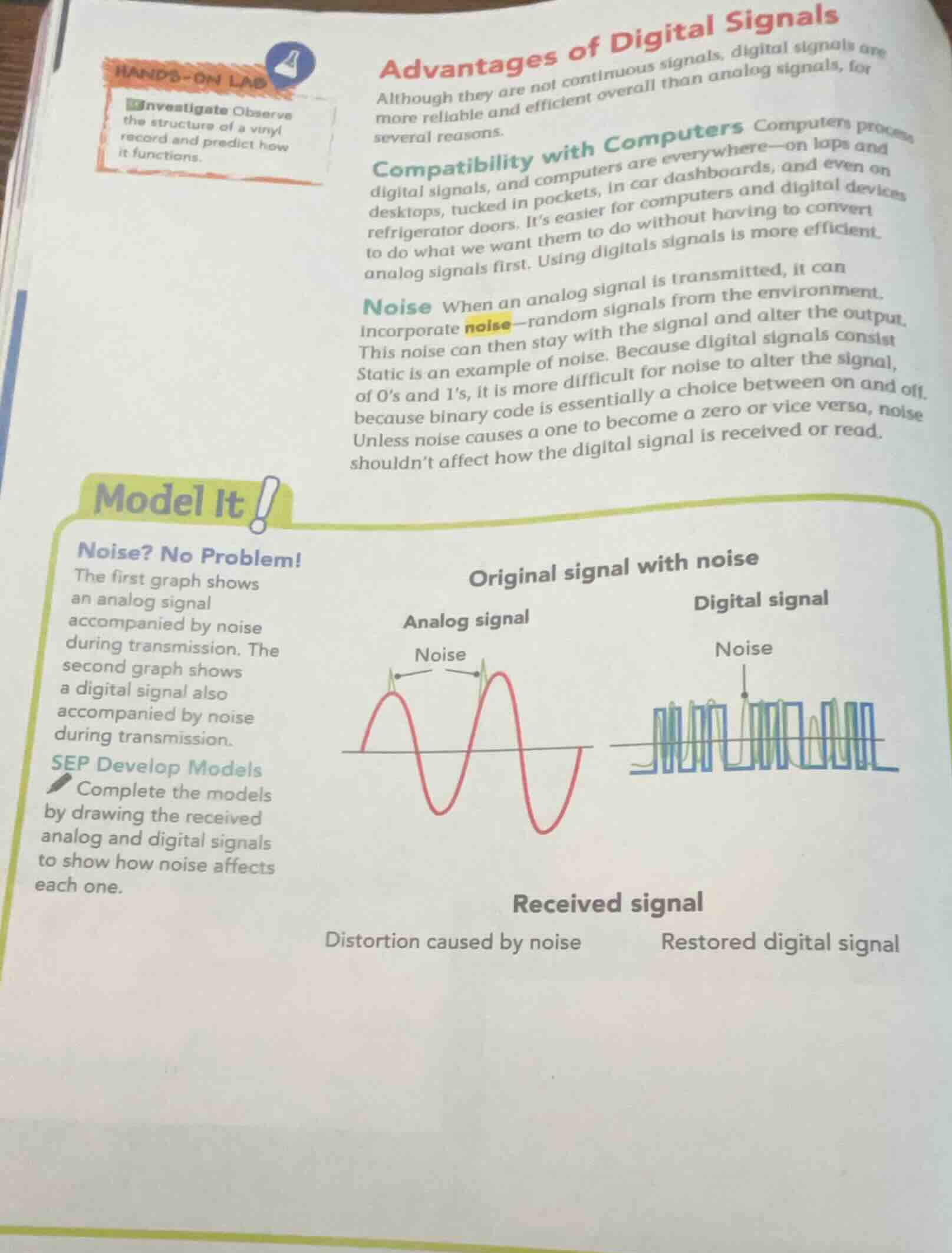
noise when an analog signal is transmitted, it can
incorporate noise—random signals from the environment.
this noise can then stay with the signal and alter the output.
static is an example of noise. because digital signals consist
of 0’s and 1’s, it is more difficult for noise to alter the signal,
because binary code is essentially a choice between on and off.
unless noise causes a one to become a zero or vice versa, noise
shouldn’t affect how the digital signal is received or read.
model it!
noise? no problem!
the first graph shows
an analog signal
accompanied by noise
during transmission. the
second graph shows
a digital signal also
accompanied by noise
during transmission.
sep develop models
complete the models
by drawing the received
analog and digital signals
to show how noise affects
each one.
original signal with noise
analog signal
digital signal
noise
noise
received signal
distortion caused by noise
restored digital signal
- For the received analog signal: Noise becomes integrated into the continuous analog wave, so the received signal is a distorted version of the original wave, retaining the noise-induced irregularities and altered amplitude/shape.
- For the received digital signal: Since digital signals use discrete 0s and 1s, noise that does not flip a bit is filtered out. The received signal is a clean, restored square wave matching the original digital signal's on/off (1/0) pattern, with no visible noise distortion.

Snap & solve any problem in the app
Get step-by-step solutions on Sovi AI
Photo-based solutions with guided steps
Explore more problems and detailed explanations
- Distortion caused by noise (Analog received signal): A wavy signal matching the original analog wave's frequency but with irregular, noisy peaks/valleys (the noise is retained, distorting the original smooth wave shape).
- Restored digital signal: A clean square wave identical to the original digital signal's pattern of high (1) and low (0) states, with all noise removed (no irregular fluctuations from the noise are present).