QUESTION IMAGE
Question
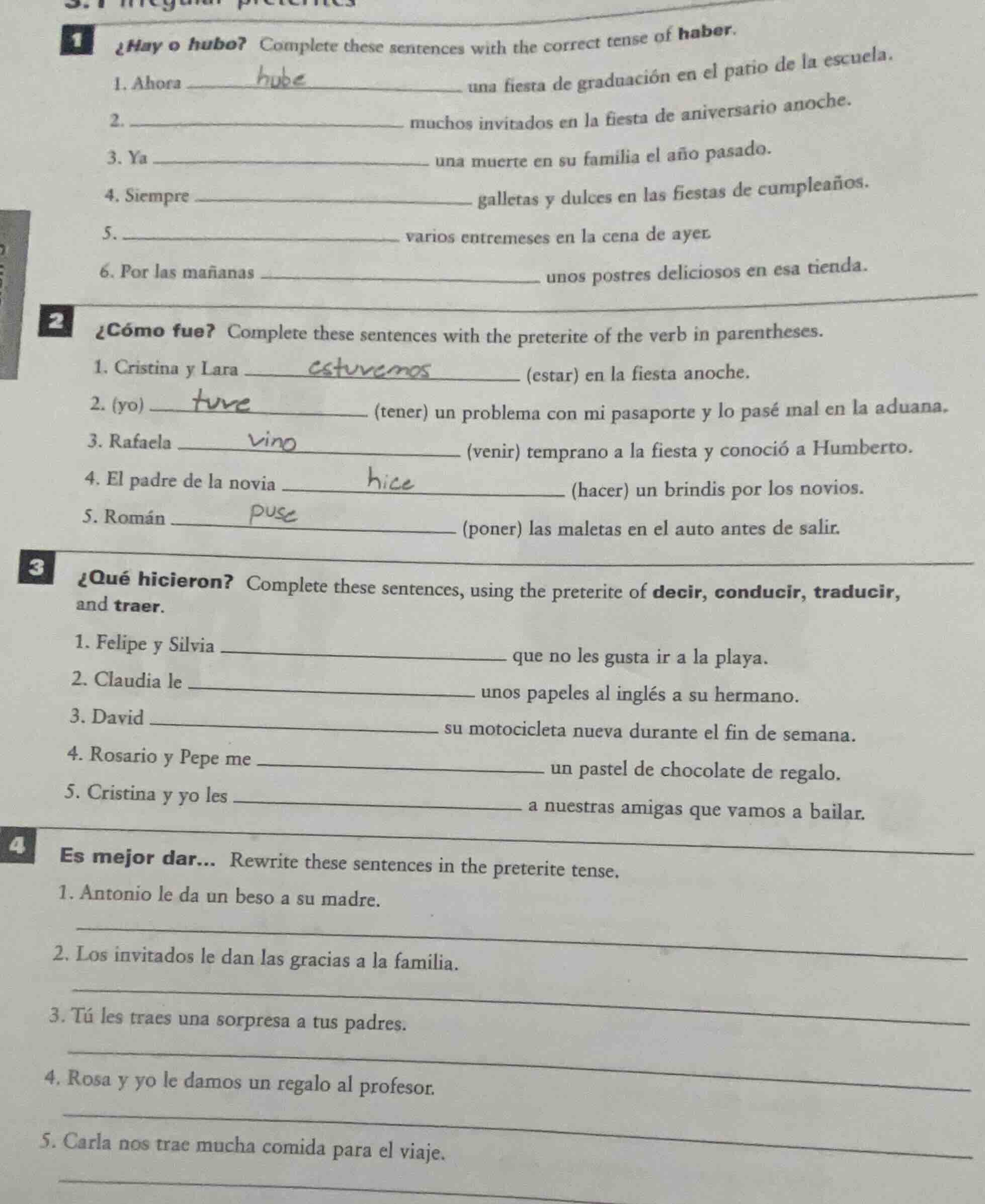
1 ¿hay o hubo? complete these sentences with the correct tense of haber. 1. ahora ____ una fiesta de graduación en el patio de la escuela. 2. __ muchos invitados en la fiesta de aniversario anoche. 3. ya __ una muerte en su familia el año pasado. 4. siempre __ galletas y dulces en las fiestas de cumpleaños. 5. __ varios entremeses en la cena de ayer. 6. por las mañanas __ unos postres deliciosos en esa tienda. 2 ¿cómo fue? complete these sentences with the preterite of the verb in parentheses. 1. cristina y lara __ (estar) en la fiesta anoche. 2. (yo) __ (tener) un problema con mi pasaporte y lo pasé mal en la aduana. 3. rafaela __ (venir) temprano a la fiesta y conoció a humberto. 4. el padre de la novia __ (hacer) un brindis por los novios. 5. román __ (poner) las maletas en el auto antes de salir. 3 ¿qué hicieron? complete these sentences, using the preterite of decir, conducir, traducir, and traer. 1. felipe y silvia __ que no les gusta ir a la playa. 2. claudia le __ unos papeles al inglés a su hermano. 3. david __ su motocicleta nueva durante el fin de semana. 4. rosario y pepe me __ un pastel de chocolate de regalo. 5. cristina y yo les __ a nuestras amigas que vamos a bailar. 4 es mejor dar... rewrite these sentences in the preterite tense. 1. antonio le da un beso a su madre. __ 2. los invitados le dan las gracias a la familia. __ 3. tú les traes una sorpresa a tus padres. __ 4. rosa y yo le damos un regalo al profesor. __ 5. carla nos trae mucha comida para el viaje. ____
Exercise 1: ¿Hay o hubo? (Correcting the tense of haber)
- Step 1: Analyze time and subject
"Ahora" (now) → present tense. Haber for "there is/are" in present is hay.
Expression: $\text{hay}$
- Step 2: Analyze time and subject
"anoche" (last night) → preterite. Haber preterite (3rd person plural) is hubo.
Expression: $\text{Hubo}$
- Step 3: Analyze time and subject
"el año pasado" (last year) → preterite. Haber preterite (3rd person singular) is hubo.
Expression: $\text{hubo}$
- Step 4: Analyze time and subject
"Siempre" (always) → present tense. Haber present is hay.
Expression: $\text{hay}$
- Step 5: Analyze time and subject
"ayer" (yesterday) → preterite. Haber preterite (3rd person plural) is hubo.
Expression: $\text{Hubo}$
- Step 6: Analyze time and subject
"Por las mañanas" (in the mornings) → present tense. Haber present is hay.
Expression: $\text{hay}$
Exercise 2: ¿Cómo fue? (Preterite of verbs)
- *Step 1: Verb estar, preterite for "Cristina y Lara" (plural)*
Preterite of estar (3rd person plural) is estuvieron.
Expression: $\text{estuvieron}$
- *Step 2: Verb tener, preterite for "yo" (1st person singular)*
Preterite of tener (1st person singular) is tuve.
Expression: $\text{tuve}$
- *Step 3: Verb venir, preterite for "Rafaela" (3rd person singular)*
Preterite of venir (3rd person singular) is vino.
Expression: $\text{vino}$
- *Step 4: Verb hacer, preterite for "El padre" (3rd person singular)*
Preterite of hacer (3rd person singular) is hizo.
Expression: $\text{hizo}$
- *Step 5: Verb poner, preterite for "Román" (3rd person singular)*
Preterite of poner (3rd person singular) is puso.
Expression: $\text{puso}$
Exercise 3: ¿Qué hicieron? (Preterite of decir, conducir, traducir, traer)
- *Step 1: Verb decir, preterite for "Felipe y Silvia" (plural)*
Preterite of decir (3rd person plural) is dijeron.
Expression: $\text{dijeron}$
- *Step 2: Verb traducir, preterite for "Claudia" (3rd person singular)*
Preterite of traducir (3rd person singular) is tradujo.
Expression: $\text{tradujo}$
- *Step 3: Verb conducir, preterite for "David" (3rd person singular)*
Preterite of conducir (3rd person singular) is condujo.
Expression: $\text{condujo}$
- *Step 4: Verb traer, preterite for "Rosario y Pepe" (plural)*
Preterite of traer (3rd person plural) is trajeron.
Expression: $\text{trajeron}$
- *Step 5: Verb decir, preterite for "Cristina y yo" (plural, 1st person inclusive)*
Preterite of decir (1st person plural) is dijimos.
Expression: $\text{dijimos}$
Exercise 4: Es mejor dar… (Rewrite in preterite)
- *Step 1: Verb dar, preterite for "Antonio" (3rd person singular)*
Preterite of dar (3rd person singular) is dio.
Sentence: $\text{Antonio le dio un beso a su madre.}$
- *Step 2: Verb dar, preterite for "Los invitados" (3rd person plural)*
Preterite of dar (3rd person plural) is dieron.
Sentence: $\text{Los invitados le dieron las gracias a la familia.}$
- *Step 3: Verb traer, preterite for "Tú" (2nd person singular)*
Preterite of traer (2nd person singular) is trajiste.
Sentence: $\text{Tú les trajiste una sorpresa a tus padres.}$
- *Step 4: Verb dar, preterite for "Rosa y yo" (1st person plural)*
Preterite of dar (1st person plural) is dimos.
Sentence: $\text{Rosa y yo le dimos un regalo al profesor.}$…

Snap & solve any problem in the app
Get step-by-step solutions on Sovi AI
Photo-based solutions with guided steps
Explore more problems and detailed explanations
Exercise 1: ¿Hay o hubo? (Correcting the tense of haber)
- Step 1: Analyze time and subject
"Ahora" (now) → present tense. Haber for "there is/are" in present is hay.
Expression: $\text{hay}$
- Step 2: Analyze time and subject
"anoche" (last night) → preterite. Haber preterite (3rd person plural) is hubo.
Expression: $\text{Hubo}$
- Step 3: Analyze time and subject
"el año pasado" (last year) → preterite. Haber preterite (3rd person singular) is hubo.
Expression: $\text{hubo}$
- Step 4: Analyze time and subject
"Siempre" (always) → present tense. Haber present is hay.
Expression: $\text{hay}$
- Step 5: Analyze time and subject
"ayer" (yesterday) → preterite. Haber preterite (3rd person plural) is hubo.
Expression: $\text{Hubo}$
- Step 6: Analyze time and subject
"Por las mañanas" (in the mornings) → present tense. Haber present is hay.
Expression: $\text{hay}$
Exercise 2: ¿Cómo fue? (Preterite of verbs)
- *Step 1: Verb estar, preterite for "Cristina y Lara" (plural)*
Preterite of estar (3rd person plural) is estuvieron.
Expression: $\text{estuvieron}$
- *Step 2: Verb tener, preterite for "yo" (1st person singular)*
Preterite of tener (1st person singular) is tuve.
Expression: $\text{tuve}$
- *Step 3: Verb venir, preterite for "Rafaela" (3rd person singular)*
Preterite of venir (3rd person singular) is vino.
Expression: $\text{vino}$
- *Step 4: Verb hacer, preterite for "El padre" (3rd person singular)*
Preterite of hacer (3rd person singular) is hizo.
Expression: $\text{hizo}$
- *Step 5: Verb poner, preterite for "Román" (3rd person singular)*
Preterite of poner (3rd person singular) is puso.
Expression: $\text{puso}$
Exercise 3: ¿Qué hicieron? (Preterite of decir, conducir, traducir, traer)
- *Step 1: Verb decir, preterite for "Felipe y Silvia" (plural)*
Preterite of decir (3rd person plural) is dijeron.
Expression: $\text{dijeron}$
- *Step 2: Verb traducir, preterite for "Claudia" (3rd person singular)*
Preterite of traducir (3rd person singular) is tradujo.
Expression: $\text{tradujo}$
- *Step 3: Verb conducir, preterite for "David" (3rd person singular)*
Preterite of conducir (3rd person singular) is condujo.
Expression: $\text{condujo}$
- *Step 4: Verb traer, preterite for "Rosario y Pepe" (plural)*
Preterite of traer (3rd person plural) is trajeron.
Expression: $\text{trajeron}$
- *Step 5: Verb decir, preterite for "Cristina y yo" (plural, 1st person inclusive)*
Preterite of decir (1st person plural) is dijimos.
Expression: $\text{dijimos}$
Exercise 4: Es mejor dar… (Rewrite in preterite)
- *Step 1: Verb dar, preterite for "Antonio" (3rd person singular)*
Preterite of dar (3rd person singular) is dio.
Sentence: $\text{Antonio le dio un beso a su madre.}$
- *Step 2: Verb dar, preterite for "Los invitados" (3rd person plural)*
Preterite of dar (3rd person plural) is dieron.
Sentence: $\text{Los invitados le dieron las gracias a la familia.}$
- *Step 3: Verb traer, preterite for "Tú" (2nd person singular)*
Preterite of traer (2nd person singular) is trajiste.
Sentence: $\text{Tú les trajiste una sorpresa a tus padres.}$
- *Step 4: Verb dar, preterite for "Rosa y yo" (1st person plural)*
Preterite of dar (1st person plural) is dimos.
Sentence: $\text{Rosa y yo le dimos un regalo al profesor.}$
- *Step 5: Verb traer, preterite for "Carla" (3rd person singular)*
Preterite of traer (3rd person singular) is trajo.
Sentence: $\text{Carla nos trajo mucha comida para el viaje.}$
Final Answers (Keyed by Exercise/Number):
Exercise 1:
- $\boldsymbol{\text{hay}}$
- $\boldsymbol{\text{Hubo}}$
- $\boldsymbol{\text{hubo}}$
- $\boldsymbol{\text{hay}}$
- $\boldsymbol{\text{Hubo}}$
- $\boldsymbol{\text{hay}}$
Exercise 2:
- $\boldsymbol{\text{estuvieron}}$
- $\boldsymbol{\text{tuve}}$
- $\boldsymbol{\text{vino}}$
- $\boldsymbol{\text{hizo}}$
- $\boldsymbol{\text{puso}}$
Exercise 3:
- $\boldsymbol{\text{dijeron}}$
- $\boldsymbol{\text{tradujo}}$
- $\boldsymbol{\text{condujo}}$
- $\boldsymbol{\text{trajeron}}$
- $\boldsymbol{\text{dijimos}}$
Exercise 4:
- $\boldsymbol{\text{Antonio le dio un beso a su madre.}}$
- $\boldsymbol{\text{Los invitados le dieron las gracias a la familia.}}$
- $\boldsymbol{\text{Tú les trajiste una sorpresa a tus padres.}}$
- $\boldsymbol{\text{Rosa y yo le dimos un regalo al profesor.}}$
- $\boldsymbol{\text{Carla nos trajo mucha comida para el viaje.}}$