QUESTION IMAGE
Question
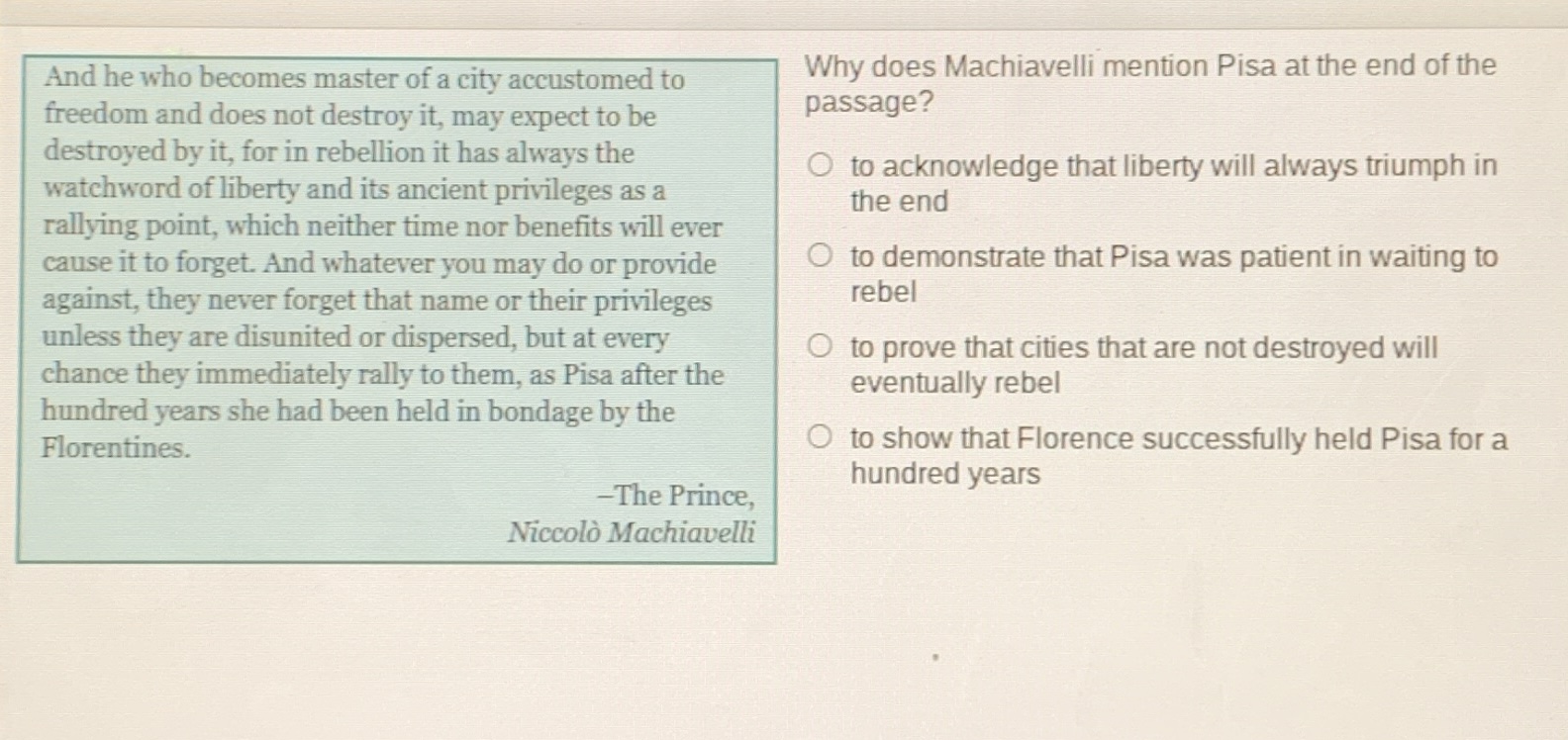
and he who becomes master of a city accustomed to freedom and does not destroy it, may expect to be destroyed by it, for in rebellion it has always the watchword of liberty and its ancient privileges as a rallying point, which neither time nor benefits will ever cause it to forget. and whatever you may do or provide against, they never forget that name or their privileges unless they are disunited or dispersed, but at every chance they immediately rally to them, as pisa after the hundred years she had been held in bondage by the florentines.
-the prince,
niccolò machiavelli
why does machiavelli mention pisa at the end of the passage?
○ to acknowledge that liberty will always triumph in the end
○ to demonstrate that pisa was patient in waiting to rebel
○ to prove that cities that are not destroyed will eventually rebel
○ to show that florence successfully held pisa for a hundred years
The passage argues that a ruler who takes a freedom-accustomed city without destroying it will face rebellion, as the city never forgets its liberty. Pisa is cited as an example: after 100 years under Florentine control, it still rallied to its old privileges, proving that undestroyed free cities eventually rebel. The other options are incorrect: the text does not claim liberty always triumphs, focus on Pisa's patience, or highlight Florence's successful control.

Snap & solve any problem in the app
Get step-by-step solutions on Sovi AI
Photo-based solutions with guided steps
Explore more problems and detailed explanations
to prove that cities that are not destroyed will eventually rebel