QUESTION IMAGE
Question
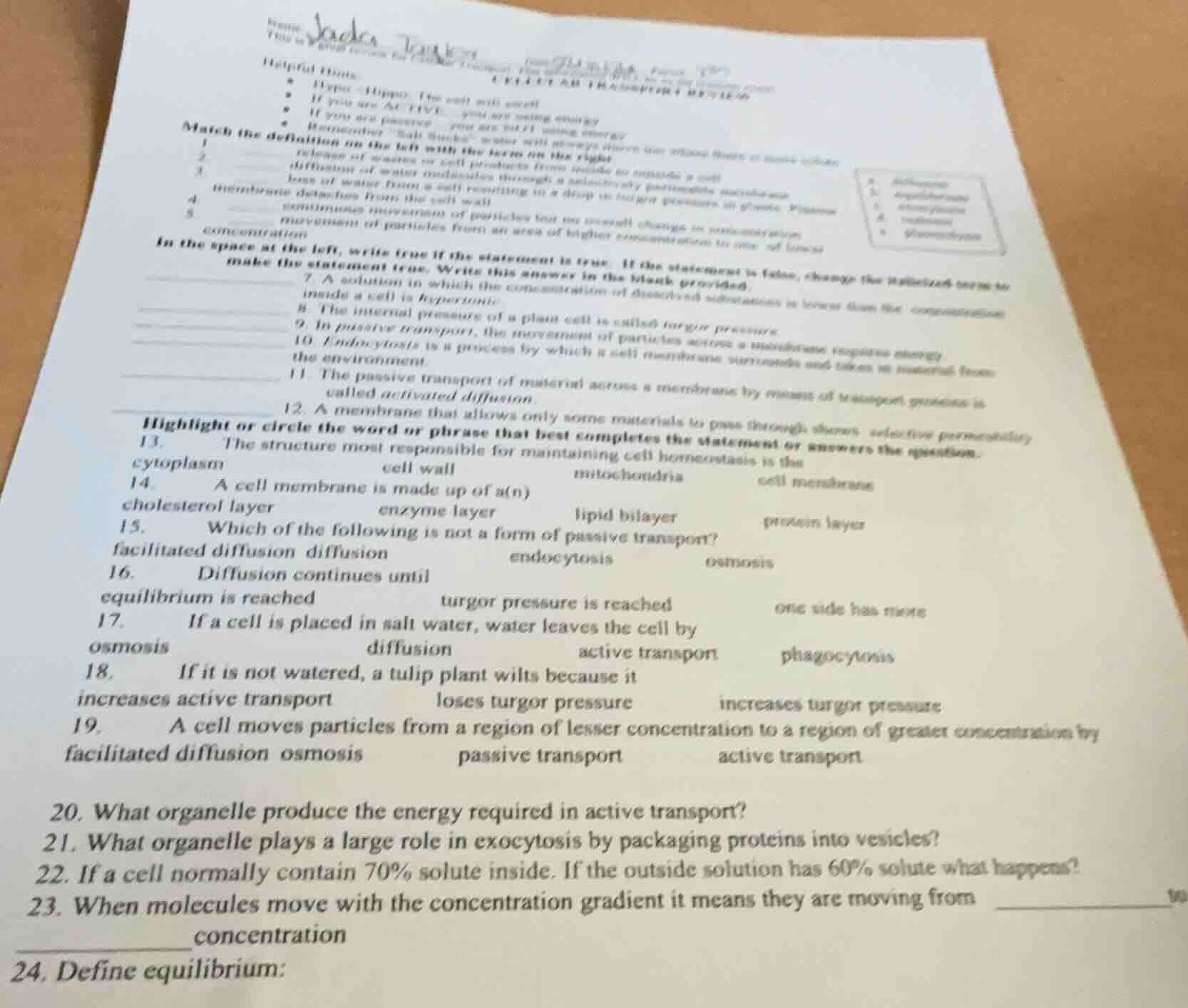
helpful hints: hypo = hippo, the cell will swell if you are active you are using energy if you are passive you are not using energy remember salt sucks water will always move into areas where there is a higher solutematch the definition on the left with the term on the right1. release of wastes or cell products from inside to outside a cell2. diffusion of water molecules through a selectively permeable membrane3. loss of water from a cell resulting in a drop in turgor pressure in plants. plasma membrane detaches from the cell wall4. continuous movement of particles but no overall change in concentration5. movement of particles from an area of higher concentration to one of lower concentrationa. diffusionb. equilibriumc. exocytosisd. osmosise. plasmolysisin the space at the left, write true if the statement is true. if the statement is false, change the italicized term to make the statement true. write this answer in the blank provided.7. a solution in which the concentration of dissolved substances is lower than the concentration inside a cell is hypertonic.8. the internal pressure of a plant cell is called turgor pressure.9. in passive transport, the movement of particles across a membrane requires energy10. endocytosis is a process by which a cell membrane surrounds and takes in material from the environment.11. the passive transport of material across a membrane by means of transport proteins is called activated diffusion.12. a membrane that allows only some materials to pass through shows selective permeabilityhighlight or circle the word or phrase that best completes the statement or answers the question.13. the structure most responsible for maintaining cell homeostasis is thecytoplasm cell wall mitochondria cell membrane14. a cell membrane is made up of a(n)cholesterol layer enzyme layer lipid bilayer protein layer15. which of the following is not a form of passive transport?facilitated diffusion diffusion endocytosis osmosis16. diffusion continues untilequilibrium is reached turgor pressure is reached one side has more17. if a cell is placed in salt water, water leaves the cell byosmosis diffusion active transport phagocytosis18. if it is not watered, a tulip plant wilts because itincreases active transport loses turgor pressure increases turgor pressure19. a cell moves particles from a region of lesser concentration to a region of greater concentration byfacilitated diffusion osmosis passive transport active transport20. what organelle produce the energy required in active transport?21. what organelle plays a large role in exocytosis by packaging proteins into vesicles?22. if a cell normally contain 70% solute inside. if the outside solution has 60% solute what happens?23. when molecules move with the concentration gradient it means they are moving from ____________ concentration24. define equilibrium:
Step1: Match definitions to terms
- Release of waste: E. exocytosis
- Diffusion out of cell: A. diffusion
- Loss of water from cell: C. plasmolysis
- Membrane detaches from cell wall: C. plasmolysis
- No overall concentration change: B. equilibrium
- Movement to lower concentration: A. diffusion
Step2: True/False statement correction
- Rewrite hypertonic to hypotonic (True if corrected)
- Rewrite turgor pressure to turgor pressure (True)
- Rewrite requires to does not require (True if corrected)
- Rewrite takes in to releases (True if corrected; this is exocytosis)
- Rewrite activated diffusion to facilitated diffusion (True if corrected)
- Rewrite shows to exhibits (True; statement is correct as-is)
Step3: Multiple choice selection
- Cell membrane
- Lipid bilayer
- Endocytosis
- Equilibrium is reached
- Osmosis
- Loses turgor pressure
- Active transport
Step4: Short answer responses
- Mitochondria (produces ATP for active transport)
- Golgi apparatus (packages proteins into vesicles)
- Water moves into the cell (cell is hypertonic relative to outside, so osmosis draws water in)
- Higher; lower (with concentration gradient = high to low)
- A state where particle concentration is equal across a space, with no net movement of particles.

Snap & solve any problem in the app
Get step-by-step solutions on Sovi AI
Photo-based solutions with guided steps
Explore more problems and detailed explanations
Matching Section
- E. exocytosis
- A. diffusion
- C. plasmolysis
- C. plasmolysis
- B. equilibrium
- A. diffusion
True/False Section
- False (corrected: hypotonic)
- True
- False (corrected: does not require)
- False (corrected: releases)
- False (corrected: facilitated diffusion)
- True
Multiple Choice Section
- cell membrane
- lipid bilayer
- endocytosis
- equilibrium is reached
- osmosis
- loses turgor pressure
- active transport
Short Answer Section
- Mitochondria
- Golgi apparatus
- Water moves into the cell via osmosis, as the cell has a higher solute concentration than the outside solution.
- higher; lower
- A state where the concentration of particles is uniform across a space, resulting in no net movement of particles.