QUESTION IMAGE
Question
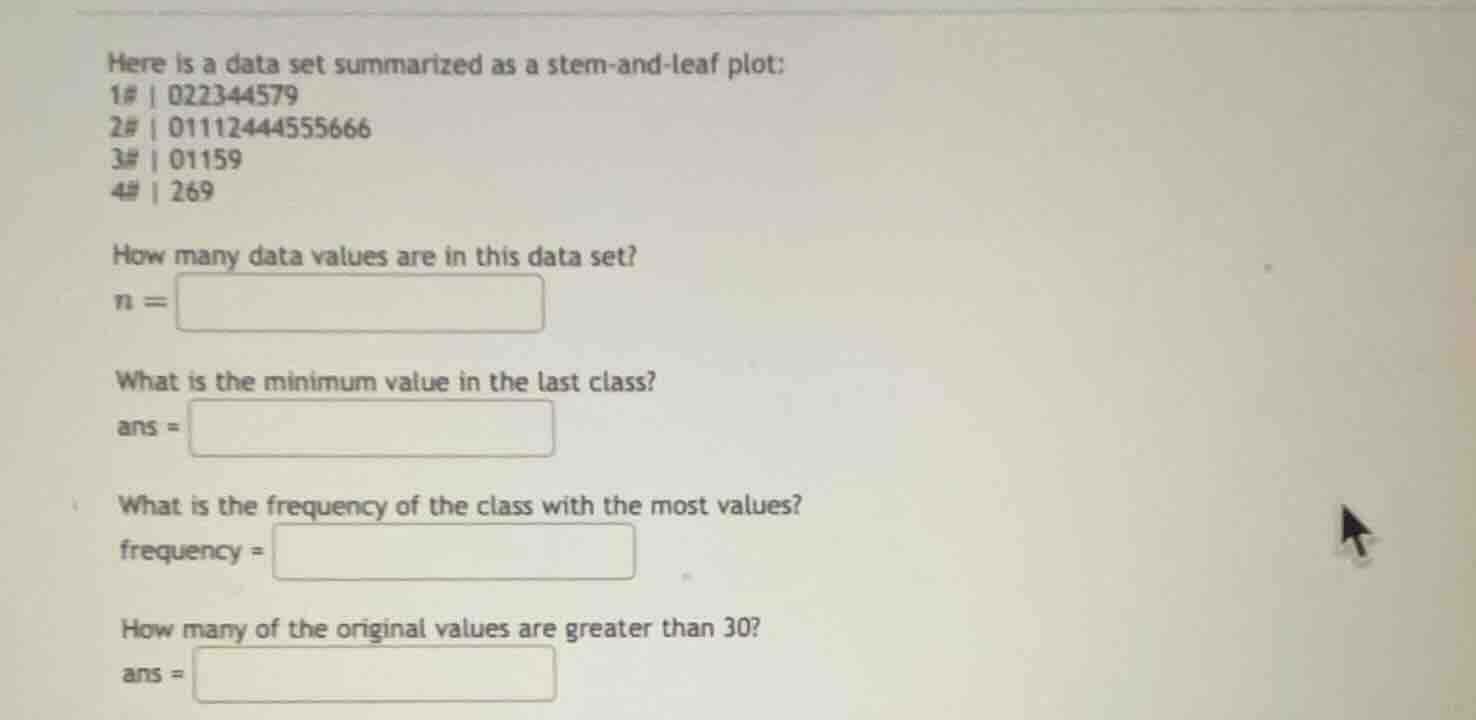
here is a data set summarized as a stem-and-leaf plot:
1# | 022344579
2# | 01112444555666
3# | 01159
4# | 269
how many data values are in this data set?
n =
what is the minimum value in the last class?
ans =
what is the frequency of the class with the most values?
frequency =
how many of the original values are greater than 30?
ans =
Sub - question 1: How many data values are in this data set?
Step 1: Count values in 1# stem
The stem 1# has leaves 0,2,2,3,4,4,5,7,9. Count them: $1 + 2+1 + 2+1+1 = 9$ (or directly count the number of digits: 9 values).
Step 2: Count values in 2# stem
The stem 2# has leaves 0,1,1,1,2,4,4,4,5,5,5,6,6,6. Count the number of digits: 14 values.
Step 3: Count values in 3# stem
The stem 3# has leaves 0,1,1,5,9. Count the number of digits: 5 values.
Step 4: Count values in 4# stem
The stem 4# has leaves 2,6,9. Count the number of digits: 3 values.
Step 5: Sum the counts
To find the total number of data values, we sum the number of values in each stem: $9 + 14+5 + 3=31$.
The last class (stem) is 4#. The leaves for 4# are 2,6,9. To form the data values, we consider the stem as the tens place and the leaf as the units place. So the data values for the 4# stem are 42, 46, 49. The minimum of these values is 42.
We already calculated the number of values in each stem: 1# has 9, 2# has 14, 3# has 5, 4# has 3. The class (stem) with the most values is 2# with 14 values. So the frequency of the class with the most values is 14.

Snap & solve any problem in the app
Get step-by-step solutions on Sovi AI
Photo-based solutions with guided steps
Explore more problems and detailed explanations
$n = 31$