QUESTION IMAGE
Question
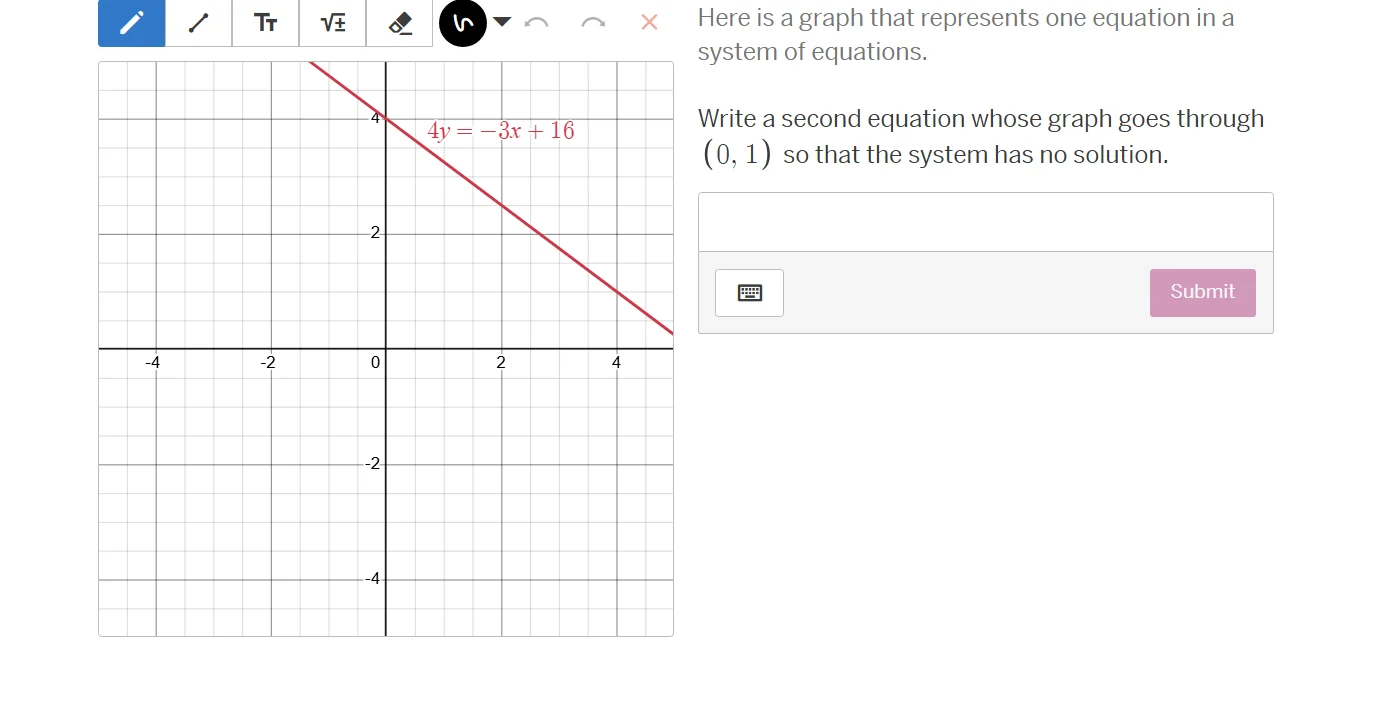
here is a graph that represents one equation in a system of equations. 4y = -3x + 16 write a second equation whose graph goes through (0, 1) so that the system has no solution.
Step1: Find the slope of the given line
The given equation is \(4y = -3x + 16\). We can rewrite it in slope - intercept form \(y=mx + b\) (where \(m\) is the slope and \(b\) is the y - intercept) by dividing both sides by 4: \(y=-\frac{3}{4}x + 4\). So the slope of the given line \(m_1=-\frac{3}{4}\).
Step2: Determine the slope of the second line
For a system of linear equations to have no solution, the two lines must be parallel. Parallel lines have the same slope. So the slope of the second line \(m_2=m_1 = -\frac{3}{4}\).
Step3: Find the equation of the second line
We know that the second line passes through the point \((0,1)\). In the slope - intercept form \(y = mx + b\), when \(x = 0\), \(y=b\). So the y - intercept \(b = 1\) and the slope \(m=-\frac{3}{4}\). Using the slope - intercept form, the equation of the line is \(y=-\frac{3}{4}x+1\). We can also rewrite it in standard form. Multiply both sides by 4 to get \(4y=-3x + 4\), or \(3x+4y=4\). But the slope - intercept form \(y = -\frac{3}{4}x + 1\) is also correct.

Snap & solve any problem in the app
Get step-by-step solutions on Sovi AI
Photo-based solutions with guided steps
Explore more problems and detailed explanations
\(y=-\frac{3}{4}x + 1\) (or equivalent forms like \(4y=-3x + 4\) or \(3x + 4y=4\))