QUESTION IMAGE
Question
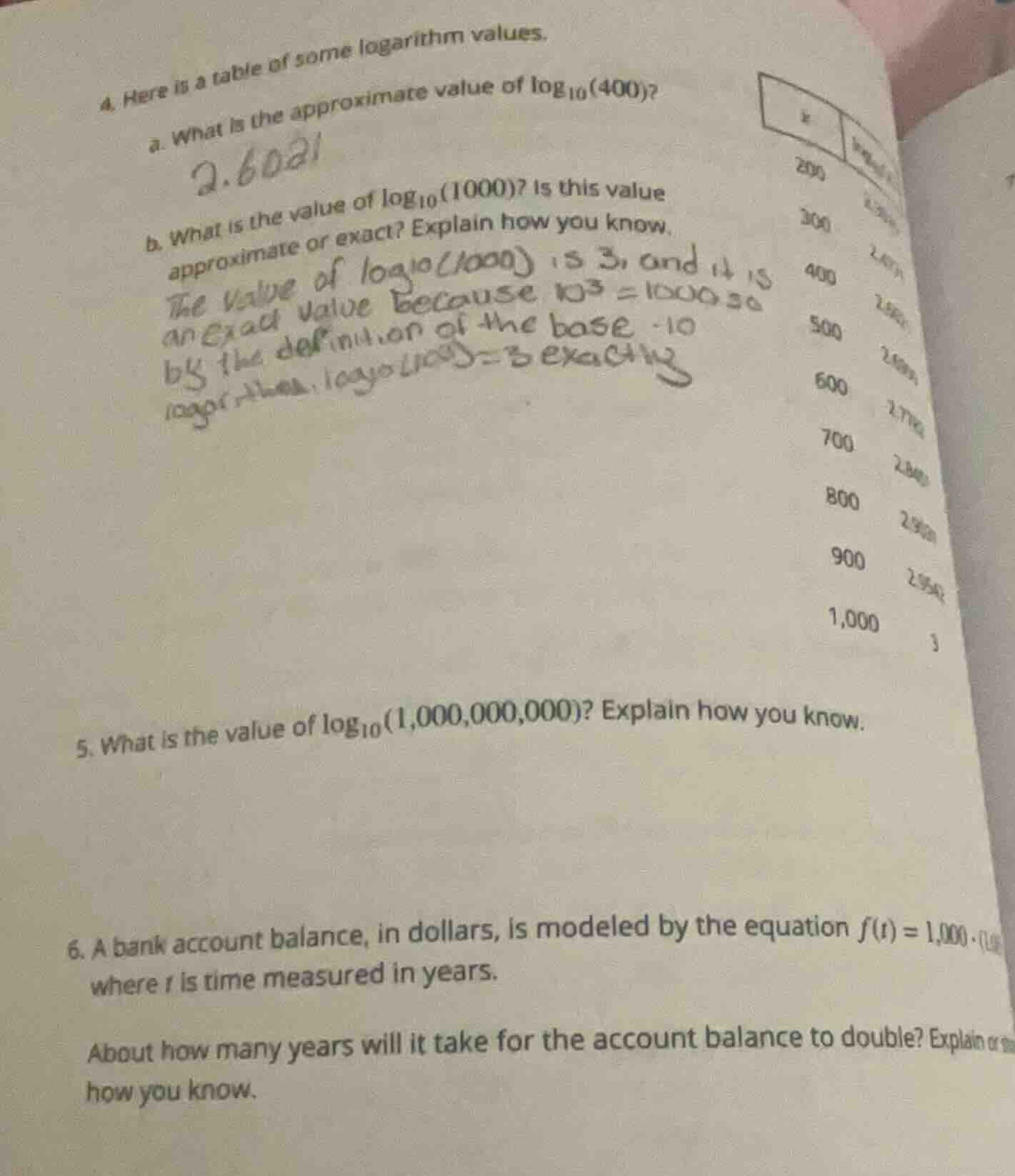
- here is a table of some logarithm values.
a. what is the approximate value of $\log_{10}(400)$?
b. what is the value of $\log_{10}(1000)$? is this value approximate or exact? explain how you know.
- what is the value of $\log_{10}(1,000,000,000)$? explain how you know.
- a bank account balance, in dollars, is modeled by the equation $f(t) = 1,000 \cdot (1.08)^t$ where $t$ is time measured in years.
about how many years will it take for the account balance to double? explain or show how you know.
4a
Step1: Recall logarithm table
From the given table, when \( x = 400 \), the logarithmic value (presumably \( \log_{10}(x) \)) is provided as \( 2.6021 \) (as seen in the handwritten note and the table structure).
Step1: Recall logarithm definition
The logarithm base \( 10 \) of a number \( y \), \( \log_{10}(y) \), is the exponent \( n \) such that \( 10^n = y \). For \( y = 1000 \), we know that \( 10^3=1000 \).
Step2: Determine exactness
Since \( 10^3 = 1000 \) holds exactly (by the definition of exponents and logarithms), \( \log_{10}(1000)=3 \) is an exact value, not an approximation.
Step1: Express the number in exponential form
We can write \( 1,000,000,000 \) as \( 10^9 \) (since \( 10\times10\times\cdots\times10 \) (9 times) \( = 10^9=1,000,000,000 \)).
Step2: Apply logarithm definition
Using the definition of a logarithm, \( \log_{10}(a^b)=b\log_{10}(a) \). For \( a = 10 \) and \( b = 9 \), \( \log_{10}(10^9)=9\log_{10}(10) \). And since \( \log_{10}(10) = 1 \) (by the definition of a logarithm, as \( 10^1 = 10 \)), we have \( \log_{10}(10^9)=9\times1 = 9 \).

Snap & solve any problem in the app
Get step-by-step solutions on Sovi AI
Photo-based solutions with guided steps
Explore more problems and detailed explanations
\( 2.6021 \)