QUESTION IMAGE
Question
- here is a table of some logarithm values.
a. what is the approximate value of \\(\log_{10}(400)\\)?
b. what is the value of \\(\log_{10}(1000)\\)? is this value approximate or exact? explain how you know.
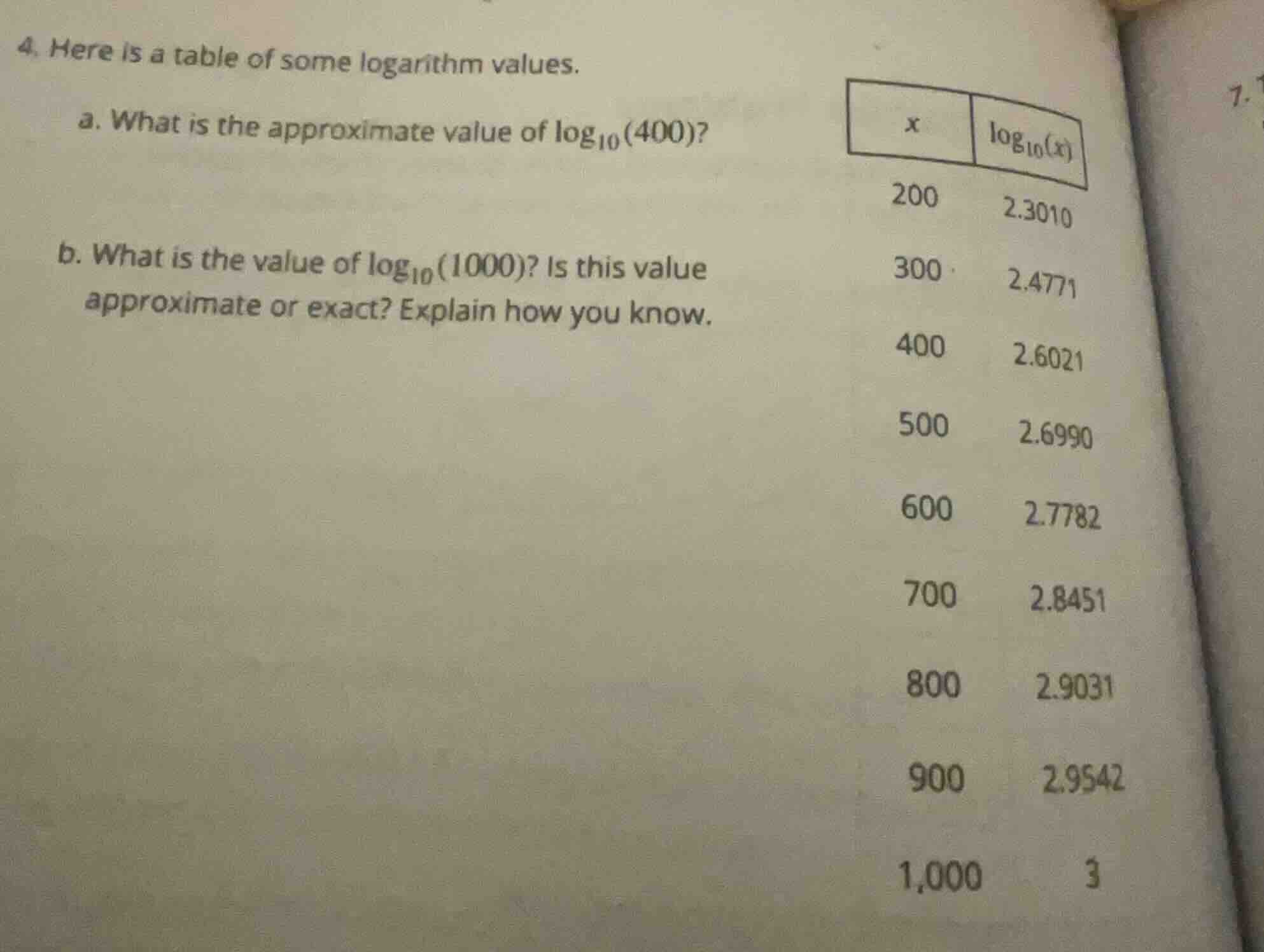
(the table on the right has two columns, x and \\(\log_{10}(x)\\), with rows: 200 - 2.3010, 300 - 2.4771, 400 - 2.6021, 500 - 2.6990, 600 - 2.7782, 700 - 2.8451, 800 - 2.9031, 900 - 2.9542, 1,000 - 3)
Part a
Step1: Locate x = 400 in the table
Find the row where \( x = 400 \) in the given logarithm table.
Step2: Read the corresponding \( \log_{10}(x) \) value
From the table, when \( x = 400 \), \( \log_{10}(400)=2.6021 \).
Step1: Recall the logarithm property for \( \log_{10}(10^n) \)
The logarithm property states that \( \log_{10}(10^n)=n \) because \( 10^n \) in base - 10 logarithm gives the exponent \( n \). For \( 1000 \), we can write \( 1000 = 10^3 \).
Step2: Calculate \( \log_{10}(1000) \)
Using the property \( \log_{10}(10^3) \), we get \( \log_{10}(1000)=3 \). To determine if it is exact or approximate, we know that by the definition of a logarithm, if \( y = \log_{10}(x) \), then \( x = 10^y \). When \( y = 3 \), \( x = 10^3=1000 \), which is an exact equality. So this value is exact because \( 10^3 = 1000 \) holds true exactly, and the logarithm of a number that is a perfect power of the base (here base 10) gives an exact exponent.

Snap & solve any problem in the app
Get step-by-step solutions on Sovi AI
Photo-based solutions with guided steps
Explore more problems and detailed explanations
\( 2.6021 \)