QUESTION IMAGE
Question
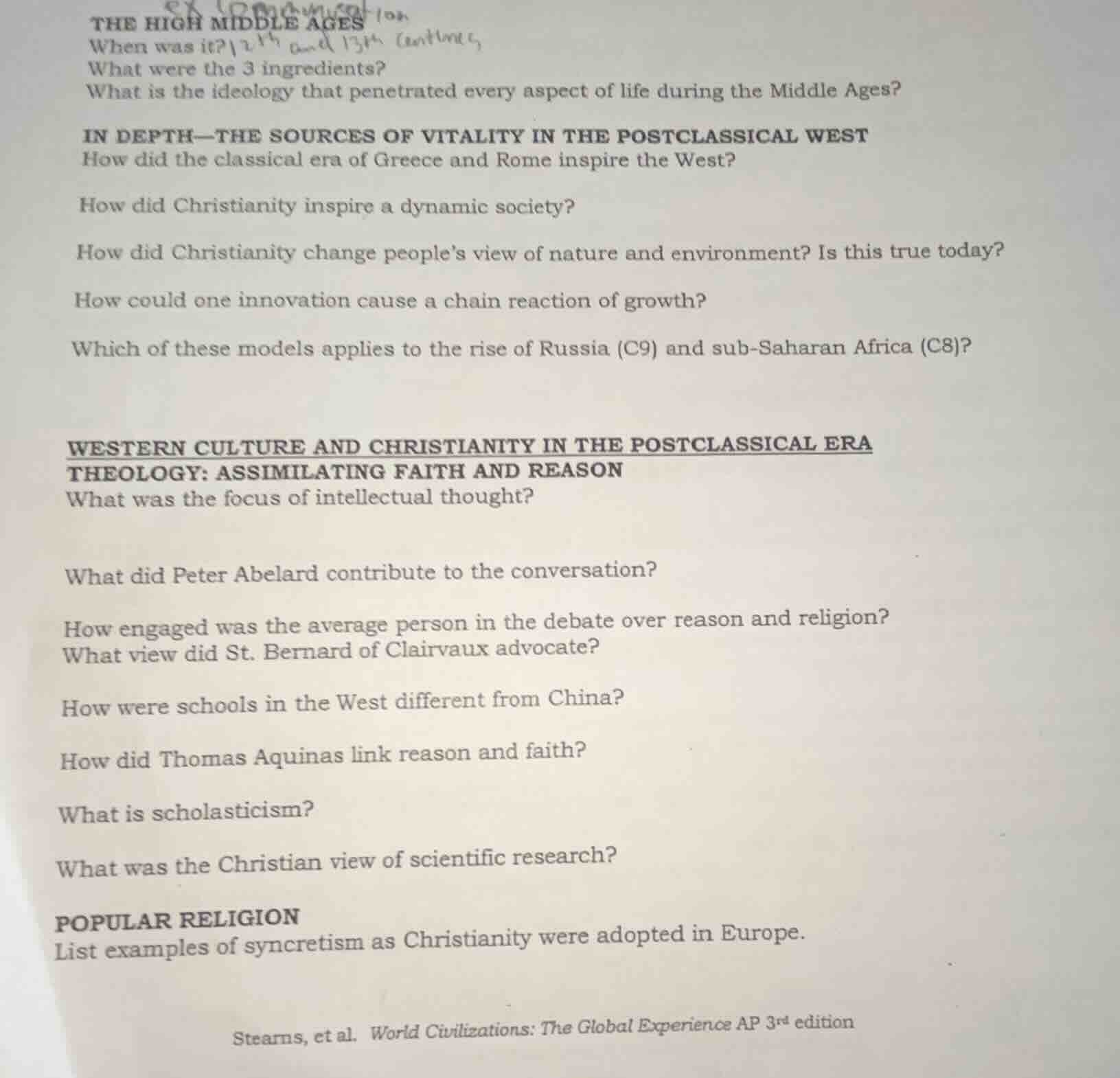
the high middle ages
when was it?
what were the 3 ingredients?
what is the ideology that penetrated every aspect of life during the middle ages?
in depth—the sources of vitality in the postclassical west
how did the classical era of greece and rome inspire the west?
how did christianity inspire a dynamic society?
how did christianity change peoples view of nature and environment? is this true today?
how could one innovation cause a chain reaction of growth?
which of these models applies to the rise of russia (c9) and sub-saharan africa (c8)?
western culture and christianity in the postclassical era
theology: assimilating faith and reason
what was the focus of intellectual thought?
what did peter abelard contribute to the conversation?
how engaged was the average person in the debate over reason and religion?
what view did st. bernard of clairvaux advocate?
how were schools in the west different from china?
how did thomas aquinas link reason and faith?
what is scholasticism?
what was the christian view of scientific research?
popular religion
list examples of syncretism as christianity were adopted in europe.
stearns, et al. world civilizations: the global experience ap 3rd edition
THE HIGH MIDDLE AGES
- When was it?: This period spans the 11th to the 13th centuries CE, marked by economic growth, religious expansion, and cultural revival in Europe.
- What were the 3 ingredients?: The three key drivers are: (1) Agricultural innovations (e.g., three-field system, heavy plow) that boosted food production; (2) Growth of trade and urban centers that created economic dynamism; (3) The influence of the Catholic Church that unified social and cultural life.
- What is the ideology that penetrated every aspect of life during the Middle Ages?: Christianity (specifically Roman Catholicism) was the dominant ideology, shaping law, education, social norms, and daily life.
IN DEPTH—THE SOURCES OF VITALITY IN THE POSTCLASSICAL WEST
- How did the classical era of Greece and Rome inspire the West?: Medieval scholars revived classical texts on philosophy (Aristotle), law (Roman legal codes), and science, using them to inform theological and intellectual thought, and adopted Roman political structures and Greek rationalism.
- How did Christianity inspire a dynamic society?: It provided a unifying moral framework, encouraged charitable institutions (hospitals, schools), motivated pilgrimage and trade, and spurred architectural and artistic innovation (e.g., Gothic cathedrals).
- How did Christianity change people's view of nature and environment? Is this true today?: Christianity framed nature as a creation of God, meant to be stewarded (not worshipped as pagan deities). Some modern Christian groups still emphasize environmental stewardship, though interpretations vary.
- How could one innovation cause a chain reaction of growth?: For example, the heavy plow enabled cultivation of northern European clay soils, increasing food supply. This supported population growth, which fueled urbanization, trade, and the rise of guilds, creating a cycle of economic and social growth.
- Which of these models applies to the rise of Russia (C9) and sub-Saharan Africa (C8)?: Russia followed the "peripheral development" model, adopting Byzantine Christian culture and political structures while adapting to local traditions. Sub-Saharan African regions used "syncretic adaptation," blending Christianity with indigenous religious practices and existing social systems.
WESTERN CULTURE AND CHRISTIANITY IN THE POSTCLASSICAL ERA: THEOLOGY: ASSIMILATING FAITH AND REASON
- What was the focus of intellectual thought?: Reconciling Christian faith with classical Greek and Roman reason (especially Aristotle's philosophy) to create a unified system of theological and philosophical understanding.
- What did Peter Abelard contribute to the conversation?: He promoted the use of dialectic (questioning and debate) to resolve theological contradictions, most famously in his work Sic et Non, which encouraged critical engagement with religious texts.
- How engaged was the average person in the debate over reason and religion?: Most ordinary people were not directly engaged; the debate was limited to educated clergy, monks, and university scholars. The average person interacted with Christianity through ritual, not intellectual debate.
- What view did St. Bernard of Clairvaux advocate?: He rejected overreliance on reason, emphasizing mystical faith, emotional devotion to God, and strict adherence to monastic piety as the path to spiritual truth.
- How were schools in the West different from China?: Western medieval schools (and later universities) focused on theology and classical liberal arts…

Snap & solve any problem in the app
Get step-by-step solutions on Sovi AI
Photo-based solutions with guided steps
Explore more problems and detailed explanations
THE HIGH MIDDLE AGES
- 11th to 13th centuries CE
- Agricultural innovation, trade/urban growth, Catholic Church influence
- Roman Catholic Christianity
IN DEPTH—THE SOURCES OF VITALITY IN THE POSTCLASSICAL WEST
- Revived classical philosophy, law, and science to inform theology and society
- Provided unifying values, spurred institutions, art, and trade
- Framed nature as God's creation to be stewarded; some modern Christian groups uphold this view
- Example: Heavy plow → more food → population growth → urbanization/trade growth
- Russia: Peripheral development; Sub-Saharan Africa: Syncretic adaptation
WESTERN CULTURE AND CHRISTIANITY IN THE POSTCLASSICAL ERA: THEOLOGY: ASSIMILATING FAITH AND REASON
- Reconciling Christian faith with classical reason
- Promoted dialectic debate to resolve theological contradictions
- Average people were not engaged; debate was for educated elites
- Emphasized mystical faith over rational inquiry
- Western schools focused on theology/liberal arts and debate; Chinese schools focused on Confucian classics and civil service training
- Argued reason and faith are complementary, both from God
- Systematic use of logic to reconcile Christian doctrine with classical thought
- Accepted as a way to understand God's creation, if aligned with doctrine
POPULAR RELIGION
- - Christmas replacing Saturnalia; Easter blending with spring rituals
- Local saints replacing pagan nature deities (e.g., St. Brigid)
- Pagan folk customs (bonfires) adapted to Christian holidays