QUESTION IMAGE
Question
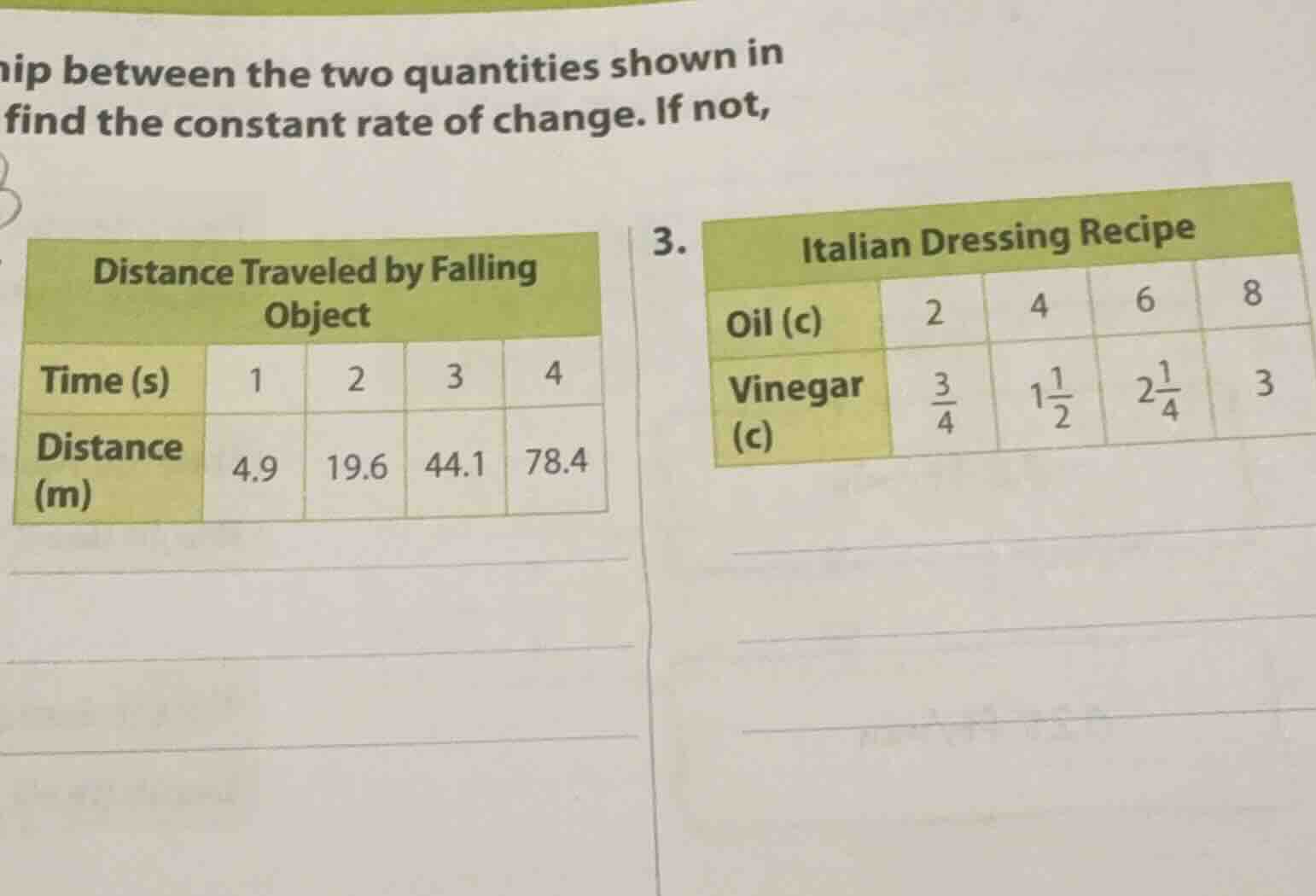
hip between the two quantities shown in find the constant rate of change. if not,
distance traveled by falling
object
time (s)
1
2
3
4
distance
(m)
4.9
19.6
44.1
78.4
- italian dressing recipe
oil (c)
2
4
6
8
vinegar
(c)
\\(\frac{3}{4}\\)
\\(1\frac{1}{2}\\)
\\(2\frac{1}{4}\\)
3
For "Distance Traveled by Falling Object" table:
Step1: Recall rate of change formula
The rate of change (slope) between two points \((x_1,y_1)\) and \((x_2,y_2)\) is \(\frac{y_2 - y_1}{x_2 - x_1}\). We'll check the rate of change between consecutive time - distance pairs.
Step2: Calculate rate between \(t = 1\) and \(t = 2\)
For \(t_1=1,y_1 = 4.9\) and \(t_2 = 2,y_2=19.6\), the rate of change \(r_1=\frac{19.6 - 4.9}{2 - 1}=\frac{14.7}{1}=14.7\).
Step3: Calculate rate between \(t = 2\) and \(t = 3\)
For \(t_1 = 2,y_1=19.6\) and \(t_2=3,y_2 = 44.1\), the rate of change \(r_2=\frac{44.1-19.6}{3 - 2}=\frac{24.5}{1}=24.5\).
Wait, we made a mistake. Wait, the formula for the distance of a falling object is \(d=\frac{1}{2}gt^{2}\), where \(g = 9.8\ m/s^{2}\). Let's recalculate the rate of change of distance with respect to time. The rate of change of \(d\) with respect to \(t\) for \(d=\frac{1}{2}gt^{2}\) is \(v = gt\) (instantaneous rate), but for average rate between \(t_1\) and \(t_2\), it is \(\frac{\frac{1}{2}g(t_2^{2}-t_1^{2})}{t_2 - t_1}=\frac{1}{2}g(t_2 + t_1)\).
For \(t_1 = 1,t_2=2\): \(\frac{1}{2}\times9.8\times(2 + 1)=4.9\times3 = 14.7\)
For \(t_1=2,t_2 = 3\): \(\frac{1}{2}\times9.8\times(3 + 2)=4.9\times5=24.5\)
For \(t_1 = 3,t_2=4\): \(\frac{1}{2}\times9.8\times(4 + 3)=4.9\times7 = 34.3\)
But the problem says "constant rate of change". Wait, maybe we misread the table. Wait, the distance values: when \(t = 1\), \(d = 4.9=\frac{1}{2}\times9.8\times1^{2}\); \(t = 2\), \(d=19.6=\frac{1}{2}\times9.8\times2^{2}\); \(t = 3\), \(d = 44.1=\frac{1}{2}\times9.8\times3^{2}\); \(t = 4\), \(d=78.4=\frac{1}{2}\times9.8\times4^{2}\).
The rate of change of distance with respect to time (average rate) between \(t\) and \(t+\Delta t\) is \(\frac{d(t + \Delta t)-d(t)}{\Delta t}=\frac{\frac{1}{2}g((t+\Delta t)^{2}-t^{2})}{\Delta t}=\frac{\frac{1}{2}g(2t\Delta t+\Delta t^{2})}{\Delta t}=gt+\frac{1}{2}g\Delta t\).
If we consider the rate of change of distance with respect to the square of time: Let \(x=t^{2}\), \(y = d\). Then \(y = 4.9x\) (since \(d=\frac{1}{2}\times9.8\times t^{2}=4.9t^{2}\)). So the rate of change of \(y\) with respect to \(x\) is \(\frac{y_2 - y_1}{x_2 - x_1}\).
For \(t = 1,x_1 = 1,y_1=4.9\); \(t = 2,x_2 = 4,y_2=19.6\). Rate \(r_1=\frac{19.6 - 4.9}{4 - 1}=\frac{14.7}{3}=4.9\).
For \(t = 2,x_2 = 4,y_2=19.6\); \(t = 3,x_3=9,y_3 = 44.1\). Rate \(r_2=\frac{44.1-19.6}{9 - 4}=\frac{24.5}{5}=4.9\).
For \(t = 3,x_3=9,y_3=44.1\); \(t = 4,x_4 = 16,y_4=78.4\). Rate \(r_3=\frac{78.4 - 44.1}{16 - 9}=\frac{34.3}{7}=4.9\).
So the relationship between distance (\(d\)) and the square of time (\(t^{2}\)) is linear with a constant rate of change of \(4.9\ m/c^{2}\) (where \(c\) is the unit of \(t^{2}\), i.e., \(s^{2}\)). But if we consider the rate of change of distance with respect to time, it is not constant (since \(v = gt\) is increasing). But the problem says "find the constant rate of change" if the relationship is linear. Wait, the table:
When \(t = 1\), \(d = 4.9\); \(t = 2\), \(d = 19.6\); \(t = 3\), \(d = 44.1\); \(t = 4\), \(d = 78.4\)
Let's check the ratio of \(d\) to \(t^{2}\):
For \(t = 1\), \(t^{2}=1\), \(\frac{d}{t^{2}}=\frac{4.9}{1}=4.9\)
For \(t = 2\), \(t^{2}=4\), \(\frac{d}{t^{2}}=\frac{19.6}{4}=4.9\)
For \(t = 3\), \(t^{2}=9\), \(\frac{d}{t^{2}}=\frac{44.1}{9}=4.9\)
For \(t = 4\), \(t^{2}=16\), \(\frac{d}{t^{2}}=\frac{78.4}{16}=4.9\)
So the relationship between \(d\) (distance) and \(t^{2}\) (time squared) is linear, with a constant rate of change of \(4.9\ m/s^{2}\) (since \(d = 4.9t^{2}\), so the rate of change of \(d\) with respect to \(t^{2}…
Step1: Recall rate of change formula
The rate of change between two points \((x_1,y_1)\) and \((x_2,y_2)\) is \(\frac{y_2 - y_1}{x_2 - x_1}\), where \(x\) is the amount of oil (in cups) and \(y\) is the amount of vinegar (in cups).
Step2: Calculate rate between \(x = 2\) and \(x = 4\)
For \(x_1=2,y_1=\frac{3}{4}\) and \(x_2 = 4,y_2=1\frac{1}{2}=\frac{3}{2}\), the rate of change \(r_1=\frac{\frac{3}{2}-\frac{3}{4}}{4 - 2}=\frac{\frac{6 - 3}{4}}{2}=\frac{\frac{3}{4}}{2}=\frac{3}{8}\).
Step3: Calculate rate between \(x = 4\) and \(x = 6\)
For \(x_1 = 4,y_1=\frac{3}{2}\) and \(x_2=6,y_2=2\frac{1}{4}=\frac{9}{4}\), the rate of change \(r_2=\frac{\frac{9}{4}-\frac{3}{2}}{6 - 4}=\frac{\frac{9 - 6}{4}}{2}=\frac{\frac{3}{4}}{2}=\frac{3}{8}\).
Step4: Calculate rate between \(x = 6\) and \(x = 8\)
For \(x_1=6,y_1=\frac{9}{4}\) and \(x_2 = 8,y_2=3\), the rate of change \(r_3=\frac{3-\frac{9}{4}}{8 - 6}=\frac{\frac{12 - 9}{4}}{2}=\frac{\frac{3}{4}}{2}=\frac{3}{8}\).
Since \(r_1=r_2=r_3=\frac{3}{8}\) cups of vinegar per cup of oil, the relationship is linear with a constant rate of change of \(\frac{3}{8}\) cups of vinegar per cup of oil.
Final Answers:
- For "Distance Traveled by Falling Object": The relationship between distance and the square of time is linear with a constant rate of change of \(4.9\ m\) per \(s^{2}\). If considering distance and time, the relationship is not linear, but distance and \(t^{2}\) is linear with rate \(4.9\ m/s^{2}\).
- For "Italian Dressing Recipe": The relationship between the amount of oil and vinegar is linear with a constant rate of change of \(\frac{3}{8}\) cups of vinegar per cup of oil.

Snap & solve any problem in the app
Get step-by-step solutions on Sovi AI
Photo-based solutions with guided steps
Explore more problems and detailed explanations
Step1: Recall rate of change formula
The rate of change between two points \((x_1,y_1)\) and \((x_2,y_2)\) is \(\frac{y_2 - y_1}{x_2 - x_1}\), where \(x\) is the amount of oil (in cups) and \(y\) is the amount of vinegar (in cups).
Step2: Calculate rate between \(x = 2\) and \(x = 4\)
For \(x_1=2,y_1=\frac{3}{4}\) and \(x_2 = 4,y_2=1\frac{1}{2}=\frac{3}{2}\), the rate of change \(r_1=\frac{\frac{3}{2}-\frac{3}{4}}{4 - 2}=\frac{\frac{6 - 3}{4}}{2}=\frac{\frac{3}{4}}{2}=\frac{3}{8}\).
Step3: Calculate rate between \(x = 4\) and \(x = 6\)
For \(x_1 = 4,y_1=\frac{3}{2}\) and \(x_2=6,y_2=2\frac{1}{4}=\frac{9}{4}\), the rate of change \(r_2=\frac{\frac{9}{4}-\frac{3}{2}}{6 - 4}=\frac{\frac{9 - 6}{4}}{2}=\frac{\frac{3}{4}}{2}=\frac{3}{8}\).
Step4: Calculate rate between \(x = 6\) and \(x = 8\)
For \(x_1=6,y_1=\frac{9}{4}\) and \(x_2 = 8,y_2=3\), the rate of change \(r_3=\frac{3-\frac{9}{4}}{8 - 6}=\frac{\frac{12 - 9}{4}}{2}=\frac{\frac{3}{4}}{2}=\frac{3}{8}\).
Since \(r_1=r_2=r_3=\frac{3}{8}\) cups of vinegar per cup of oil, the relationship is linear with a constant rate of change of \(\frac{3}{8}\) cups of vinegar per cup of oil.
Final Answers:
- For "Distance Traveled by Falling Object": The relationship between distance and the square of time is linear with a constant rate of change of \(4.9\ m\) per \(s^{2}\). If considering distance and time, the relationship is not linear, but distance and \(t^{2}\) is linear with rate \(4.9\ m/s^{2}\).
- For "Italian Dressing Recipe": The relationship between the amount of oil and vinegar is linear with a constant rate of change of \(\frac{3}{8}\) cups of vinegar per cup of oil.