QUESTION IMAGE
Question
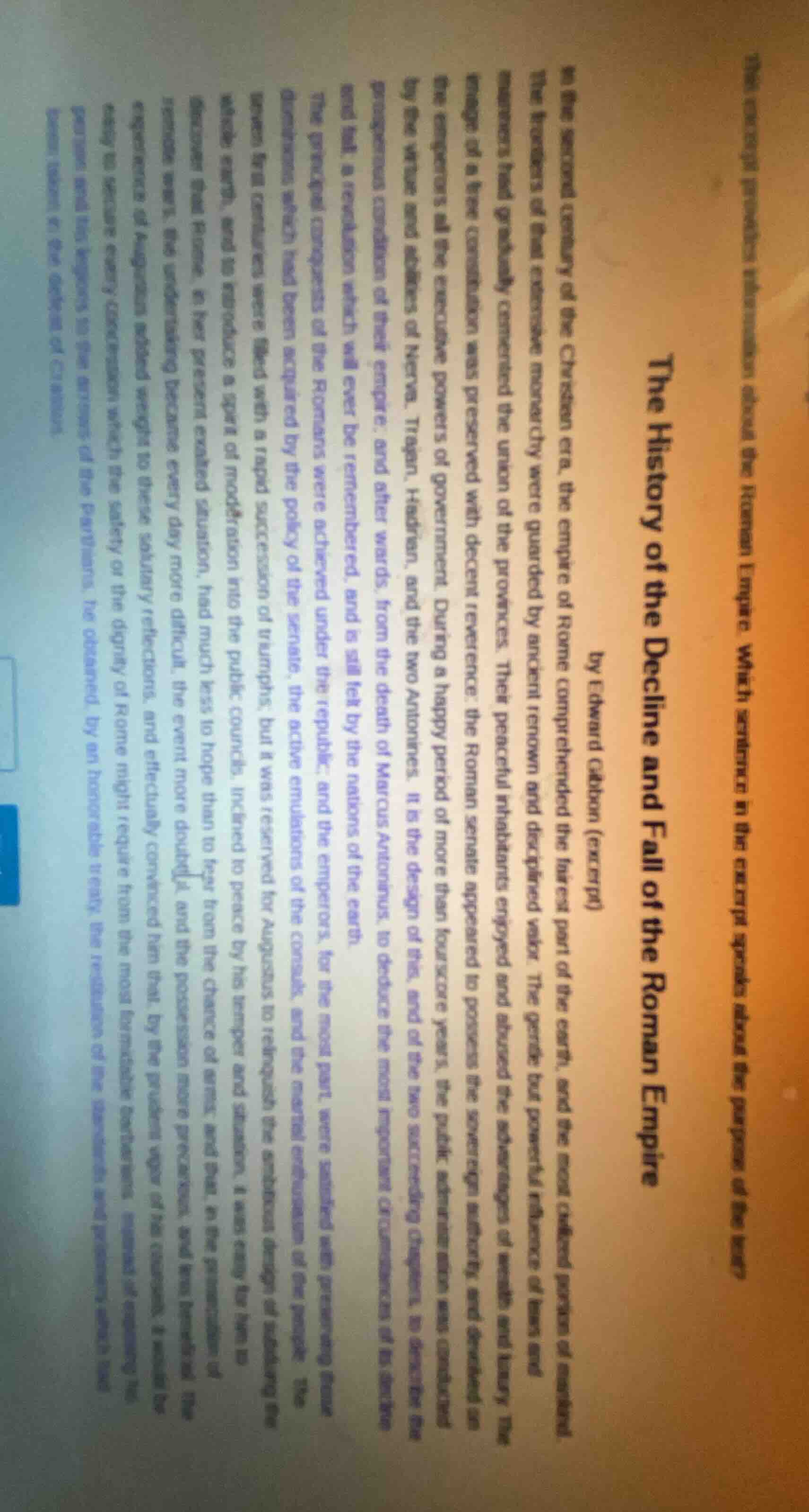
the history of the decline and fall of the roman empire by edward gibbon (excerpt) in the second century of the christian era, the empire of rome comprehended the fairest part of the earth, and the most civilized portion of mankind. the frontiers of that extensive monarchy were guarded by ancient renown and disciplined valor. the gentle but powerful influence of laws and manners had gradually cemented the union of the provinces. their peaceful inhabitants enjoyed and abused the advantages of wealth and luxury. the image of a free constitution was preserved with decent reverence: the roman senate appeared to possess the sovereign authority, and devolved on the emperors all the executive powers of government. during a happy period of more than fourscore years, the public administration was conducted by the virtue and abilities of nerva, trajan, hadrian, and the two antonines. it is the design of this, and of the two succeeding chapters, to describe the prosperous condition of their empire; and after wards, from the death of marcus antoninus, to deduce the most important circumstances of its decline and fall. a revolution which will ever be remembered, and is still felt by the nations of the earth. the principal conquests of the romans were achieved under the republic; and the emperors, for the most part, were satisfied with preserving those dominions, which had been acquired by the policy of the senate, the active emulations of the consuls, and the martial enthusiasm of the people. the seventh will comprehend a rapid succession of triumphs; but it was reserved for augustus to relinquish the ambitious design of subduing the whole earth, and to introduce a spirit of moderation into the public councils. inclined to peace by his temper and situation, it was easy for him to discern that rome, in her present exalted situation, had much less to hope than to fear from the chance of arms; and that, in the prosecution of remote wars, the undertaking became every day more difficult, the event more doubtful, and the possession more precarious. the experience of augustus added weight to these salutary reflections; and effectually convinced him that, by the prudent vigor of his counsels, it would be easier to secure the obedience of the provinces, than to extend the boundaries of the empire. he was the first that taught the romans to depend for their safety on the dignity of rome, rather than on the progress of their arms. the moderation of the emperor was assailed by the importunate demands of the legions. their consent had been secured by a solemn promise of eternal dominion, of undiminished pay, and of perpetual peace. throughout the extent of his dominions, augustus had kept alive the memory of their independence, and the desire of liberty. he had respected the prejudices of the people, and, by an honorable treaty, had established the freedom of the constitution. he had restored the authority of the senate, and the forms of the republican government. he had even permitted the election of the consuls, and the other magistrates, to be conducted according to the ancient laws. but the soldiers, who had been accustomed to the license of the camp, and the arbitrary power of their generals, could not brook the restraints of law and order. they demanded the rewards of their services, and the gratification of their passions. they were impatient of the slow proceedings of justice, and the tedious forms of legal prosecution. they were eager to enjoy the fruits of their victory, and to taste the pleasures of a conquered world. the mutiny of the legions was suppressed by the firmness and address of augustus. he had the art to persuade them, that their interests were inseparably connected with the prosperity of the empire; and that the preservation of peace was the surest guarantee of their happiness. he reminded them of the dangers and difficulties which they had encountered in the service of their country; and he pointed out to them the advantages which they now enjoyed, and which they would lose by a renewal of the war. he promised them, that he would take care of their families, and provide for their old age. he assured them, that he would respect their rights, and protect their liberties. the soldiers were convinced by his arguments, and submitted to his authority. from that time, the roman army became the firmest support of the emperor, and the most formidable instrument of his power. the provinces, which had been subject to the republic, were now governed by the emperors, according to the laws and regulations which had been established by augustus. the administration of justice was entrusted to the proconsuls, the legates, and the prefects, who were appointed by the emperor, and were responsible to him for their conduct. the taxes were levied with regularity and moderation; and the revenues of the empire were applied to the support of the army, the maintenance of the public works, and the payment of the civil list. the people of the provinces were protected in their persons and property; and they were permitted to enjoy the benefits of the roman laws, and the advantages of the roman civilization. the empire of rome was, in fact, a great confederacy of nations, united under the same sovereign, and governed by the same laws. the romans had introduced their language, their manners, and their religion, into the countries which they had conquered. they had established schools and colleges, for the education of the youth; and they had encouraged the cultivation of the arts and sciences. the provinces, in return, had contributed to the wealth and power of the empire; and they had added to the splendor and glory of rome. the history of the decline and fall of the roman empire is a subject of the deepest interest and importance. it is a history of the gradual decay of a great empire, which, after having reached the summit of power and prosperity, was at length overwhelmed by the barbarians, and sunk into a state of darkness and confusion. the causes of this decline and fall have been the subject of much speculation and inquiry. some have attributed it to the vices of the people, others to the tyranny of the emperors, others to the corruption of the senate, others to the degeneracy of the army, and others to the invasions of the barbarians. it is probable, that all these causes, and many others, contributed to the downfall of the roman empire. but the principal cause, perhaps, was the want of a proper balance of power in the constitution. the emperors, by degrees, acquired an absolute authority, which they exercised without control. the senate lost its dignity and influence; the people were deprived of their liberties; and the army became the instrument of tyranny and oppression. the provinces, which had been the support of the empire, were oppressed by the exactions of the government, and were at length driven to rebellion. the barbarians, who had been so long kept at bay by the valor of the roman arms, at last found an opportunity to invade the empire, and to overthrow its power. the decline and fall of the roman empire is a warning to all nations, to beware of the dangers of tyranny, corruption, and oppression. it is a proof, that no government, however powerful and prosperous, can be secure, unless it is founded on the principles of justice, liberty, and moderation. it is a lesson, that the happiness of a people depends, not on the extent of their dominions, but on the wisdom and virtue of their rulers.
The question asks for the sentence about the Senate's purpose. Scanning the excerpt, the relevant sentence outlines that the Senate held sovereign authority, maintained the free constitution with reverence, and delegated executive powers to emperors, while the peaceful population enjoyed wealth and luxury.

Snap & solve any problem in the app
Get step-by-step solutions on Sovi AI
Photo-based solutions with guided steps
Explore more problems and detailed explanations
"The Roman senate appeared to possess the sovereign authority, and devolved on the emperors all the executive powers of government."