QUESTION IMAGE
Question
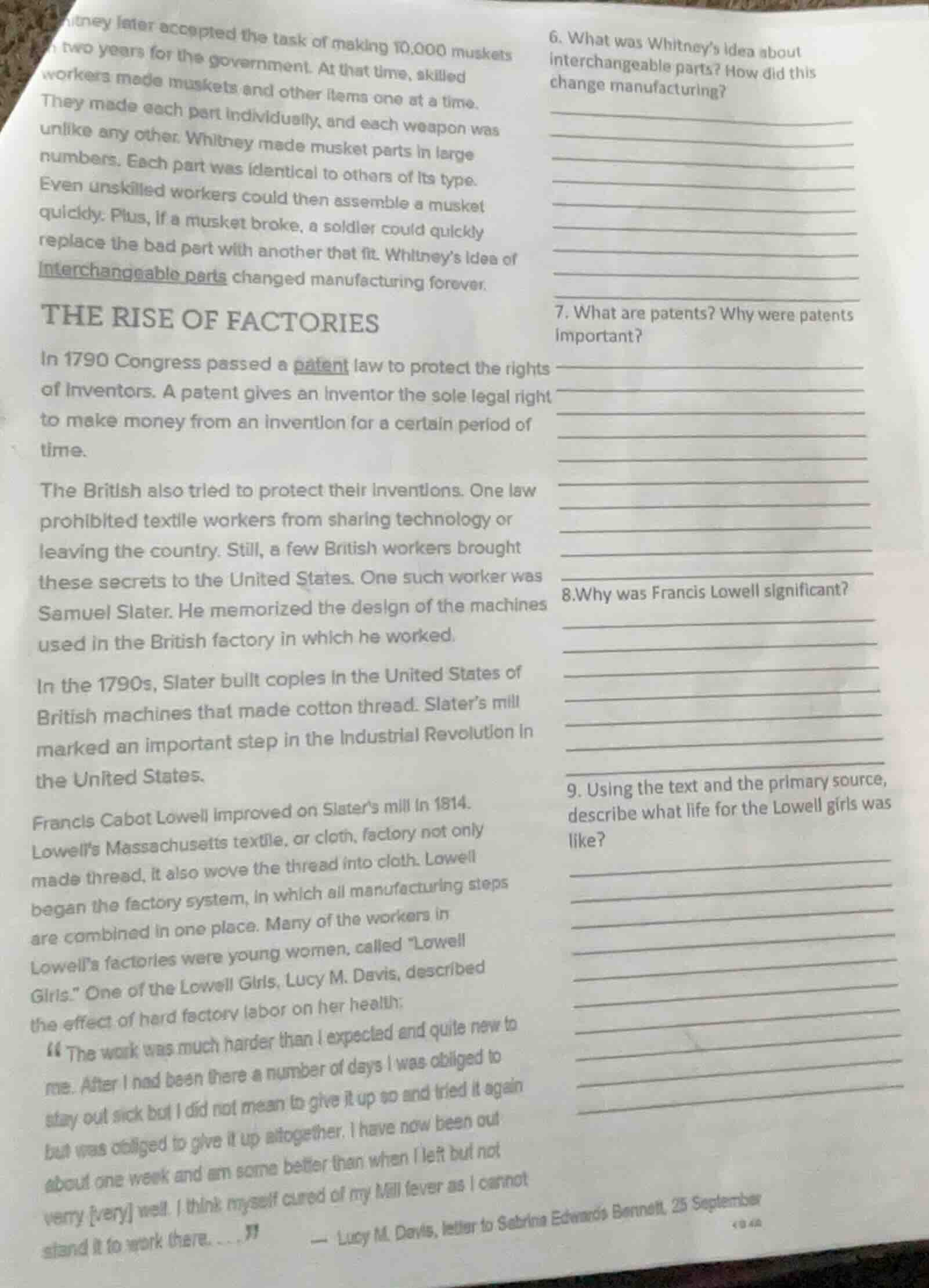
hitney later accepted the task of making 10,000 muskets in two years for the government. at that time, skilled workers made muskets and other items one at a time. they made each part individually, and each weapon was unlike any other. whitney made musket parts in large numbers. each part was identical to others of its type. even unskilled workers could then assemble a musket quickly. plus, if a musket broke, a soldier could quickly replace the bad part with another that fit. whitneys idea of interchangeable parts changed manufacturing forever.the rise of factoriesin 1790 congress passed a patent law to protect the rights of inventors. a patent gives an inventor the sole legal right to make money from an invention for a certain period of time.the british also tried to protect their inventions. one law prohibited textile workers from sharing technology or leaving the country. still, a few british workers brought these secrets to the united states. one such worker was samuel slater. he memorized the design of the machines used in the british factory in which he worked.in the 1790s, slater built copies in the united states of british machines that made cotton thread. slaters mill marked an important step in the industrial revolution in the united states.francis cabot lowell improved on slaters mill in 1814. lowells massachusetts textile, or cloth, factory not only made thread, it also wove the thread into cloth. lowell began the factory system, in which all manufacturing steps are combined in one place. many of the workers in lowells factories were young women, called \lowell girls.\ one of the lowell girls, lucy m. davis, described the effect of hard factory labor on her health:\the work was much harder than i expected and quite new to me. after i had been there a number of days i was obliged to stay out sick but i did not mean to give it up so and tried it again but was obliged to give it up altogether. i have now been out about one week and am some better than when i left but not very very well. i think myself cured of my mill fever as i cannot stand it to work there. ...\— lucy m. davis, letter to sabrina edwards bennett, 25 september6. what was whitneys idea about interchangeable parts? how did this change manufacturing?7. what are patents? why were patents important?8.why was francis lowell significant?9. using the text and the primary source, describe what life for the lowell girls was like?
For Question 6:
Whitney's idea was to create identical musket parts (interchangeable parts) that fit any weapon of the same type. This let unskilled workers assemble muskets quickly, and broken parts could be replaced easily. It shifted manufacturing from one-by-one craft production to standardized, mass production.
For Question 7:
Patents are legal protections that give inventors the sole right to profit from their invention for a set time. They were important because they encouraged inventors to share their ideas without fear of others stealing and profiting from them, driving innovation.
For Question 8:
Francis Lowell improved Slater's mill by creating a factory that handled all textile manufacturing steps (making thread and weaving cloth) in one place, establishing the modern factory system. He also employed young women (Lowell Girls) as workers, a notable labor practice of the time.
For Question 9:
Based on the text and Lucy M. Davis's letter, life for Lowell Girls involved very hard, physically taxing factory labor that negatively impacted their health (like "Mill fever"). Work was more difficult than expected, and even when ill, some tried to return to work before being forced to quit temporarily due to poor health.

Snap & solve any problem in the app
Get step-by-step solutions on Sovi AI
Photo-based solutions with guided steps
Explore more problems and detailed explanations
- Whitney's idea was to create identical, interchangeable musket parts that fit any matching weapon. This changed manufacturing by enabling fast assembly by unskilled workers, easy replacement of broken parts, and shifting production from custom craft work to standardized mass production.
- Patents are legal protections that grant inventors the exclusive right to profit from their invention for a specific period. They were important because they incentivized innovation by protecting inventors from having their ideas stolen and exploited by others.
- Francis Lowell was significant because he created a fully integrated textile factory (handling thread-making and cloth-weaving in one location) that established the modern factory system in the U.S., and he employed young women (Lowell Girls) as a key part of his workforce.
- Life for the Lowell Girls involved extremely hard, physically demanding factory labor that caused serious health issues (such as "Mill fever"). The work was far more strenuous than expected; even when ill, some girls tried to keep working before being forced to take time off due to poor health that persisted after leaving the factory.