QUESTION IMAGE
Question
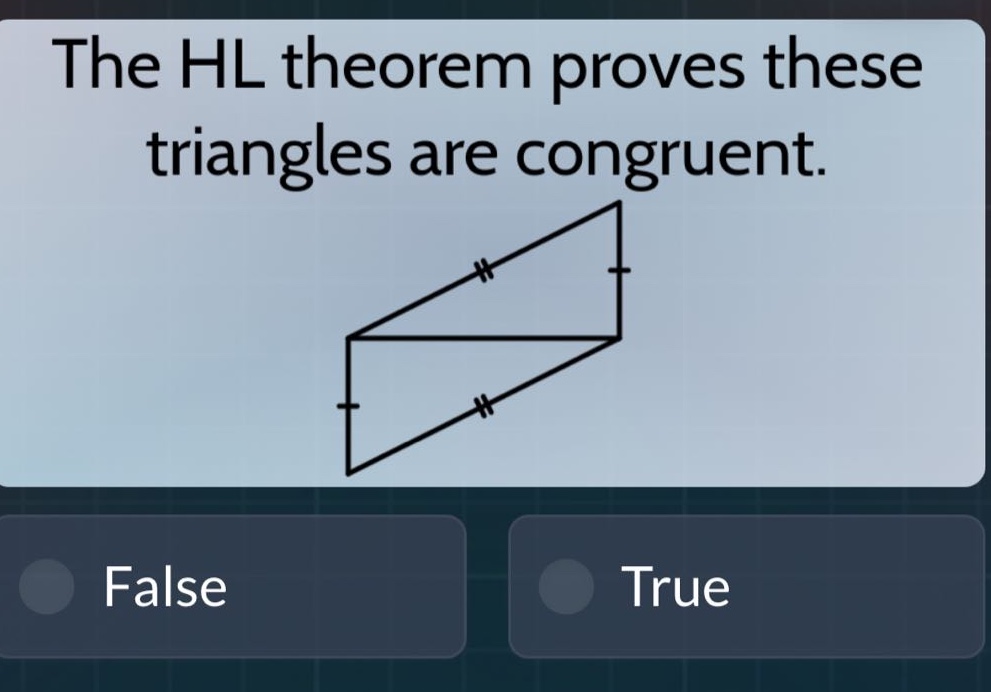
the hl theorem proves these triangles are congruent.
false
true
The HL (Hypotenuse - Leg) theorem is used to prove the congruence of right - angled triangles, where the hypotenuse and one leg of one right triangle are equal to the hypotenuse and one leg of another right triangle. In the given figure, we can see that the triangles are congruent by SSS (Side - Side - Side) congruence criterion (since all three corresponding sides are marked as equal) or SAS (Side - Angle - Side) as well. But if we consider the HL theorem, first we need to confirm if the triangles are right - angled. From the figure, the triangles seem to be right - angled (due to the right - angle - like appearance from the sides with markings). However, the HL theorem is for right triangles with hypotenuse and leg equal. But here, the markings show that the two legs and the hypotenuse (the common side) are equal. Wait, actually, the HL theorem can be applied here if we consider the right triangles. But wait, the SSS is also applicable. But the statement says "The HL theorem proves these triangles are congruent". Let's recall: HL is for right triangles, hypotenuse and one leg. In the figure, the triangles are right - angled (assuming the right angles at the vertical and horizontal sides), and we have a hypotenuse (the common diagonal) and a leg equal (the marked sides). Wait, no, actually, the two triangles have two legs equal (the marked sides) and the hypotenuse (the diagonal) common. So HL can be used because in right triangles, if hypotenuse and one leg are equal, they are congruent. But wait, maybe I made a mistake. Wait, no, the HL theorem is a special case for right triangles. Let's check again. The figure shows two right triangles (since the sides are perpendicular, forming right angles) with a common hypotenuse and one pair of legs equal (marked). So by HL, they should be congruent. Wait, but maybe the answer is True? Wait, no, wait. Wait, the HL theorem requires hypotenuse and one leg. But in the figure, the two legs are marked as equal (the vertical and horizontal sides) and the hypotenuse (the diagonal) is common. So in right triangles, if we have hypotenuse (common) and one leg (marked) equal, then HL applies. So the statement is True? Wait, no, wait. Wait, maybe the triangles are congruent by SSS, but the question is about HL. Let's think again. The HL theorem states that if the hypotenuse and one leg of a right triangle are congruent to the hypotenuse and one leg of another right triangle, then the triangles are congruent. In the given figure, we have two right triangles, they share the hypotenuse (the diagonal), and one pair of legs (the marked sides) are congruent. So HL can be used to prove their congruence. So the statement is True? Wait, but maybe I am wrong. Wait, no, let's check the markings. The figure has two triangles, with two sides marked as equal (the vertical and horizontal sides) and the diagonal (hypotenuse) common. So in right triangles, hypotenuse (diagonal) and one leg (e.g., the vertical side) are equal, so HL applies. So the statement "The HL theorem proves these triangles are congruent" is True. Wait, but I am confused. Wait, maybe the answer is True.

Snap & solve any problem in the app
Get step-by-step solutions on Sovi AI
Photo-based solutions with guided steps
Explore more problems and detailed explanations
True