QUESTION IMAGE
Question
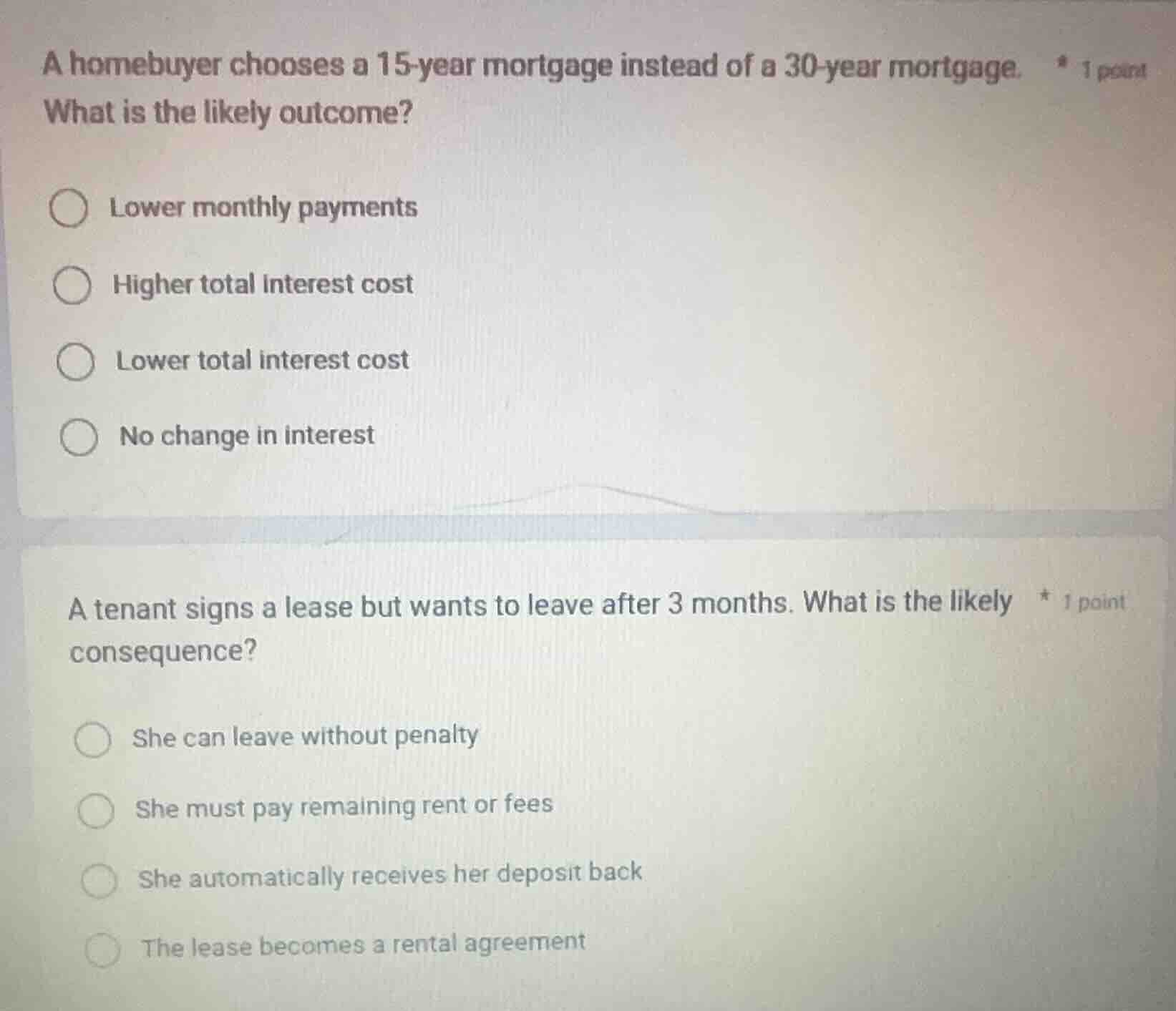
a homebuyer chooses a 15-year mortgage instead of a 30-year mortgage. what is the likely outcome?
lower monthly payments
higher total interest cost
lower total interest cost
no change in interest
a tenant signs a lease but wants to leave after 3 months. what is the likely consequence?
she can leave without penalty
she must pay remaining rent or fees
she automatically receives her deposit back
the lease becomes a rental agreement
First Question (Mortgage)
For a mortgage, the total interest paid depends on the loan term and monthly payments. A 15 - year mortgage has a shorter term than a 30 - year one. With a shorter term, even though monthly payments are higher, the total amount of interest paid over the life of the loan is lower because the principal is paid off faster, reducing the time interest accrues. Lower monthly payments would be for a 30 - year mortgage (longer term, spreading payments), higher total interest is incorrect (shorter term means less interest over time), and no change in interest is wrong as term affects interest. So the likely outcome is lower total interest cost.
A lease is a legal agreement for a set period. If a tenant signs a lease and wants to leave before the lease term (e.g., 3 months into a longer lease), they are typically bound by the lease terms. Usually, they have to pay the remaining rent or associated fees as they are breaking the lease early. Leaving without penalty is not typical, automatically getting the deposit back is incorrect (deposit is for damages/ unpaid rent), and a lease doesn't become a rental agreement just because the tenant wants to leave early.

Snap & solve any problem in the app
Get step-by-step solutions on Sovi AI
Photo-based solutions with guided steps
Explore more problems and detailed explanations
C. Lower total interest cost