QUESTION IMAGE
Question
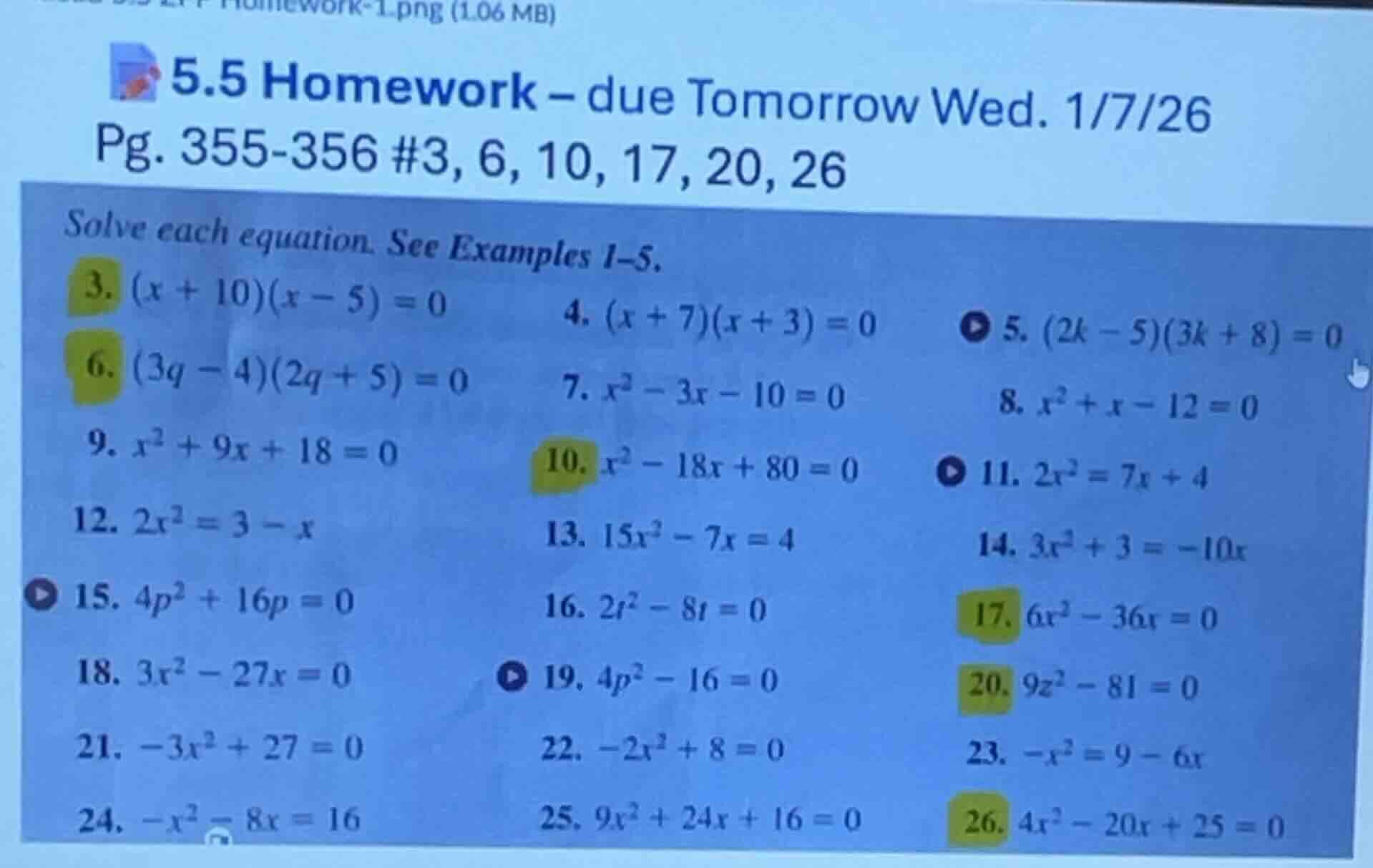
5.5 homework – due tomorrow wed. 1/7/26
pg. 355-356 #3, 6, 10, 17, 20, 26
solve each equation. see examples 1–5.
- ((x + 10)(x - 5) = 0) 4. ((x + 7)(x + 3) = 0) (\boldsymbol{5}). ((2k - 5)(3k + 8) = 0)
- ((3q - 4)(2q + 5) = 0) 7. (x^2 - 3x - 10 = 0) 8. (x^2 + x - 12 = 0)
- (x^2 + 9x + 18 = 0) 10. (x^2 - 18x + 80 = 0) (\boldsymbol{11}). (2x^2 = 7x + 4)
- (2x^2 = 3 - x) 13. (15x^2 - 7x = 4) 14. (3x^2 + 3 = -10x)
(\boldsymbol{15}). (4p^2 + 16p = 0) 16. (2t^2 - 8t = 0) 17. (6x^2 - 36x = 0)
- (3x^2 - 27x = 0) (\boldsymbol{19}). (4p^2 - 16 = 0) 20. (9z^2 - 81 = 0)
- (-3x^2 + 27 = 0) 22. (-2x^2 + 8 = 0) 23. (-x^2 = 9 - 6x)
- (-x^2 - 8x = 16) 25. (9x^2 + 24x + 16 = 0) 26. (4x^2 - 20x + 25 = 0)
To solve these equations, we'll use the Zero-Product Property (if \( ab = 0 \), then \( a = 0 \) or \( b = 0 \)) or factoring/isolating the variable. Let’s solve a few selected problems:
Problem 3: \( (x + 10)(x - 5) = 0 \)
Step 1: Apply Zero-Product Property
If \( (x + 10)(x - 5) = 0 \), then either \( x + 10 = 0 \) or \( x - 5 = 0 \).
Step 2: Solve for \( x \) in each case
- For \( x + 10 = 0 \): Subtract 10 from both sides.
\( x = -10 \)
- For \( x - 5 = 0 \): Add 5 to both sides.
\( x = 5 \)
Step 1: Apply Zero-Product Property
If \( (3q - 4)(2q + 5) = 0 \), then either \( 3q - 4 = 0 \) or \( 2q + 5 = 0 \).
Step 2: Solve for \( q \) in each case
- For \( 3q - 4 = 0 \): Add 4 to both sides, then divide by 3.
\( 3q = 4 \implies q = \frac{4}{3} \)
- For \( 2q + 5 = 0 \): Subtract 5 from both sides, then divide by 2.
\( 2q = -5 \implies q = -\frac{5}{2} \)
Step 1: Factor the quadratic
We need two numbers that multiply to \( 80 \) and add to \( -18 \). These numbers are \( -10 \) and \( -8 \).
Thus, \( x^2 - 18x + 80 = (x - 10)(x - 8) \).
Step 2: Apply Zero-Product Property
If \( (x - 10)(x - 8) = 0 \), then either \( x - 10 = 0 \) or \( x - 8 = 0 \).
Step 3: Solve for \( x \)
- \( x - 10 = 0 \implies x = 10 \)
- \( x - 8 = 0 \implies x = 8 \)

Snap & solve any problem in the app
Get step-by-step solutions on Sovi AI
Photo-based solutions with guided steps
Explore more problems and detailed explanations
\( x = -10 \) or \( x = 5 \)