QUESTION IMAGE
Question
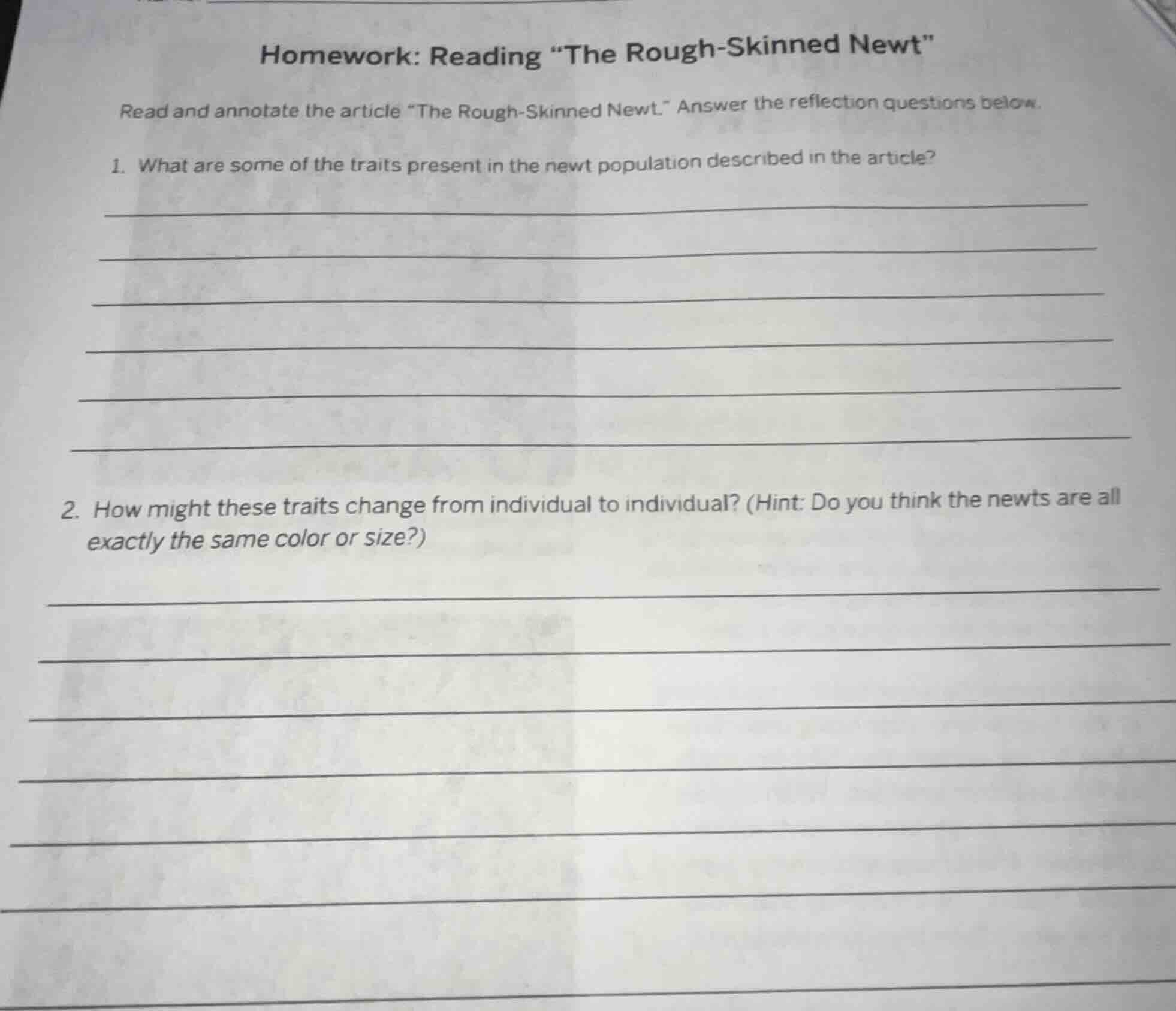
homework: reading \the rough - skinned newt\
read and annotate the article \the rough - skinned newt.\ answer the reflection questions below.
- what are some of the traits present in the newt population described in the article?
- how might these traits change from individual to individual? (hint: do you think the newts are all exactly the same color or size?)
To answer these questions, we would need to refer to the article "The Rough - Skinned Newt". Since the article's content is not provided here, we can only give a general approach:
For Question 1:
- First, find the part of the article that describes the newt population. Look for details about their physical characteristics (like skin texture, color, size), behavioral traits (if any), or physiological traits (like toxin levels, if the article mentions that).
- List out the traits that are clearly stated or can be inferred from the article's description of the newt population. For example, if the article says the newts have rough skin (hence the name), bright coloration (as a warning sign), and varying levels of toxin, these would be the traits.
For Question 2:
- Recall the concept of variation within a population. In most biological populations, even within the same species, individuals show variation.
- For traits like color, size, and toxin levels, we can expect that there will be differences from one newt to another. For example, some newts might be larger or smaller than others, their color might be slightly more or less intense, and the amount of toxin they produce might vary. This variation can be due to genetic differences, environmental influences, or a combination of both.
If you can provide the content of the article "The Rough - Skinned Newt", we can give more specific answers.

Snap & solve any problem in the app
Get step-by-step solutions on Sovi AI
Photo-based solutions with guided steps
Explore more problems and detailed explanations
To answer these questions, we would need to refer to the article "The Rough - Skinned Newt". Since the article's content is not provided here, we can only give a general approach:
For Question 1:
- First, find the part of the article that describes the newt population. Look for details about their physical characteristics (like skin texture, color, size), behavioral traits (if any), or physiological traits (like toxin levels, if the article mentions that).
- List out the traits that are clearly stated or can be inferred from the article's description of the newt population. For example, if the article says the newts have rough skin (hence the name), bright coloration (as a warning sign), and varying levels of toxin, these would be the traits.
For Question 2:
- Recall the concept of variation within a population. In most biological populations, even within the same species, individuals show variation.
- For traits like color, size, and toxin levels, we can expect that there will be differences from one newt to another. For example, some newts might be larger or smaller than others, their color might be slightly more or less intense, and the amount of toxin they produce might vary. This variation can be due to genetic differences, environmental influences, or a combination of both.
If you can provide the content of the article "The Rough - Skinned Newt", we can give more specific answers.