QUESTION IMAGE
Question
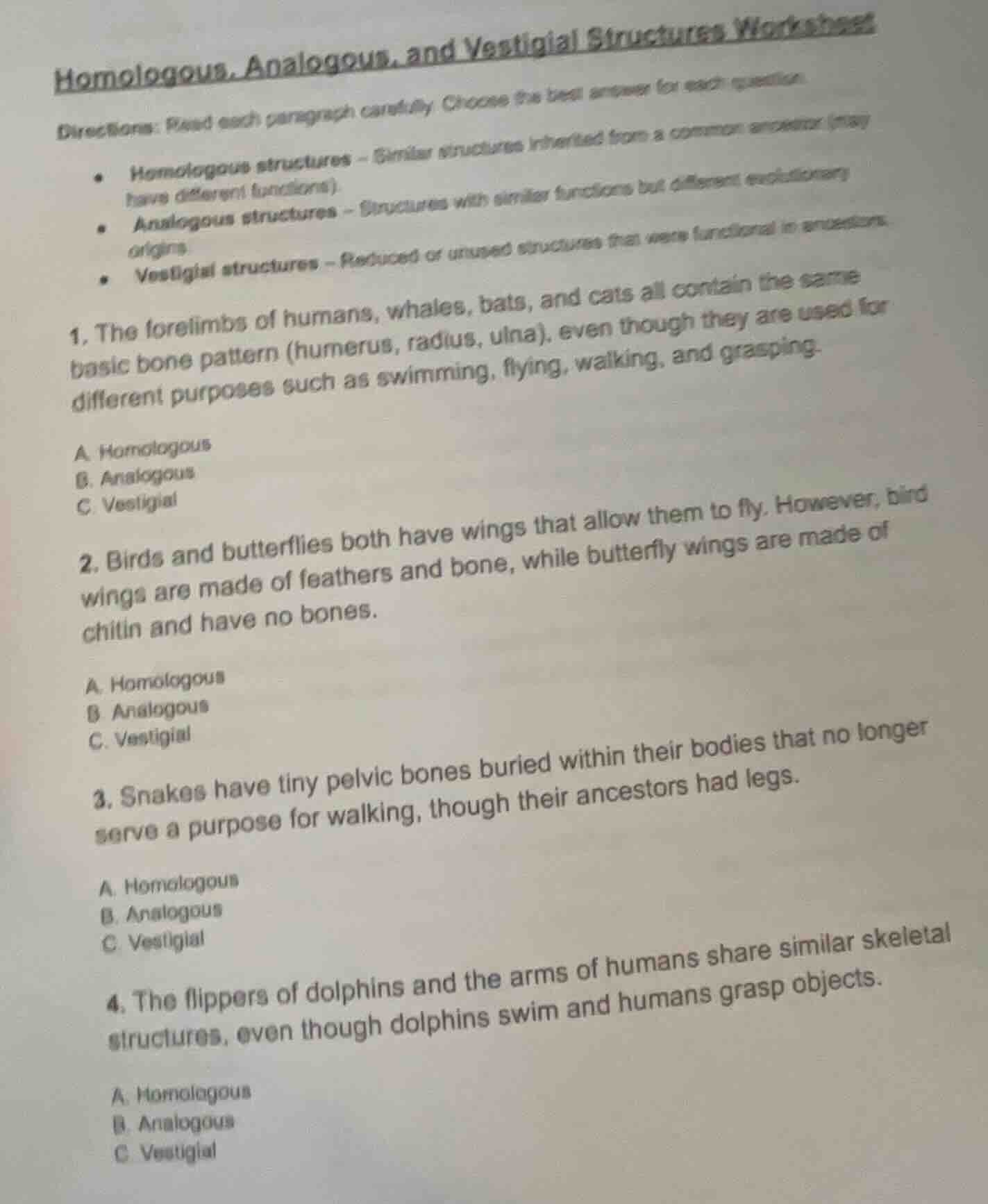
homologous, analogous, and vestigial structures worksheet
directions: read each paragraph carefully. choose the best answer for each question.
- homologous structures - similar structures inherited from a common ancestor (may have different functions).
- analogous structures - structures with similar functions but different evolutionary origins.
- vestigial structures - reduced or unused structures that were functional in ancestors.
- the forelimbs of humans, whales, bats, and cats all contain the same basic bone pattern (humerus, radius, ulna), even though they are used for different purposes such as swimming, flying, walking, and grasping.
a. homologous
b. analogous
c. vestigial
- birds and butterflies both have wings that allow them to fly. however, bird wings are made of feathers and bone, while butterfly wings are made of chitin and have no bones.
a. homologous
b. analogous
c. vestigial
- snakes have tiny pelvic bones buried within their bodies that no longer serve a purpose for walking, though their ancestors had legs.
a. homologous
b. analogous
c. vestigial
- the flippers of dolphins and the arms of humans share similar skeletal structures, even though dolphins swim and humans grasp objects.
a. homologous
b. analogous
c. vestigial
Brief Explanations
- The structures share a common bone pattern (from a common ancestor) but have different functions, matching homologous structures.
- Bird and butterfly wings have the same function (flight) but different evolutionary origins and structures, matching analogous structures.
- Snake pelvic bones are reduced, unused for walking, but were functional in their legged ancestors, matching vestigial structures.
- Dolphin flippers and human arms share similar skeletal structures (from a common ancestor) but have different functions, matching homologous structures.

Snap & solve any problem in the app
Get step-by-step solutions on Sovi AI
Photo-based solutions with guided steps
Explore more problems and detailed explanations
- A. Homologous
- B. Analogous
- C. Vestigial
- A. Homologous