QUESTION IMAGE
Question
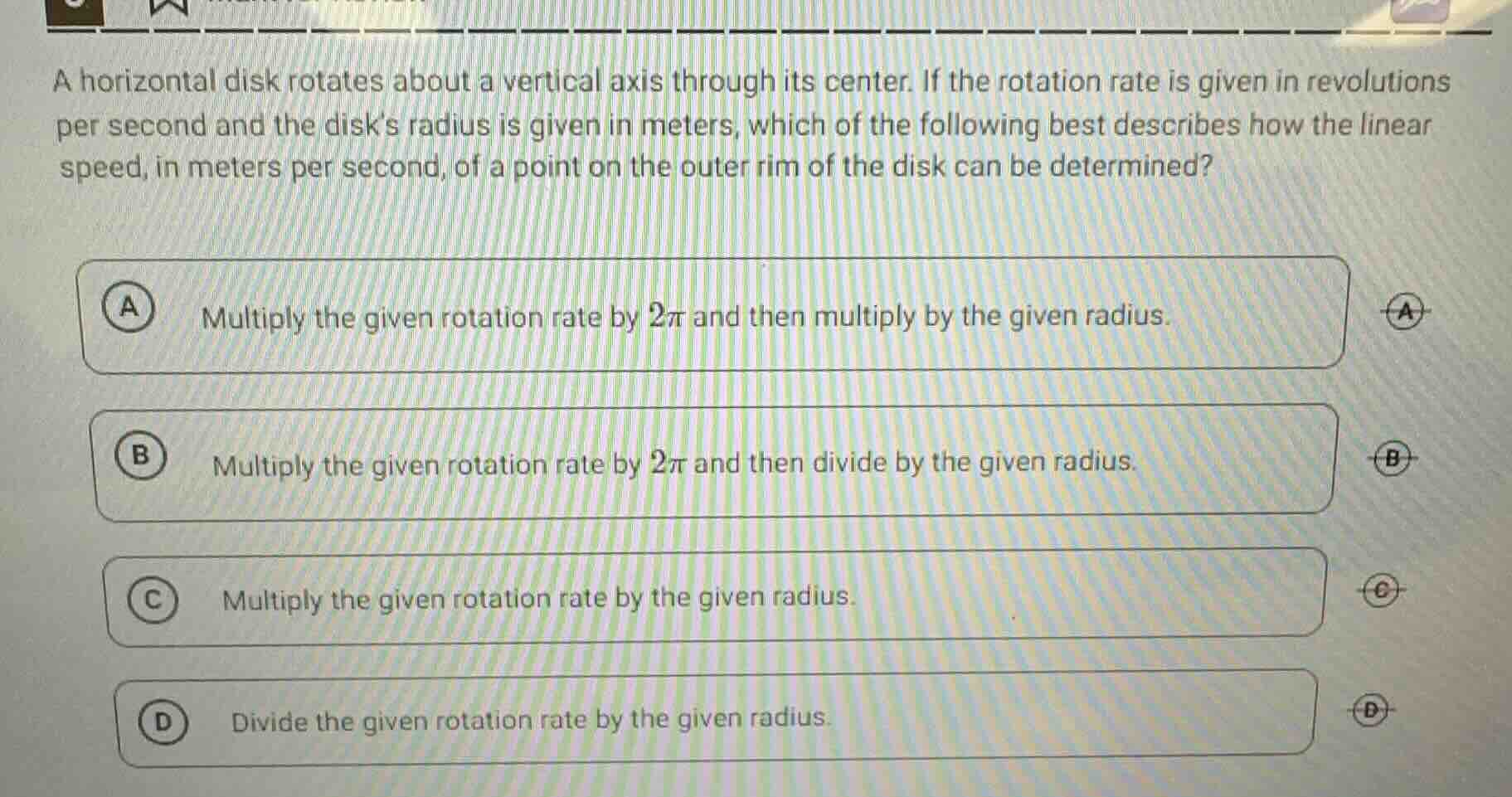
a horizontal disk rotates about a vertical axis through its center. if the rotation rate is given in revolutions per second and the disk’s radius is given in meters, which of the following best describes how the linear speed, in meters per second, of a point on the outer rim of the disk can be determined?
a multiply the given rotation rate by $2\pi$ and then multiply by the given radius.
b multiply the given rotation rate by $2\pi$ and then divide by the given radius.
c multiply the given rotation rate by the given radius.
d divide the given rotation rate by the given radius.
To determine the linear speed \( v \) of a point on the rim of a rotating disk, we use the relationship between linear speed, angular speed (\( \omega \)), and radius (\( r \)): \( v = \omega r \). The angular speed \( \omega \) (in radians per second) is related to the rotation rate \( f \) (in revolutions per second) by \( \omega = 2\pi f \) (since one revolution is \( 2\pi \) radians). Substituting \( \omega = 2\pi f \) into \( v = \omega r \), we get \( v = 2\pi f r \). This means we multiply the rotation rate (\( f \)) by \( 2\pi \) (to get angular speed) and then multiply by the radius (\( r \)).

Snap & solve any problem in the app
Get step-by-step solutions on Sovi AI
Photo-based solutions with guided steps
Explore more problems and detailed explanations
A. Multiply the given rotation rate by \( 2\pi \) and then multiply by the given radius.