QUESTION IMAGE
Question
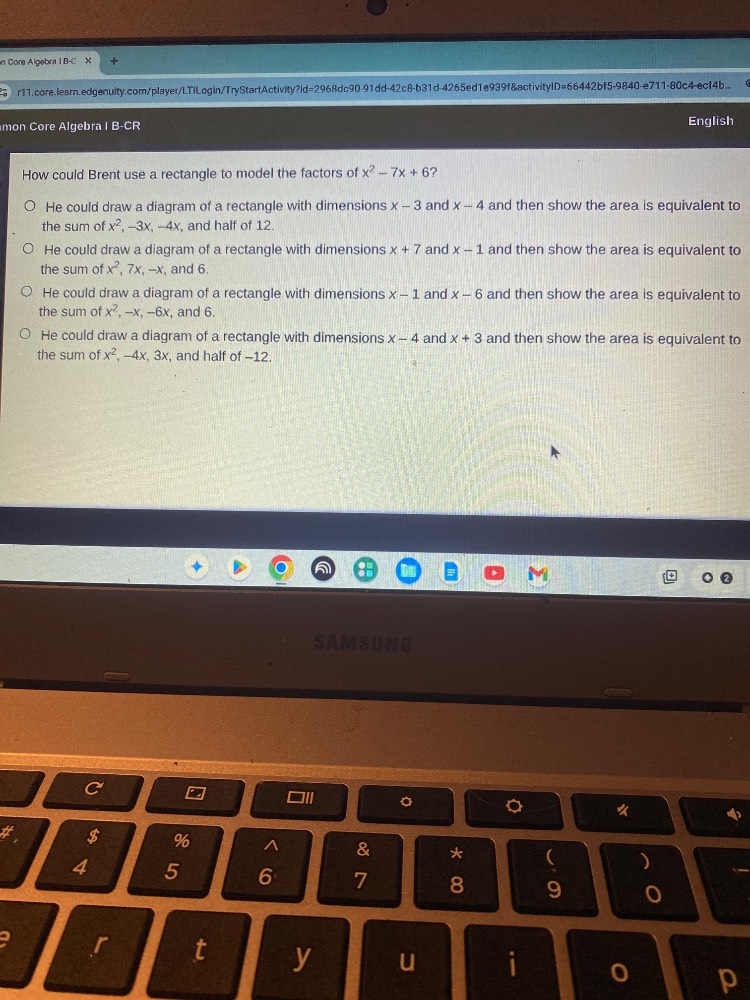
how could brent use a rectangle to model the factors of ( x^2 - 7x + 6 )?
- he could draw a diagram of a rectangle with dimensions ( x - 3 ) and ( x - 4 ) and then show the area is equivalent to the sum of ( x^2 ), ( -3x ), ( -4x ), and half of 12.
- he could draw a diagram of a rectangle with dimensions ( x + 7 ) and ( x - 1 ) and then show the area is equivalent to the sum of ( x^2 ), ( 7x ), ( -x ), and 6.
- he could draw a diagram of a rectangle with dimensions ( x - 1 ) and ( x - 6 ) and then show the area is equivalent to the sum of ( x^2 ), ( -x ), ( -6x ), and 6.
- he could draw a diagram of a rectangle with dimensions ( x - 4 ) and ( x + 3 ) and then show the area is equivalent to the sum of ( x^2 ), ( -4x ), ( 3x ), and half of ( -12 ).
To factor \(x^2 - 7x + 6\), we find two numbers that multiply to \(6\) and add to \(-7\). The numbers are \(-1\) and \(-6\), so the factored form is \((x - 1)(x - 6)\). Now, we expand \((x - 1)(x - 6)\) using the distributive property (FOIL method):
- First: \(x \times x = x^2\)
- Outer: \(x \times (-6) = -6x\)
- Inner: \(-1 \times x = -x\)
- Last: \(-1 \times (-6) = 6\)
Adding these terms together: \(x^2 - 6x - x + 6 = x^2 - 7x + 6\), which matches the original expression. Let's check the other options:
- Option 1: Dimensions \(x - 3\) and \(x - 4\) expand to \(x^2 - 7x + 12\), not \(x^2 - 7x + 6\).
- Option 2: Dimensions \(x + 7\) and \(x - 1\) expand to \(x^2 + 6x - 7\), not the original.
- Option 4: Dimensions \(x - 4\) and \(x + 3\) expand to \(x^2 - x - 12\), not the original.
Only Option 3 has the correct factored dimensions and the correct expansion.

Snap & solve any problem in the app
Get step-by-step solutions on Sovi AI
Photo-based solutions with guided steps
Explore more problems and detailed explanations
C. He could draw a diagram of a rectangle with dimensions \(x - 1\) and \(x - 6\) and then show the area is equivalent to the sum of \(x^2\), \(-x\), \(-6x\), and \(6\).