QUESTION IMAGE
Question
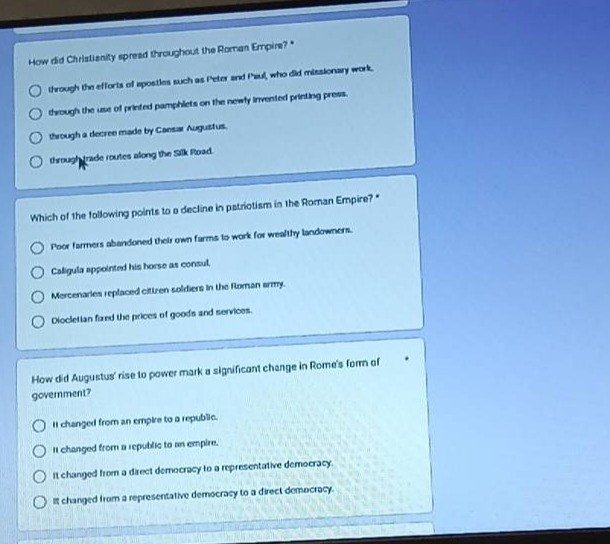
how did christianity spread throughout the roman empire?
○ through the efforts of apostles such as peter and paul, who did missionary work.
○ through the use of printed pamphlets on the newly invented printing press.
○ through a decree made by caesar augustus.
○ through trade routes along the silk road.
which of the following points to a decline in patriotism in the roman empire?
○ poor farmers abandoned their own farms to work for wealthy landowners.
○ caligula appointed his horse as consul.
○ mercenaries replaced citizen soldiers in the roman army.
○ diocletian fixed the prices of goods and services.
how did augustus rise to power mark a significant change in romes form of government?
○ it changed from an empire to a republic.
○ it changed from a republic to an empire.
○ it changed from a direct democracy to a representative democracy.
○ it changed from a representative democracy to a direct democracy.
First Question: How did Christianity spread throughout the Roman Empire?
- The first option: Apostles like Peter and Paul did missionary work to spread Christianity in the Roman Empire, which is historically accurate.
- The second option: The printing press was invented much later (during the Renaissance), so it's impossible for it to be used in the Roman Empire era.
- The third option: Caesar Augustus was a Roman emperor, and there's no decree by him to spread Christianity (Christianity emerged after his time).
- The fourth option: The Silk Road was mainly for trade between Asia and Europe, and Christianity's spread in the Roman Empire was more due to missionary work within the empire rather than through Silk Road trade routes.
- The first option: Poor farmers abandoning their farms to work for wealthy landowners is related to economic and social issues, not directly patriotism.
- The second option: Caligula appointing his horse as consul is a sign of his tyranny and absurdity, not directly about patriotism decline.
- The third option: Mercenaries replacing citizen soldiers means citizens were less willing to serve in the army, showing a decline in patriotism (as serving in the army was a patriotic duty in the Roman Empire).
- The fourth option: Diocletian fixing prices was an economic measure, not related to patriotism.
- The first option: Rome was a republic before Augustus, and he established the empire, so it's not from empire to republic.
- The second option: Before Augustus, Rome was a republic (with a system of senators, consuls, etc.), and Augustus' rule marked the transition from the Roman Republic to the Roman Empire.
- The third option: Rome was never a direct democracy, so this option is incorrect.
- The fourth option: Rome was not a representative democracy in the way described, and this change didn't happen.

Snap & solve any problem in the app
Get step-by-step solutions on Sovi AI
Photo-based solutions with guided steps
Explore more problems and detailed explanations
through the efforts of apostles such as Peter and Paul, who did missionary work.