QUESTION IMAGE
Question
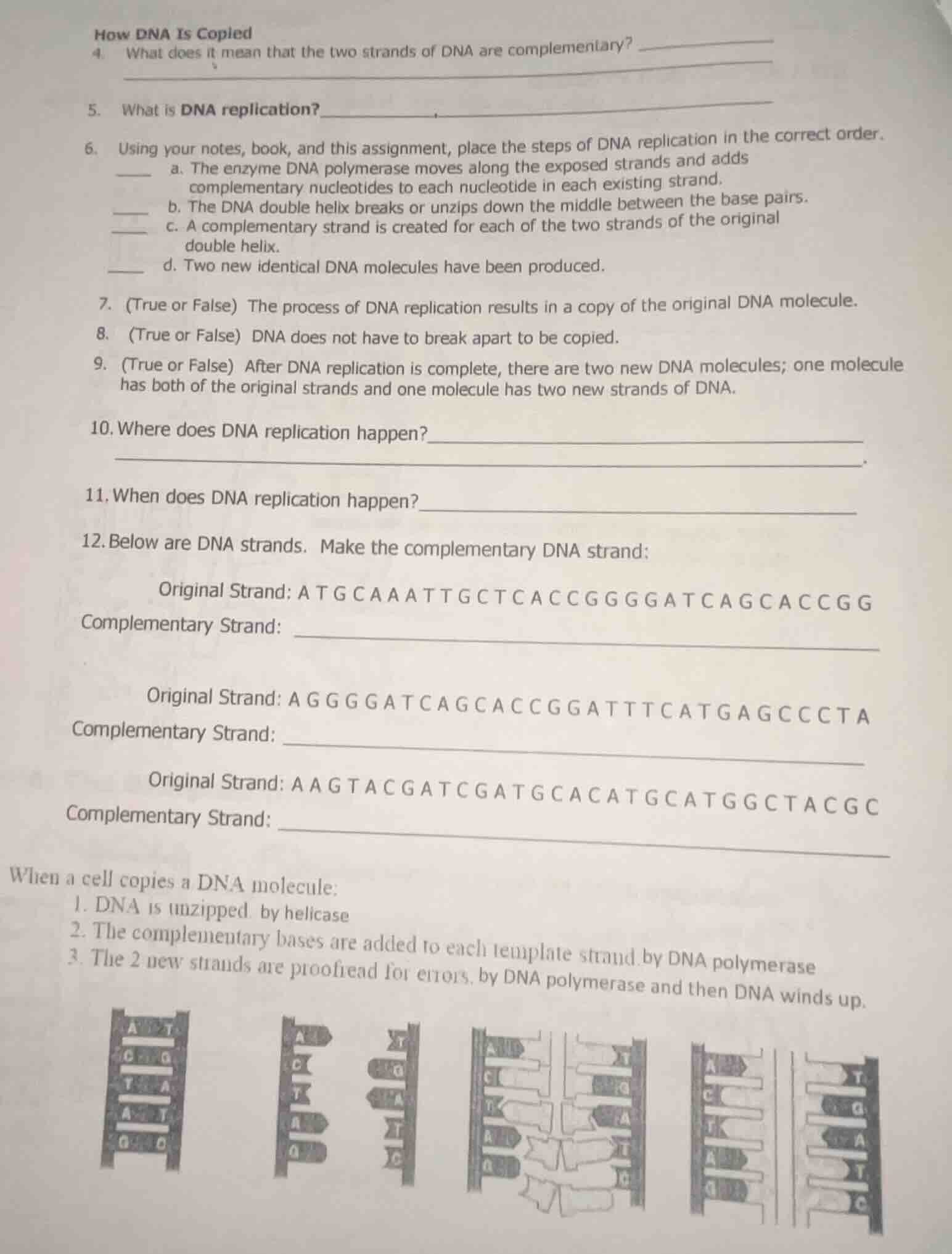
how dna is copied
- what does it mean that the two strands of dna are complementary?
- what is dna replication?
- using your notes, book, and this assignment, place the steps of dna replication in the correct order.
____ a. the enzyme dna polymerase moves along the exposed strands and adds
complementary nucleotides to each nucleotide in each existing strand.
____ b. the dna double helix breaks or unzips down the middle between the base pairs.
____ c. a complementary strand is created for each of the two strands of the original
double helix.
____ d. two new identical dna molecules have been produced.
- (true or false) the process of dna replication results in a copy of the original dna molecule.
- (true or false) dna does not have to break apart to be copied.
- (true or false) after dna replication is complete, there are two new dna molecules; one molecule
has both of the original strands and one molecule has two new strands of dna.
- where does dna replication happen?
- when does dna replication happen?
- below are dna strands. make the complementary dna strand:
original strand: a t g c a a a t t g c t c a c c g g g g a t c a g c a c c g g
complementary strand:
original strand: a g g g g a t c a g c a c c g g a t t t c a t g a g c c c t a
complementary strand:
original strand: a a g t a c g a t c g a t g c a c a t g c a t g g c t a c g c
complementary strand:
when a cell copies a dna molecule:
- dna is unzipped by helicase
- the complementary bases are added to each template strand by dna polymerase
- the 2 new strands are proofread for errors, by dna polymerase and then dna winds up.
Question 4
In DNA, complementary strands mean that the nitrogenous bases (Adenine - Thymine, Guanine - Cytosine) pair in a fixed way. So the sequence of one strand determines the sequence of the other as A pairs with T and G pairs with C, allowing for accurate replication and transcription.
DNA replication is the biological process where a cell makes an identical copy of its DNA. It's a semi - conservative process (each new DNA molecule has one original and one new strand) that occurs before cell division (like mitosis or meiosis) to ensure that each new cell gets a complete set of genetic information.
Step 1: Analyze step b
The first step in DNA replication is the unzipping of the DNA double helix. The DNA double helix breaks or unzips down the middle between the base pairs. So step b is the first step, so we assign it 1.
Step 2: Analyze step a
After the DNA is unzipped, the enzyme DNA polymerase moves along the exposed strands and adds complementary nucleotides to each nucleotide in each existing strand. So step a comes after step b, so we assign it 2.
Step 3: Analyze step c
Once the DNA polymerase adds the complementary nucleotides, a complementary strand is created for each of the two strands of the original double helix. So step c comes after step a, so we assign it 3.
Step 4: Analyze step d
After the complementary strands are created, two new identical DNA molecules have been produced. So step d is the last step, so we assign it 4.

Snap & solve any problem in the app
Get step-by-step solutions on Sovi AI
Photo-based solutions with guided steps
Explore more problems and detailed explanations
It means that the nitrogenous bases of the two strands pair in a specific way: adenine (A) pairs with thymine (T), and guanine (G) pairs with cytosine (C). So the sequence of one strand dictates the sequence of the other, which is crucial for DNA replication and other processes.